
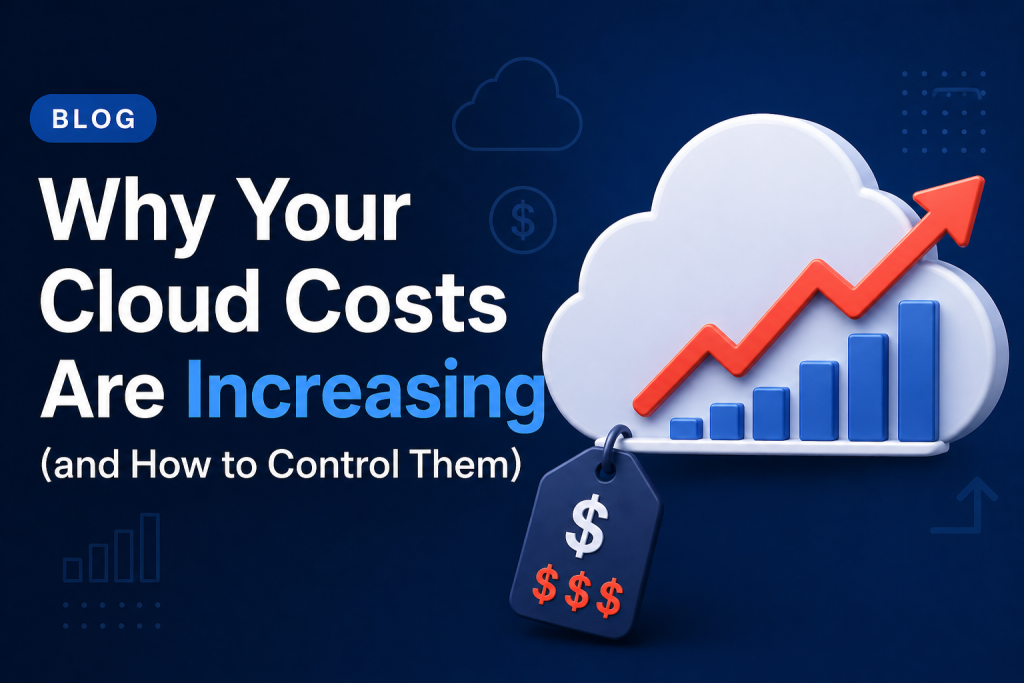
You opened your cloud invoice last month and did a double take. The number was higher again. And honestly, you’re not alone in that moment of quiet panic. All across industries, companies that jumped to the cloud expecting lower costs and more flexibility are now watching their bills climb month after month, with very little explanation as to why. This is exactly where cloud cost optimization stops being a buzzword and becomes something you genuinely need to act on.
Here is the reality: a jaw-dropping portion of what businesses spend on cloud every year is just… wasted. Idle resources sitting untouched, forgotten services nobody uses, and infrastructure that got spun up fast and never revisited. The silver lining? These problems have real solutions. Let’s get into what’s actually causing your bill to grow and what you can do to stop it.
The Hidden Culprits Behind Rising Cloud Bills
1. Over-Provisioning is More Common Than You Think
There’s a very human instinct at work when engineers size up cloud infrastructure – nobody wants to be the person who under-provisioned a production system and caused a slowdown. So teams go bigger. Larger instance types, more storage, extra compute headroom. Just in case.
The trouble is, “just in case” has a monthly price tag. That beefy server you provisioned for a product launch six months back? It’s still humming along at 15% utilization. Multiply that across dozens of services, teams, and environments, and you’re essentially paying full price for a hotel where most of the rooms are empty, night after night.
2. Cloud Resource Sprawl
Agile teams move fast. They spin up test environments, try out new services, run experiments — and then they move on to the next thing. The problem is those temporary environments almost never get torn down. Add shadow IT into the mix — developers or entire departments spinning up their own resources outside of any central oversight — and suddenly nobody has a clear picture of what’s actually running or who owns it.
Resource sprawl is one of the sneakiest cost drivers out there. What looks like a couple of forgotten S3 buckets today can quietly snowball into hundreds of orphaned resources burning through your budget around the clock.
3. Data Transfer and Egress Fees
Moving data in the cloud isn’t free, and those charges have a way of catching businesses completely off guard. Egress fees — what you pay when data leaves the cloud — can get surprisingly steep, particularly for organizations doing heavy data processing, running multi-region setups, or integrating with a lot of third-party services.
Most companies only realize this is a problem when it shows up as a fat line item on their invoice. Data moving between availability zones within the same provider adds up quietly. Data flowing out to on-premises systems or external APIs? That adds up even faster.
4. Reserved Instance Waste
Reserved Instances and Savings Plans from AWS, Azure, and Google Cloud can slash your costs by 40–70% compared to on-demand pricing — but only if you actually use what you commit to. When workloads shift, scale down, or get deprecated, those reservations don’t disappear. You’re still locked into paying for capacity that’s no longer serving any real purpose. What started as a smart financial move becomes dead weight on your cloud budget.
5. Lack of Tagging and Cost Attribution
Without a proper tagging strategy, your cloud bill is essentially a mystery. You can see the total spend, but you have no idea which team, project, product, or environment is responsible for what portion of it. Nobody’s accountable, so nobody’s watching and costs drift upward unchallenged.
This hits especially hard at growing companies where multiple teams share the same cloud environment, each quietly assuming that someone else is keeping an eye on the spend.
What’s Actually Driving the Acceleration
Beyond the technical stuff, there’s an organizational problem that doesn’t get talked about enough. Cloud purchasing is decentralized by nature. A developer can spin up a new resource in two minutes. The finance team’s visibility into that decision? It might arrive weeks later, buried in an invoice.
Engineering velocity has outrun financial oversight and as companies go deeper into cloud-native architectures, the problem compounds. One application that used to run on a handful of VMs might now involve dozens of Lambda functions, load balancers, managed databases, API gateways, and CDN layers. Every single one of those generates cost at a granular level that’s nearly impossible to track without the right tooling in place.
How to Take Back Control
Conduct a Cloud Cost Audit
You can’t fix what you can’t see. Cloud cost optimization starts here – a proper, thorough audit of everything running in your environment. Find the idle and underutilized resources. Map out your data transfer patterns. Take stock of every service, every environment, every account. Native dashboards like AWS Cost Explorer and Azure Cost Management are useful starting points, but they’re not going to do the heavy lifting for you.
Right-Size Your Infrastructure
Right-sizing means matching what you’ve provisioned to what you actually need. It’s not complicated in theory, but it demands ongoing attention. Set up auto-scaling wherever you can infrastructure that grows when traffic spikes and shrinks when it doesn’t. For many organizations, this one change alone can cut compute costs by 30–40%.
Leverage Cloud Optimization Services
For a lot of organizations, building this level of internal expertise from scratch is not realistic. Working with cloud optimization services gives you access to specialists who do this every day — they can spot inefficiencies you would miss, put governance frameworks in place, and keep a continuous eye on your environment as it grows. If your team is scaling fast and internal visibility cannot keep up, outside support is often the smartest move.
Implement a Tagging Policy and Enforce It
Every resource in your cloud environment should carry tags — team, project, environment type (production, staging, dev), and cost center. Bake it into your infrastructure-as-code templates and make it non-negotiable in your deployment pipelines. Good tagging gives you the visibility you need to hold teams accountable and have honest conversations about where money is actually going.
Optimize Reserved Instances Strategically
Don’t over-commit upfront. Look at your baseline workloads — the things that run steadily day and night — and cover those with Reserved Instances or Savings Plans. For anything variable, short-lived, or experimental, stick with on-demand or spot pricing. And revisit your reservations every quarter. Cloud architectures evolve, and your commitments should evolve with them.
Adopt FinOps Practices
FinOps is about getting engineering, finance, and business leadership speaking the same language around cloud spend. When developers understand the cost implications of their technical choices — and have tools to see those costs in real time — the culture starts to shift. Engineers begin treating cost the same way they treat performance or reliability. That mindset change is worth more than any single optimization tactic.
Consider Managed Cloud Services for Operational Efficiency
Not every piece of your infrastructure needs to be managed by hand. Managed cloud services can take a significant chunk of operational burden off your plate — patching, maintenance, scaling — so your team can focus on work that actually moves the needle. And because the underlying infrastructure is being handled by people who know how to run it efficiently, you tend to get a leaner, better-optimized environment as a byproduct.
Building a Culture of Cost Consciousness
Tools and tactics only take you so far. The most durable fix is cultural. When engineers are cost-aware and empowered to act on that awareness, waste naturally decreases. Work cost reviews into your sprint cycles. Recognize the engineering decisions that trim spend without hurting performance. Make cloud economics part of how your team thinks — not something finance brings up once a quarter when the bill arrives.
Conclusion
Runaway cloud costs aren’t some inevitable taxes on doing business in the modern world. They’re a symptom of fast growth that outpaced governance, of architectures that were never revisited, of blind spots that quietly accumulated over time.
Getting it under control starts with visibility, runs through right-sizing and automation, and eventually matures into a full FinOps discipline where every dollar spent in the cloud is a deliberate choice. Whether you’re a startup that scaled quickly or an enterprise navigating a complex multi-cloud environment, the companies that win are the ones that treat cloud cost optimization as a genuine engineering and business priority not a cleanup task that gets tackled after the invoice lands and the damage is already done.
Start auditing. Start tagging. And start seeing your cloud bill for what it really is – a direct reflection of how your organization operates.