

6 Database Performance Issues and How to Solve Them
A support ticket queue that keeps growing. A dashboard your team has quietly stopped trusting. A checkout flow that works fine in the demo and falls apart the moment real…
Read article →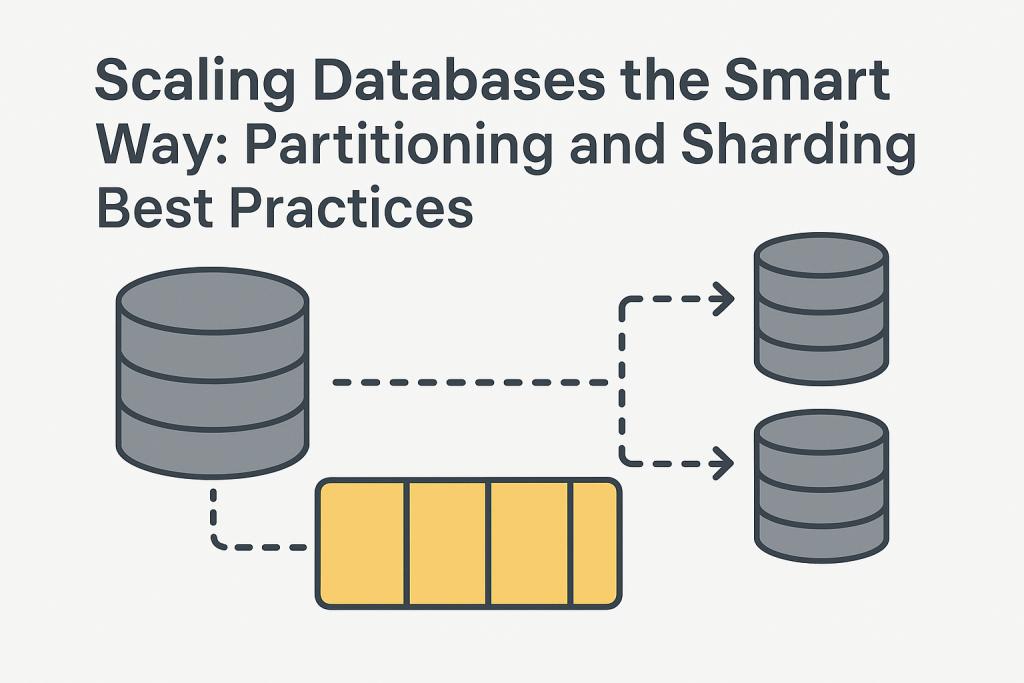
In today’s world, data is everywhere and the real challenge for businesses is not just gathering it, but making sure it can be stored, processed, and scaled without slowing things down. As companies grow, so does the pressure on their databases. What once managed a few thousand transactions a day may suddenly be expected to handle millions, even billions. That is where techniques like partitioning and sharding come in, offering smarter, more scalable ways to keep databases running smoothly under heavy demand.
Before we get into the best practices, let’s take a moment to unpack what partitioning and sharding actually are, why they matter, and how businesses can put them to use without getting tangled in unnecessary complexity.
Traditional monolithic databases work well when data volumes are small. You have one database, one server, one storage location—simple and straightforward.
But as applications grow, several issues start to appear:
This is where scaling comes in. Scaling can be done in two ways:
Partitioning and sharding fall under horizontal scaling and form the backbone of modern large-scale database architectures.
These two terms are often used interchangeably, but they are not the same thing.
Think of it this way:
For growing enterprises, especially those working with IT consulting services and tech advisors, scaling decisions impact not just performance but the entire digital strategy. Poorly designed databases can slow down operations, increase infrastructure costs, and create bottlenecks for innovation.
A well-thought-out scaling strategy involving partitioning and sharding helps:
This is why many companies turn to database design consulting services early in their growth stage—to ensure they choose the right approach from the start.
Before jumping into sharding, it’s essential to understand partitioning since it’s the foundation. There are several partitioning strategies, each with its advantages and best-use cases:
Once partitions grow too big for a single server, sharding becomes the logical next step. Each shard runs on a separate server, with its own database instance.
There are two main sharding approaches:
Scaling databases the smart way requires not just technical implementation but strategic foresight. Here are some best practices that IT consulting services often recommend:
1. Design for Scalability from Day One
It’s much easier to plan for partitioning and sharding before the database grows too large. Retroactively applying sharding can involve complex data migration and management services, downtime, and increased costs.
2. Choose the Right Partitioning Key
The partitioning key determines how evenly data is distributed. A poor choice can lead to uneven partitions or overloaded shards.
3. Automate When Possible
Tools like Vitess, Citus (for PostgreSQL), or MongoDB’s native sharding can handle much of the complexity automatically.
4. Monitor and Adjust
Partition sizes and query patterns change over time. Regular monitoring helps prevent hotspots and imbalances.
5. Plan for Failover and Backup
Each shard or partition should have independent backup and failover mechanisms. Losing one shard should not compromise the entire system.
Even with best practices, companies often stumble when implementing partitioning or sharding. Here are a few common mistakes:
Consider an e-commerce platform growing from thousands to millions of daily transactions. Initially, a single database works fine. But soon:
By introducing range partitioning for order history (e.g., partition by month) and sharding based on customer IDs across multiple servers, the platform can:
This is where database design consulting services play a crucial role, helping businesses pick the right mix of partitioning and sharding for optimal performance.
While AI is transforming many areas of IT, the fundamentals of database scaling will continue to rely on sound architecture. Future trends likely to shape partitioning and sharding include:
Even in this evolving landscape, the core principles of smart partitioning and sharding will remain essential for performance and reliability.
As businesses continue to generate and rely on massive amounts of data, the need for systems that can scale efficiently has become more critical than ever. A well-structured approach to database growth is not just about handling larger workloads—it’s about ensuring consistent performance, data integrity, and system reliability even under increasing demands.
Future-ready database systems require more than just technical upgrades; they demand strategic planning, robust architecture, and continuous optimization. By focusing on scalability, organizations can ensure seamless user experiences, maintain operational efficiency, and stay ahead in a competitive digital landscape. The goal is to build systems that are not only capable of supporting current requirements but are also flexible enough to adapt to emerging technologies and evolving business needs.
Ultimately, success lies in designing data infrastructures that can grow gracefully, delivering speed, security, and stability as the organization expands
A support ticket queue that keeps growing. A dashboard your team has quietly stopped trusting. A checkout flow that works fine in the demo and falls apart the moment real…
Read article →DBMS stands for ‘Database Management System’, and RDBMS stands for ‘Relational Database Management system’. In both cases, the data and its management system are the key concerns. Let’s start with…
Read article →Tell us where you are and what's slowing you down. A senior engineer will get back to you within one business day.
Our team will get back to you within one business day.
Leave a Reply