
By Sygitech Solutions | Cloud Infrastructure Management & DevOps
Most SaaS founders and CTOs eventually face the same decision: should we hire a dedicated DevOps or cloud engineer, or should we outsource infrastructure management to a specialist team?
On the surface, hiring feels like the right answer. You get someone in-house, fully committed to your stack, available whenever you need them. Control, continuity, and ownership – all in one.
But the full cost of that decision is almost never calculated correctly upfront. And by the time the real numbers become visible, the business has already absorbed months of delay, unexpected expense, and in many cases, the exact same infrastructure risk it was trying to solve.
This article breaks down the complete cost on both sides – so you can make the decision with accurate numbers, not assumptions.
The True Cost of Hiring a DevOps / Cloud Engineer
1. Salary and Compensation
A mid-level DevOps engineer in India with 3–5 years of experience commands:
- Base salary: ₹14–22L per annum
- PF (employer contribution): ~₹1.0–1.5L per annum
- Health insurance (group policy): ~₹0.3–0.5L per annum
- Performance bonus (if applicable): ₹1–3L per annum
Total annual compensation cost: ₹16–27L per annum
For a senior engineer (5–8 years, AWS/GCP certified): ₹22–35L per annum.
2. Recruitment Cost
Hiring takes time and money. For a specialised DevOps role:
- Recruiter fee (if using a placement agency): 8–12% of annual salary = ₹1.2–2.5L
- Internal HR time (job posting, screening, interviews): 3–6 weeks of partial bandwidth
- Time to hire from job posting to offer acceptance: typically 6–12 weeks in India for a qualified DevOps candidate
One-time recruitment cost: ₹1.5–3L + 6–12 weeks of lost time
3. Onboarding and Ramp-Up
This is the cost most founders forget entirely. A new engineer – regardless of how experienced they are – does not know your infrastructure on day one. They need time to:
- Understand your cloud architecture, regions, services in use
- Learn your deployment workflows and toolchain
- Gain context on incidents, known issues, and workarounds
- Build trust with your engineering team
Realistic ramp-up time to full productivity: 3–6 months
During this period, the engineer is being paid but delivering partial value. At ₹20L annual salary, that is ₹5–10L in compensation before they are genuinely productive.
4. Tool and Infrastructure Access Costs
When hiring in-house, the company typically needs to procure and fund the full monitoring and DevOps toolchain:
- Enterprise APM tools (Datadog, New Relic): ₹1.5–4L/year depending on usage
- IaC tooling, secrets management, CI/CD platforms: ₹0.5–2L/year
- Training and certification renewal: ₹0.3–0.8L/year
Annual tooling cost: ₹2–7L per annum (often partially absorbed by the company regardless, but frequently overlooked when comparing with outsourcing)
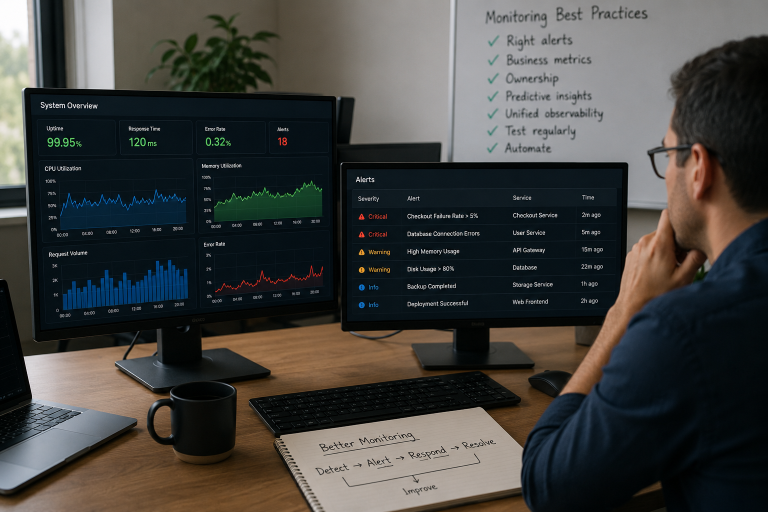
One important distinction when evaluating managed service providers: not all monitoring toolchains are equivalent. Sygitech uses Zabbix and a proprietary monitoring stack for infrastructure-level monitoring – covering server health, uptime, alerts, and resource utilisation. This is included in the retainer at no additional cost.
Application Performance Monitoring (APM) – which tracks response times, error rates, and performance at the application layer – requires a separate toolchain such as Datadog, New Relic, or Dynatrace. If APM is a requirement, this is typically licensed separately and the cost is passed through at cost. This is worth clarifying with any MSP during evaluation – infrastructure monitoring and APM are distinct capabilities with different tooling and pricing.
5. The Single Point of Failure Risk
This is not a financial cost – but it has a financial consequence.
When your entire infrastructure knowledge lives in one person, that person becomes your biggest operational risk. When they:
- Go on leave
- Fall sick
- Have a personal crisis
- Resign
…your infrastructure management capacity drops to zero overnight. You are then scrambling to either cover internally or hire again – at which point you repeat the entire recruitment and onboarding cycle.
The average tenure of a DevOps engineer in an Indian SaaS or SME company is 14–20 months. That means on average, you rebuild from scratch every 1.5 years.
6. The Coverage Gap
A single engineer works:
- 8–9 hours per day
- 5 days per week
- Excluding leaves, holidays, and sick days
Infrastructure problems do not follow this schedule. A cloud outage at 2 AM on a Saturday is not covered by your in-house hire – unless you are paying on-call allowances and managing the burnout that comes with it.
Total Year 1 cost of hiring (realistic): ₹22–38L
(Salary + recruitment + ramp-up + tooling + estimated on-call/overtime allowances)
The True Cost of Outsourcing to a Managed Service Provider
1. Monthly Retainer
A professional managed cloud and DevOps service for an SME or SaaS company in India typically ranges from:
- Entry-level (monitoring + cost management): ₹50,000–80,000/month
- Mid-tier (cloud + CI/CD + environment management): ₹80,000–1.2L/month
- Full managed stack (24/7 response + dedicated lead): ₹1.2–1.8L/month
Annual cost range: ₹6L–20L depending on scope
For the most common engagement scope (cloud management + basic DevOps), the realistic annual cost is ₹6–20L – broadly comparable to one mid-level hire, but with a very different value profile.
2. What You Get That Hiring Cannot Provide
What a managed service gives you that one hire cannot:
– Coverage: 24/7 vs 8–9 hrs/day, 5 days/week
– Team depth: Full specialist team vs 1 person
– Expertise: Cloud + DevOps + Security + Infrastructure Monitoring vs one profile
– Ramp-up: Live in 7 days vs 3–6 months
– Knowledge if they leave: Fully documented vs lost
– Scalability: Scope adjustment vs hire again
– 2 AM incident response: Included vs ad hoc / on-call premium
3. What to Be Aware Of
Outsourcing is not without nuances – and being transparent about them builds more trust than pretending otherwise.
Working across multiple clients makes the team stronger, not weaker – Unlike an in-house hire who works on one stack, a managed service team works across many different environments, industries, and infrastructure challenges simultaneously. This breadth of exposure means your team has seen more failure modes, solved more edge cases, and brings knowledge that a single-client engineer rarely accumulates. For the right MSP, this is a feature, not a limitation – and it shows in the quality and speed of problem resolution.
Coordination is simpler than it sounds – With clearly defined communication channels, a dedicated account manager as a single point of contact, and agreed response SLAs, the day-to-day coordination overhead is minimal in practice. Most clients communicate with us the same way they would with an internal team member – via Slack, WhatsApp, or email – and often with faster response times than many internal teams achieve.
Product roadmap visibility requires a small proactive step – An external team will not always have full visibility into your upcoming feature development cycle unless you share it proactively. The practical fix is straightforward: a brief monthly or quarterly sync on what is coming keeps the infrastructure team aligned with where the product is going. Most clients do this naturally, and it works well. For time-sensitive releases or infrastructure-heavy features, a heads-up in advance is all that is typically needed.
These are manageable nuances, not fundamental limitations. The question is whether they outweigh the cost and coverage advantages – and for most SMEs and growing companies, the answer is clearly yes.
Side-by-Side Cost Comparison
In-house hire (Year 1):
– Base compensation: ₹16–22L
– Recruitment cost: ₹1.5–3L
– Ramp-up (lost productivity): ₹5–10L
– Tooling and platforms: ₹2–7L
– On-call / overtime: ₹1–3L
– 24/7 coverage: Not included
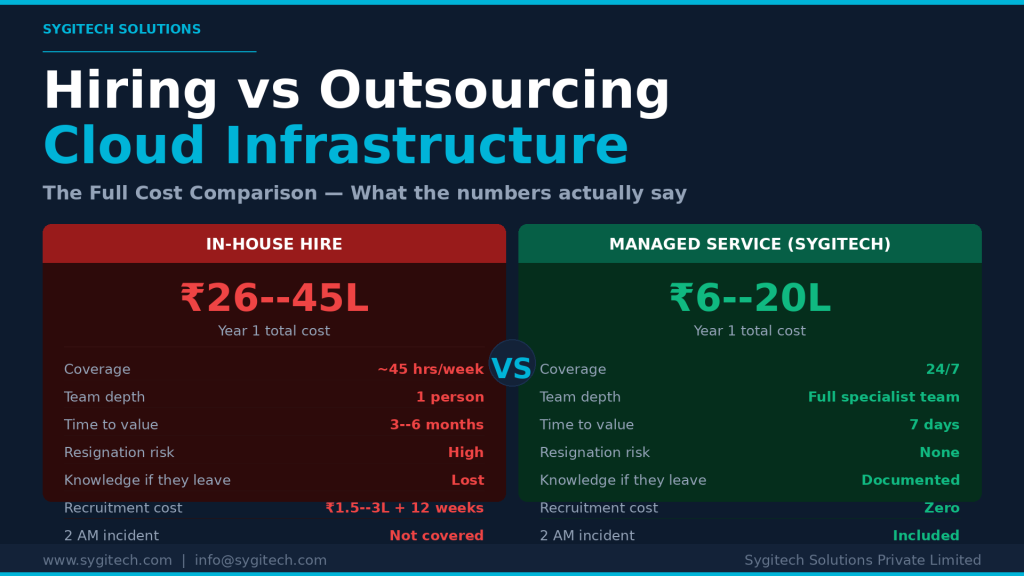
– Total Year 1: ₹26–45L | ~45 hrs/week coverage | 1 person
Managed service provider (Year 1):
– Infrastructure monitoring toolchain: Included (Zabbix + proprietary stack)
– APM tools (Datadog / New Relic): Separate licensing if required
– On-call / overtime: Included
– 24/7 coverage: Included
– Retainer fee: ₹6–20L
– Total Year 1: ₹6–20L | 168 hrs/week coverage | Full team
When Hiring Makes More Sense
This is not an argument that outsourcing is always right. Hiring a dedicated engineer or team makes sense when:
- Infrastructure strategy is a board-level conversation that requires someone deeply embedded in executive planning on a daily basis – not just execution. This typically applies when infrastructure decisions directly shape product strategy in real time, not just support it.
- Your product has highly specialised or proprietary infrastructure requirements that demand constant, real-time collaboration with the core engineering team throughout every sprint – for example, a company building a cloud platform or infrastructure product itself.
- You are building internal infrastructure as a core competitive differentiator, where the team’s depth of internal knowledge becomes inseparable from the product.
- You have the bandwidth and expertise to manage hiring, onboarding, retention, and succession planning without it becoming a distraction from the core business.
One important clarification on team size: the number of engineers you have is not the deciding factor. A well-structured managed service engagement scales effectively with large engineering organisations. Companies with 70–80 developers can and do work with external infrastructure partners without any structural limitation – provided the right processes, communication rhythms, and escalation paths are in place. The question is not how large your team is, but whether infrastructure management requires full-time strategic embedding at the leadership level.
For most companies – regardless of size – where infrastructure management is an operational function rather than a core strategic differentiator, outsourcing delivers better coverage, faster resolution, and lower total cost than a comparable in-house setup.
The Question That Changes the Conversation
Before making this decision, ask yourself one question:
“If our current infrastructure person left tomorrow, how long would it take us to recover?”
If the honest answer involves significant disruption, knowledge loss, or a multi-month recovery – you already have a structural risk that hiring alone will not solve. Because the next hire carries the same risk.
The right infrastructure strategy is one where the knowledge lives in the system – in documentation, runbooks, and processes – not in a single person’s head. Whether you hire or outsource, that is the standard to hold yourself to.
Summary
At a glance:
– Year 1 cost: ₹26–45L (in-house hire) vs ₹6–20L (managed service)
– Time to value: 3–6 months vs 7 days
– Coverage: Business hours vs 24/7
– Resignation risk: High vs None
– Knowledge retention: Person-dependent vs Documented
– Best for: Infrastructure as strategic differentiator vs operational function
Sygitech Solutions provides managed cloud infrastructure and DevOps services for SaaS companies and SMEs across India. If you are evaluating this decision for your organisation, we offer a free infrastructure audit – no commitment required.
Contact us at info@sygitech.com or visit Cloud Management