


Monitoring Mistakes and How to Fix Them
If your team only learns about outages from angry customer emails, you don’t have a monitoring problem. You have a pain problem. In fact, this pain usually comes from a…
Read article →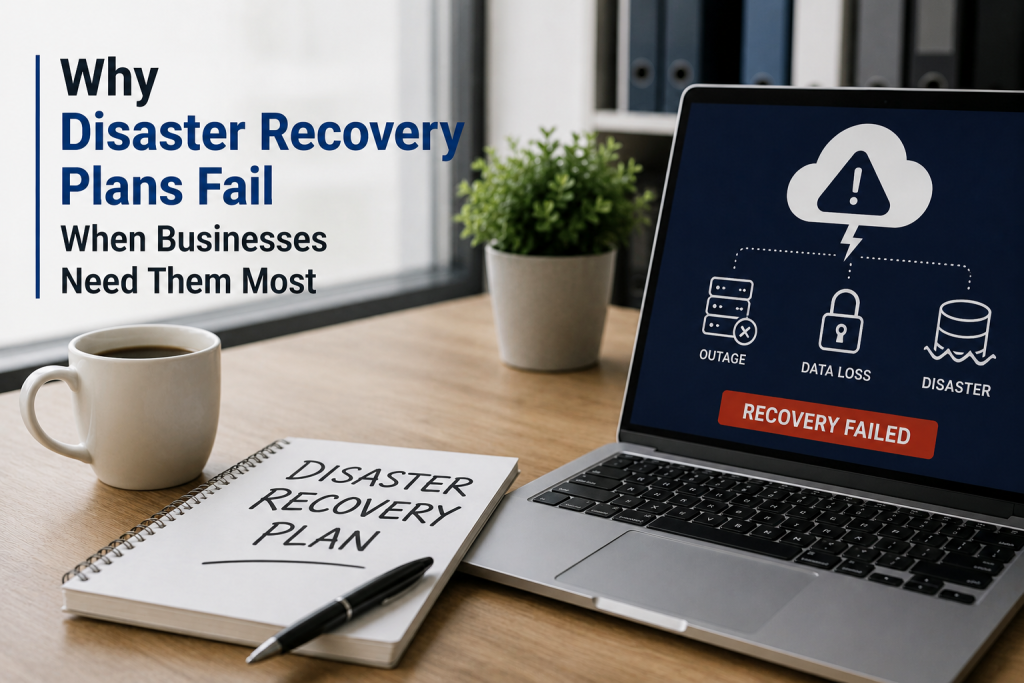
Most companies believe they are prepared for a crisis. They have a disaster recovery plan, regular backups, and assume everything will work when disaster strikes. Then disaster strikes-a ransomware attack, flood, or human error and the recovery plan fails within minutes.
This is not a rare story. It is the norm. Studies from IT resilience researchers consistently show that a large share of businesses that experience a major outage never fully recover, and many close permanently within a year or two. The irony is that most of these companies had a disaster recovery plan on paper. Understanding why disaster recovery plans fail is the first step toward building one that actually holds up when it matters most.
There is a meaningful difference between owning a disaster recovery plan and being operationally ready to execute it. Many organizations confuse the two.
A written plan tells you what should happen. Readiness means your team and systems can recover quickly, even under pressure.
This gap exists because disaster recovery planning is frequently treated as a compliance exercise rather than an operational capability. A document gets created to satisfy an auditor or a client requirement, it gets filed away, and nobody touches it again until the next audit cycle. Meanwhile, the actual IT environment keeps changing. New applications get deployed. Cloud resources shift. Employees leave and take institutional knowledge with them. The plan quietly becomes obsolete while everyone assumes it is still valid.
Any one of these issues can turn a manageable incident into a prolonged outage.
Writing a disaster recovery plan is the easy part. Testing it honestly is where most organizations fall short, and this is one of the most common reasons disaster recovery plans fail once a real incident begins.
A tabletop exercise where executives discuss hypothetical scenarios in a conference room is useful, but it is not the same as a live failover test where systems are actually switched to backup infrastructure and employees try to work from it. Real tests expose real problems, missing credentials, forgotten dependencies, slow restore speeds, and gaps in staff knowledge.
Businesses that rely on managed IT services tend to fare better here because testing becomes a scheduled, recurring responsibility rather than something that gets postponed indefinitely. An external provider brings discipline to the process and does not let testing slip because everyone is busy with daily priorities.
Skipping these steps leaves businesses unsure whether their recovery plan will actually work.
Many disaster recovery plans were originally written for a world of on premises servers and a single data center. Today, businesses run workloads across public cloud platforms, private infrastructure, SaaS applications, and remote employee devices. A plan built for the old model simply does not account for this complexity.
This is where thoughtful cloud migration planning and ongoing cloud oversight become essential rather than optional. Moving workloads to the cloud is not just a technical lift and shift project. It requires rethinking how backups, failover, and recovery workflows function across distributed environments.
Organizations that invest in proper cloud strategy and planning early in their cloud journey build resilience into the architecture itself, rather than trying to bolt recovery capabilities onto a system that was never designed for them. This forward planning pays off enormously when an actual incident occurs, because recovery paths are already mapped, tested, and automated rather than improvised under pressure.
Without clear cloud optimization guiding resource allocation and architecture decisions, businesses often overspend on redundant capacity in the wrong places while leaving genuinely critical systems under protected.
A disaster recovery plan is only as good as the speed at which a problem is detected. If an outage or breach goes unnoticed for hours, the recovery clock starts far too late, and the damage compounds while nobody is responding.
This is why continuous oversight matters so much. Businesses that rely on internal teams checking dashboards occasionally during business hours are far more exposed than those using round the clock monitoring. Threats and failures do not politely wait for office hours. Ransomware attacks are frequently launched late at night or over weekends specifically because attackers know staffing is thinner during those windows.
Effective ongoing monitoring catches anomalies early, whether that is unusual login activity, a failing backup job, or a performance degradation that signals an impending hardware failure. Early detection often means the difference between a quick fix and a full scale disaster.
Disaster recovery ultimately comes down to data. If your data cannot be restored quickly, accurately, and completely, nothing else about your plan matters. A well-planned data backup and recovery strategy ensures that critical information remains protected, recovery times stay predictable, and business operations can resume with minimal downtime after an incident.
Unfortunately, many databases are designed purely for performance and cost efficiency during normal operations, with recovery treated as an afterthought. This is where sound database design consulting makes a measurable difference. A well designed schema with proper replication, clear backup boundaries, and documented recovery procedures dramatically reduces both recovery time and the risk of data corruption during restoration.
Similarly, businesses that invest in structured data migration and management practices avoid the chaos of trying to figure out, mid crisis, where every piece of critical data actually lives and how it relates to other systems.
Speed is everything during a disaster. Every hour of downtime translates directly into lost revenue, damaged customer trust, and in some industries, regulatory exposure. Manual recovery processes, where engineers log into systems one by one and execute steps from a document, are simply too slow for the scale of modern IT environments.
This is precisely the problem that DevOps focused automation solves. Automated recovery pipelines can spin up replacement infrastructure, restore data, and redirect traffic in a fraction of the time a manual process would take. When organizations work with a capable automation partner, disaster recovery becomes something closer to a scripted, repeatable workflow rather than an improvised scramble.
A well built continuous integration and deployment approach also means that recovery environments stay in sync with production, so you are not restoring an outdated version of your application that is missing recent updates or security patches. Businesses that lean on experienced automation specialists often find that the same practices used for everyday deployments translate directly into faster, more reliable disaster recovery.
Sometimes the disaster recovery plan itself is sound, but the underlying application architecture was never built to support fast recovery. A monolithic application with tightly coupled dependencies is inherently harder to restore quickly than a well architected system with clear separation of concerns.
This is where custom web development built with resilience in mind pays long term dividends. Applications designed with redundancy, graceful degradation, and clear failover logic from the start recover far more gracefully than legacy systems retrofitted after the fact.
Broader IT consulting engagements can help identify these architectural weaknesses before they become emergencies, offering an outside perspective that internal teams sometimes miss simply because they are too close to the systems they built.
Knowing why plans fail is useful only if it leads to better decisions going forward. Here is a practical approach that consistently produces more resilient outcomes.
Businesses that combine managed cloud services with strong internal governance around these principles consistently recover faster and with less financial damage than those relying on outdated, untested documents.
Disaster recovery plans fail for the same handful of reasons again and again, not because businesses do not care about resilience, but because planning gets treated as a static, one time exercise instead of a living operational capability that requires continuous attention, testing, and investment.
The businesses that come through a crisis intact are almost always the ones who tested their assumptions before disaster struck, automated what could be automated, and kept a close eye on their systems every single day, not just during scheduled reviews.
If your organization has not stress tested its recovery plan recently, or if your infrastructure has changed significantly since it was written, now is the time to revisit it, before an incident forces the issue. A conversation with an experienced technology partner can help you identify the gaps that matter most and build a plan that holds up when it actually counts.
How often should a disaster recovery plan be tested?
Most experts recommend testing at least twice a year, with additional tests triggered whenever significant infrastructure, application, or staffing changes occur. Annual testing alone is generally not frequent enough for fast moving IT environments.
What is the difference between a backup and a disaster recovery plan?
A backup is a copy of your data. A disaster recovery plan is the complete process, including people, procedures, and infrastructure, needed to restore full business operations after an incident. Having backups without a tested recovery process still leaves a business exposed.
How long should it take to recover from a major outage?
Recovery time depends heavily on the business and its recovery time objectives, but many well prepared organizations aim to restore critical systems within hours rather than days. This benchmark should be defined clearly in the plan and validated through testing.
Can small and mid sized businesses afford proper disaster recovery planning?
Yes, and in many cases it is more affordable than the alternative. Partnering with a provider offering scalable, subscription based support allows smaller businesses to access enterprise grade resilience without building an entire internal team from scratch.
What is the biggest mistake companies make with disaster recovery? The most common mistake is writing a plan once and never revisiting or testing it again. Infrastructure, staff, and threats all change over time, and a plan that is not maintained quietly becomes ineffective long before anyone notices.
If your team only learns about outages from angry customer emails, you don’t have a monitoring problem. You have a pain problem. In fact, this pain usually comes from a…
Read article →Ask any IT leader if their company has a disaster recovery plan. Almost everyone will say yes. Ask them when they last tested it, and the confidence usually drops fast.…
Read article →Every plant manager knows the feeling: the order book is finally full, the lines are running at full tilt, and then, without warning, a system stalls. Screens freeze, sensors stop…
Read article →Tell us where you are and what's slowing you down. A senior engineer will get back to you within one business day.
Our team will get back to you within one business day.
Leave a Reply