

One AWS regional outage. One enterprise prospect asking for your SOC 2 report before signing. One Friday deployment that takes down production at 6pm. Any single one of these can undo months of business momentum in an afternoon and none of them announce themselves in advance.
That is the thing about infrastructure failure. It does not arrive as a dramatic crash with flashing red alerts. It arrives as a sales call that goes quiet after the security questionnaire. As a senior engineer handing in their notice because they are tired of firefighting. As a customer churning quietly because your product has been “a bit slow lately.”
Your sales team is closing more deals than ever. Your product roadmap is ambitious. But somewhere underneath all that momentum, your infrastructure is accumulating debt that your business will eventually have to repay with interest.
The companies that scale successfully are not the ones that never have infrastructure problems. They are the ones that spot the warning signs early enough to act before the bill comes due.
Building the right IT infrastructure for business growth is not a one-time project. It is an ongoing discipline. Here are the signs that yours is falling behind.
Why Growing Businesses Outpace Their Own Infrastructure
Here is the uncomfortable truth about infrastructure: the decisions that got you here are often the ones holding you back now.
When you were a team of five, you picked tools and architectures that were fast to set up. When you hit 20 people, you patched what was already there instead of stepping back to rethink it. By the time you are at 80 or 100 people, you are running a complex, high-stakes production environment on top of decisions that were made in a sprint.
That is not a failure of engineering judgment. That is just how growth works. But recognizing where the cracks are starting to form that is where IT infrastructure for business growth becomes a strategic conversation, not just a technical one.
1. Your Deployment Process Has Become a Source of Dread
There is a tell-tale sign we see all the time when we start working with a new client. We ask: “When did you last ship something on a Friday afternoon without anyone breaking a sweat?”
The answer usually comes with a laugh. Because for most teams past a certain size, Friday deployments stopped being casual a long time ago.
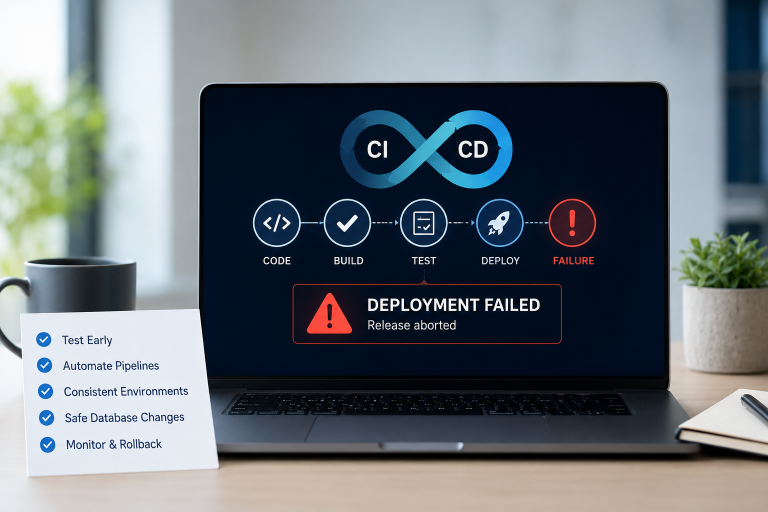
Slow, risky deployments are one of the earliest symptoms of infrastructure that has not grown with the team. What tends to drive it is a monolithic codebase where a small change still requires a full re-deploy, a CI/CD pipeline that was set up years ago and never meaningfully updated, staging and production environments that have quietly diverged over time, and test suites that nobody has audited so they run end-to-end even when only three lines changed.
In SaaS and DevOps environments, how fast you can ship is directly connected to how fast you can compete. Research from DORA consistently shows that elite performing engineering teams deploy multiple times per day while low performers deploy once a month or less. That gap is not just a technical metric. It translates directly into how quickly you can respond to customers, fix bugs, and ship the features your competitors are racing to build. When your deployment pipeline becomes something engineers work around rather than through, you are not just losing developer hours. You are losing market position.
From our work with clients: A 35-person SaaS engineering team came to us after their deployment window had stretched from around 25 minutes to close to four hours over the course of 18 months. No single change had caused it. It was dozens of small additions to the pipeline, each adding a little friction, until the whole thing had become a weekly source of stress. We ran a CI/CD audit, introduced parallelization, cleaned up the branching strategy, and deployments were back under 40 minutes within six weeks. The fix was not glamorous. But the relief was immediate.
2. You Find Out About Production Issues From Customers, Not Your Own Alerts
This one stings a little when teams hear it, but it is worth saying plainly: if your customers are your early warning system, your monitoring has not kept up with your product.
Reactive monitoring is fine when you have two services and three engineers. At that scale, someone is always close enough to notice when something breaks. But once you are running 15, 20, or 30 microservices across multiple regions, manual correlation between logs and alerts simply stops working. Problems start cascading in ways that are invisible until a customer tweets about it.
What mature IT infrastructure for business growth looks like in practice is this: your on-call engineer gets an alert before the customer notices anything is wrong, they already have logs, traces, and metrics surfaced in a single view, and the mean time to recovery is measured in minutes rather than hours.
In our experience, most growing engineering teams underestimate how fast reactive monitoring becomes unsustainable. The shift from “we notice when things break” to “we know before things break” is one of the highest-leverage infrastructure investments a scaling company can make. And the cost of not making it is not just engineering stress. Every hour of undetected downtime costs real revenue. For a SaaS product generating $2 million ARR, a single hour of downtime represents roughly $228 in lost revenue but the churn risk from a frustrated enterprise customer is worth far more than that.
3. Your Cloud Bill Is Growing Faster Than Your User Base
If your cloud costs are climbing at twice the rate of your active users, something is wrong and it is almost never obvious where.
Here is a number that should give every engineering leader pause: according to the Flexera 2026 State of the Cloud Report, organizations waste around 29% of their total cloud spend. For a company running a $500,000 annual cloud budget, that is roughly $145,000 a year going to over-provisioned instances, orphaned snapshots, forgotten staging environments, and resources that scale up but never scale down.
The frustrating part is that this waste tends to be invisible without the right tooling and governance in place. Nobody made a deliberate decision to burn $145,000. It accumulated slowly, one slightly-too-large instance at a time.
Without proper cloud infrastructure management services, most teams only discover the true scale of their cloud waste during a financial review at which point untangling it is a months-long project rather than a quick cleanup.
The benchmark we use with clients is straightforward. Your infrastructure costs should grow roughly in proportion to your active usage. If they are growing faster than that, start by asking when you last audited your resource utilization, whether you have auto-scaling configured and tested, and whether you have any cost attribution by team or product line.
4. Your Best Engineers Are Spending Their Days Keeping the Lights On
This is one of the most expensive and least-talked-about signs of infrastructure debt. And it is expensive not just in salary cost but in what it does to morale over time.
We worked with a B2B software company that was scaling from around 50 to 120 employees. During an infrastructure review, we found that their senior engineers were spending close to 30 percent of their week on tasks that had no automation behind them at all. Certificate renewals were handled manually. Getting a new developer set up with a working environment took two days of back-and-forth with the DevOps lead. Database backups were verified by hand every morning because nobody had gotten around to setting up automated validation.
None of this was malicious neglect. These tasks had simply never been prioritized because the team was always heads-down on the next product feature. But the cumulative effect was that your highest-leverage people were spending a significant chunk of their time on work that a well-written script could handle.
Healthy IT infrastructure for business growth should be largely self-running. When it is not, you are not just paying an infrastructure cost. You are paying an engineering talent cost too. If a senior engineer costs your business $150,000 a year and spends 30 percent of their time on tasks that could be automated, that is $45,000 annually in misallocated talent per person. Multiply that across a team of five senior engineers and you are looking at $225,000 a year in productivity quietly going to work that should not require a human at all.
5. Your Database Is Starting to Buckle
For most SaaS companies, the database is the first place where growth reveals its teeth.
It starts subtly. A query that used to return instantly now takes a second or two. An analytics report that ran overnight now takes half the morning and locks tables while it does. Your team adds an index, performance improves, and everyone moves on. Six months later the same thing happens again.
This cycle of reactive tuning is a sign that the architecture needs a more fundamental rethink, not more indexes.
Many teams start on a single relational database which is completely the right call at early stage. But as data volume and query complexity grow, that single instance becomes both a performance bottleneck and a single point of failure. The conversation then shifts toward read replicas to offload analytics, separating transactional and reporting workloads, introducing caching layers like Redis to keep pressure off the database, and eventually thinking about multi-region replication if latency is becoming a customer issue.
If your database team is regularly getting paged at night for slow queries, that is not a DBA problem. That is an architecture conversation waiting to happen.
6. Security and Compliance Feel Like a Fire Drill Every Time
Nobody deprioritizes security because they think it is unimportant. They deprioritize it because the product deadline is real and the security incident is hypothetical. That tradeoff makes sense at five people chasing product-market fit. The problem is that most companies never consciously revisit it and growth moves quietly in the background, expanding the attack surface, adding integrations, bringing in enterprise customers with real data, until one day the security posture you built for a scrappy startup is holding the door open on a company that genuinely cannot afford a breach.
We see the same pattern almost every time. Engineers still have production access from roles they held two years ago because nobody thought to revoke it when they moved teams. Credentials are living in .env files and Slack messages because a proper secrets manager was on the backlog for eighteen months and kept getting bumped. And the SOC 2 audit that should have been a three-week exercise became a three-month scramble because compliance was treated as a certification to get rather than a practice to build.
Here is the part that stings for commercial teams specifically. Enterprise prospects are not waiting until after they sign to ask about your security posture. They are asking before. A weak or vague answer on access control, incident response, or data handling can quietly kill a deal your sales team spent four months building. Security debt does not just create technical risk. It creates revenue risk in a way that is very hard to explain to a board after the fact.
7. A Single Outage Could Take Your Entire Product Offline
Ask yourself honestly: if the AWS region your application runs in went down right now, what would happen?
For a lot of growing SaaS companies, the honest answer is that their product would go offline, their support queue would flood, and their engineers would scramble for hours to bring things back up.
Single-region deployments are a perfectly sensible starting point. But as you take on more enterprise customers and start making SLA commitments, the risk profile of that single region changes dramatically. What was an acceptable tradeoff at $500k ARR looks very different at $5 million ARR.
The conversation around high availability does not need to start with a full multi-region active-active setup. It can start with formally defining your RTO and RPO, testing your disaster recovery runbooks at least once a year, and moving toward an active-passive failover configuration that reduces recovery time even if it does not eliminate it entirely.
8. Every New Initiative Gets Stuck in an Infrastructure Queue
Here is a question that reveals a lot about infrastructure maturity: how long does it take to spin up a new service or onboard a new engineering team from scratch?
If the answer involves a ticket to the platform team, several days of waiting, a back-and-forth about permissions, and a manual setup process that only one person fully understands that is a bottleneck that gets more expensive with every new hire and every new product initiative.
Fast-growing companies need infrastructure that scales horizontally across teams, not just vertically in capacity. That means having Infrastructure as Code in place with Terraform, Pulumi, or CloudFormation so that environments are reproducible and version-controlled, golden paths that let product teams self-serve common infrastructure without needing platform team involvement, and environment standardization so that switching between services does not feel like switching between entirely different companies.
Without this, every growth initiative carries a hidden infrastructure tax. And that tax accumulates.
9. Nobody Can Answer Basic Capacity Questions With Confidence
Here is a simple test. Try to get confident answers to these three questions from your team right now.
How much additional traffic can your current infrastructure absorb before users notice performance degradation? At your current data growth rate, when will you hit meaningful storage limits? What happens to your application if your primary payment provider or authentication service goes down?
If getting answers requires digging through old Slack messages, tracking down the one engineer who set things up, or admitting that you genuinely do not know that is a sign your operational maturity has not kept pace with your infrastructure complexity.
Solid IT infrastructure for business growth needs capacity planning as a regular rhythm, not a one-off exercise when things start slowing down. That means maintaining up-to-date utilization baselines, having documented thresholds that trigger scaling reviews, and running dependency failure scenarios before they happen in production.
10. The Word “Rewrite” Keeps Coming Up in Engineering Conversations
This is the most human signal on this list and in some ways the most important.
When senior engineers start regularly floating the idea of rewriting a core service or re-platforming a critical system, it is rarely because they want the work. Rewrites are painful, risky, and time-consuming. Engineers advocate for them when they genuinely believe that continuing to build on the current foundation is slower and riskier than starting fresh.
That conversation is worth taking seriously. Not because a rewrite is always the right answer -it often is not but because it tells you something real about how your team feels about the infrastructure they are working within every day.
Most rewrite discussions begin when systems are pushed beyond what they were originally designed to handle. Over time, constant patches, dependencies, and complexity make even small changes slow, risky, and dependent on a few specialists.
What to Do When You Recognize These Signs
Let me be honest with you about something first. Most teams that read a post like this nod along, forward it to one or two people, and then open their sprint board and go back to what they were already doing. The problems feel real in the moment of reading and then get absorbed back into the noise.
So before the practical advice, a word on that. The companies we have seen actually fix these problems do not do it by tackling everything at once. They do it by picking the two or three things that are genuinely costing them the most right now in money, in engineering time, or in customer trust and going deep on those first. That focus is usually what separates the teams that make real progress from the ones that are still talking about the same infrastructure problems two years later.
With that said, here is where to start.
1. Get an honest picture of what you actually have. Not the architecture diagram someone drew 18 months ago. What is actually running, what it costs, where it breaks, and what happens to the business when it does. This is harder than it sounds because most teams are too close to see it clearly. Working with an experienced IT infrastructure consulting services partner often surfaces things that have been invisible internally for years not because the team is not smart, but because they are too busy keeping things running to step back and look at the full picture.
2. Prioritize ruthlessly by business impact, not engineering interest. This is where teams go wrong most often. There is always something technically interesting to work on. But the question to ask is: what infrastructure problem is most directly costing us customers, revenue, or the ability to ship? That thing goes first. Everything else gets a numbered ticket.
3. Make sure reliability has a real owner. Past about 30 engineers, “everyone owns reliability” is the same as nobody owning it. It does not need to be a large team. It can be one person with a clear mandate and protected time. But someone needs to be thinking about this proactively rather than just responding when things break.
4. Get your infrastructure into code before your next hire, not after. Terraform, Pulumi, CloudFormation-the specific tool matters less than the discipline. Every week you wait, another manual process gets added, another environment drifts, another piece of institutional knowledge lives only in someone’s head. Start now. The migration is never as painful as teams expect it to be.
5. Instrument before you need it. Distributed tracing, structured logging, meaningful alerts with context attached. Set this up during a quiet week, not during a late-night incident when it is already too late to help. This is one of the fastest-paying infrastructure investments, often proving its value during the very first outage.
Conclusion
Infrastructure debt is patient. It accumulates quietly, hides behind busy roadmaps, and only announces itself when the timing is worst during a product launch, a fundraising round, or the week you are trying to close your biggest enterprise deal.
If three or more of the signs in this post sound familiar, your infrastructure is already behind where it needs to be. Not catastrophically in most cases. The gap between your current infrastructure and future business demands will eventually create real operational and financial costs. It can impact engineering morale, customer trust, and long-term business growth.
Most of these problems are fixable without starting from scratch. But they do not get fixed by accident and they do not get easier the longer you wait. The strongest teams treat infrastructure as a core part of product success, not an afterthought after development.
If reading this felt a little too familiar, do not let that feeling disappear into the next sprint. Do something with it this week.
Three or more of these signs sound like your team? Have that conversation this week not next quarter.
Our IT consulting services are built for exactly this stage of growth. We help scaling businesses fix infrastructure gaps and build systems that support long-term growth. No drawn-out sales process. Just an honest conversation about where you are and what it would actually take to get ahead of it. Reach out today.