

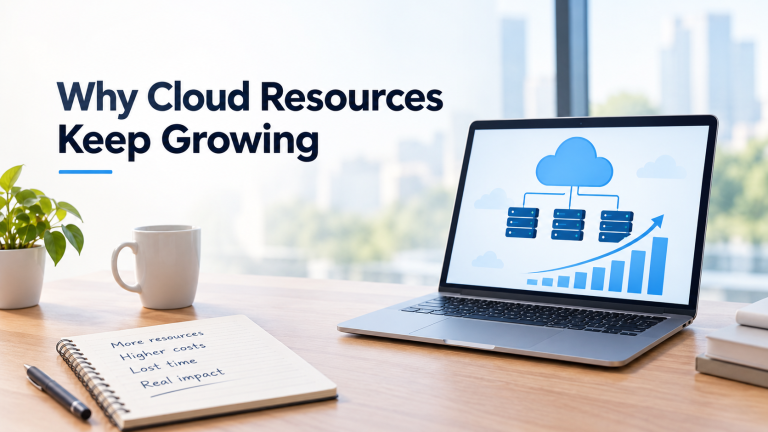
Why Cloud Resources Keep Growing
Monday morning, your finance lead sends a message. The cloud bill jumped again, and she wants to know why. You open the console and scroll through hundreds of resources. You…
Read article →
Nobody wakes up one morning and decides to build a tangled mess of a cloud setup. It happens slowly. A developer spins up a quick Lambda function to test an idea and forgets to tear it down. A different team adds an EKS cluster for “just this one project,” and it quietly becomes a critical piece of infrastructure two years later. Someone grants an IAM role “temporarily” during a launch crunch and it’s still active eight months on, with nobody quite sure what it touches. Fast forward a year or two, and nobody in the company can say with full confidence what’s actually running, who owns it, or why half of it exists.
Sound familiar? You’re not the only one. cloud environment complexity is one of those problems that rarely shows up as one big dramatic failure. It builds up quietly, through sprawl and shortcuts and good intentions, until one day your team is spending more hours firefighting than building anything new.
Here’s the part that actually matters, though: this is fixable. The trick is catching it early, before it eats your budget and your team’s patience. So let’s talk about what to actually look for.
Try this little experiment. Ask a few engineers to sketch your current cloud setup from memory, no dashboards, no Terraform state files open in another tab, just what’s in their head. If you get blank stares, three conflicting diagrams, or someone saying “honestly, I think there’s an S3 bucket in there we forgot to shut down,” that’s a problem.
This is what cloud environment complexity looks like from the inside. Documentation stops keeping up with reality. Staging environments spun up for a Q2 launch are still running in Q4 of the following year, quietly billing away. Access gets granted during a migration and never revoked once it’s over. Eventually the environment turns into something even the people who built it can’t fully explain, which makes every audit, every onboarding, and every 2 a.m. troubleshooting session take three times longer than it should.
A growing cloud bill isn’t automatically a bad sign. Growth costs money, that’s normal. What’s not normal is when finance flags a 30% jump on the AWS or Azure invoice and engineering just… shrugs.
EC2 instances left running after a project wrapped up. Snapshots and old backups nobody’s touched in over a year. An RDS database still provisioned for Black Friday traffic that never actually needed to scale that high. These things pile up quietly and cost real money every single day they’re left alone. It’s not unusual for teams to discover that a fifth or more of their monthly spend was going toward resources doing basically nothing. This is exactly the kind of leak that cloud optimization services are built to catch: going through your environment line by line, spotting the waste, resizing what’s oversized, and putting some actual guardrails (budgets, alerts, tagging policies) in place so your spend starts matching your usage again.
In a healthy setup, shipping code should feel routine, even a little boring. If your team schedules deployments for Friday at 6 PM “just in case,” opens a dedicated Slack channel every time, and everyone quietly holds their breath, something’s off.
That kind of fragility usually comes from infrastructure that grew organically without much standardization. Maybe one team ships through Jenkins, another pushes straight from GitHub Actions with no staging step, and a third still deploys manually over SSH because “that’s how it’s always been done.” No consistent testing, no real rollback plan, pipelines patched together over time by whoever happened to be around at the time. Eventually teams start avoiding deployments altogether, batching two weeks of changes into one risky release instead of shipping small and often, and that slows the whole business down, which kind of defeats the point of moving to the cloud in the first place.
Here’s an honest question to ask yourself: over the last month, how much of your engineering team’s time went toward fixing broken things versus building new ones?
If it’s mostly patching outages, chasing permission errors, or manually syncing configurations across environments, your team is stuck in reactive mode, and that’s draining, both for output and for morale. This is one of the clearest tells that cloud environment complexity has gotten out of hand. Skilled people end up babysitting infrastructure instead of moving the product forward, and that’s a fast way to lose good engineers to burnout.
Every new service, every integration, every region you add creates a little more surface area to secure. When environments grow without a consistent strategy behind them, you end up with inconsistent access rules, API keys sitting in a Slack thread from 2023, unpatched EC2 instances, and a storage bucket that got set to public during a demo and never got locked back down. Hopefully whoever finds it first is on your team, and not an attacker.
If your security reviews keep turning up things nobody knew existed, that’s not really a “fix it once” problem. It’s a sign your environment has grown past the point where anyone actually has full visibility into it.
Running multiple clouds or a hybrid setup isn’t a red flag by itself, plenty of companies do it well. The trouble starts when nobody has one clear view across all of it. Maybe production sits on AWS, analytics runs on GCP because a data scientist preferred BigQuery, and a legacy app is still parked in a private data center because migrating it never made it up the priority list. Monitoring tools that don’t talk to each other. Alerts scattered across five different dashboards: CloudWatch here, a separate APM tool there, a spreadsheet someone maintains manually for the legacy piece.
This kind of fragmentation is a textbook symptom of cloud environment complexity, and it’s exactly why so many companies eventually bring in cloud monitoring and management services, to get one live, unified picture of health, cost, and risk instead of manually stitching together five half views every time something breaks.
The whole point of the cloud is elasticity: scaling up and down as demand shifts, without a fuss. If scaling events trigger anxiety instead of confidence, if someone has to manually step in every time traffic spikes, or performance gets shaky under load in ways nobody can predict, your setup isn’t really behaving like cloud infrastructure anymore. It’s just old style data center thinking wearing cloud pricing.
Complexity has a hidden cost on people, too. If it takes a new engineer a month just to understand how the pieces connect and who owns what, you’re paying an invisible tax on every single hire. And when the knowledge of “how this all fits together” lives in two or three people’s heads instead of anywhere written down, you’re one resignation away from a real problem.
Here’s the reassuring part: none of this means your cloud strategy failed. It just means your environment outgrew ad hoc management, and honestly, that happens to most companies that scale. It’s not a permanent state. It’s a fixable one.
A few things tend to make the biggest difference:
Start with visibility. You can’t untangle what you can’t see. Solid cloud monitoring and management services give you a real, live picture of performance, cost, and security across everything you’re running. That’s the foundation everything else gets built on.
Bring in people who do this every day. Working with a team that offers managed cloud services means dedicated experts are handling architecture reviews, cost cleanup, security hardening, and daily operations, so your internal team can go back to building the product instead of babysitting servers.
Automate the repetitive stuff. Standardized CI/CD pipelines, infrastructure managed as code, and consistent deployment habits take the guesswork (and the Friday night nerves) out of shipping software.
Cloud environment complexity doesn’t resolve on its own. It just keeps compounding. Every quarter you put off dealing with it, the sprawl gets a bit wider, the bill creeps a bit higher, and the risk gets a bit harder to untangle. But recognizing the signs is genuinely most of the battle. Once you can name the problem, you can actually fix it.
And you don’t have to sort it out alone, either. The right support helps you eliminate runaway costs, stabilize deployments, close security gaps, and build a flexible, scalable cloud environment.
If a few too many of these signs hit close to home, that’s not a failure on your part. It’s just a nudge that it’s time to deal with it, before the fix gets more expensive than the problem.
Monday morning, your finance lead sends a message. The cloud bill jumped again, and she wants to know why. You open the console and scroll through hundreds of resources. You…
Read article →You dread deployment day. You flinch when the cloud invoice lands in your inbox. You’ve stopped trying to explain the architecture to new hires because you’re not fully sure how…
Read article →Your migration was supposed to be finished by now. Instead, you’re staring at a cloud bill that’s twice your budget. An application keeps timing out. Your team is exhausted from…
Read article →Tell us where you are and what's slowing you down. A senior engineer will get back to you within one business day.
Our team will get back to you within one business day.

Leave a Reply