

7 Signs of Cloud Complexity & How to Simplify Them
You dread deployment day. You flinch when the cloud invoice lands in your inbox. You’ve stopped trying to explain the architecture to new hires because you’re not fully sure how…
Read article →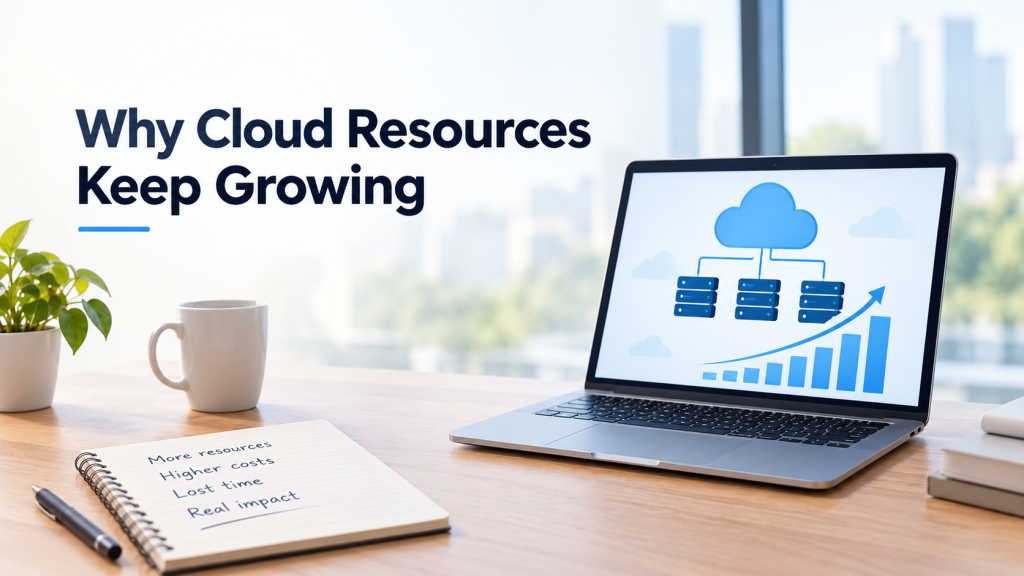
Monday morning, your finance lead sends a message. The cloud bill jumped again, and she wants to know why. You open the console and scroll through hundreds of resources. You can’t answer her. Neither can anyone on your team. That moment hurts, and it happens in companies of every size. This guide explains why cloud resources keep growing, what it quietly costs you, and how to fix it.
Many industry surveys estimate that about 30 percent of cloud spend goes to waste. Take a company that pays $50,000 a month. That means $15,000 vanishes every month, or $180,000 every year. You get nothing for it.
Money is not the only loss. Engineers lose days hunting for mystery servers. Finance loses trust in your forecasts. Leaders lose patience with a technology that was supposed to save money. Let’s look at what causes the drift.
In a traditional data center, new capacity meant buying hardware. You waited weeks, and every purchase needed approval. That friction kept growth in check.
The cloud removed the friction. A developer can launch a server or a database in minutes. That speed helps your business, but it also invites carelessness. Creating a resource takes one click. Deleting it needs someone to remember.
Nobody writes “remove test server” on a sprint board. So the leftovers stay, and you pay for them every hour.
Some growth is healthy. More customers bring more traffic and more data. Seasonal spikes also push teams to add capacity for holiday sales or product launches.
The trouble starts after the peak. The rush ends, but the extra servers keep running. Nobody schedules the scale down, so a three week spike turns into a twelve month expense.
Every app, device, and customer click creates data. Logs, backups, analytics events, and media files all need a home. Storage costs little per gigabyte, so keeping everything feels harmless.
It isn’t. Small prices multiplied by years of unmanaged data become a large line item. Old snapshots, duplicate datasets, and forgotten archives add up quietly. Without retention rules, storage only moves in one direction.
Digital transformation brings new portals, workflows, and mobile apps. Each project needs development, testing, staging, and production environments. Each environment needs databases, queues, caches, and monitoring tools.
Microservices add to the count. Instead of one application server, you might run fifty services. Each one has its own container, load balancer, and logging pipeline. Every choice looks sensible alone. Together, they swell your footprint fast.
Ask an engineer how much capacity a workload needs. The answer usually sounds generous. Nobody wants to cause an outage, so the team adds a safety buffer. Later, someone adds another. Nobody revisits the original guess.
Studies of cloud usage keep finding the same pattern. A large share of provisioned compute sits idle. Oversized instances and unused reservations top the list. Each one drains your budget every single month.
This is where cloud optimization services pay for themselves. Specialists compare what you buy with what you actually use. They resize the gap and show you the savings in plain numbers.
Innovation needs experiments. Teams build proofs of concept, run load tests, and try new tools. These setups have real value while they last.
Then people move on. Picture a test cluster built for a two week project. The engineer who built it joins another team. A year later, the cluster still runs and still charges you. With no owner and no expiry date, nobody notices until someone audits the account.
Machine learning and real time analytics have gone mainstream. They also consume a lot. Training a model or serving predictions at scale needs powerful compute, fast storage, and plenty of memory.
These workloads behave unpredictably. One experiment can burn a month of budget in a weekend. Teams respond by overprovisioning even more, which makes the bill harder to predict.
Poor visibility may be the biggest driver of all. Picture several teams sharing accounts, regions, and projects. Simple questions become hard. Who owns this server? What does it do? Does anyone still use it? What does it cost?
When nobody owns a resource, nobody feels responsible for shutting it down. That is a major reason why cloud resources keep growing even when no one plans it. A small environment quietly becomes a sprawling one.
Cloud monitoring and management services solve this problem. They give every team a constant view of what runs, who owns it, and what it costs. They also alert you when spending jumps, so you hear about problems in days instead of at month end.
Providers offer dozens of instance types, storage classes, and discount programs. Picking the wrong one wastes money. Paying on demand rates for a steady workload is a common mistake. So is storing rarely used data in premium tiers.
Hidden charges make it worse. Data transfer fees, idle load balancers, and unattached storage volumes rarely get attention. They show up as surprise lines on the invoice. Most teams lack the time to track every detail.
Ignoring the problem feels free, but it isn’t. Consider what happens when you put this off for another year.
Your waste compounds. Every unmanaged resource keeps billing, and new ones join it each week. Your engineers spend hours on cost questions instead of building features. Forgotten servers also become security risks, because nobody patches what nobody remembers. Meanwhile, your finance team loses faith in every cloud forecast you share.
The longer the sprawl runs, the harder the cleanup becomes. A messy account with ten thousand untagged resources takes months to untangle. A tidy one takes days.
No. Growth that matches real demand signals success. More customers and more innovation need more resources. You should not shrink your cloud at any cost.
The real problem is unmanaged growth, which means resources that exist because of habit, neglect, or guesswork. Once you separate healthy scaling from waste, you also see why cloud resources keep growing in your specific environment. That clarity is the first step toward control.
You don’t need a huge project. Start with this simple plan.
Week 1: Get visibility. Tag every resource with an owner, project, environment, and cost center. List everything that has no tag. Those are your first suspects.
Week 2: Remove the dead weight. Delete unattached volumes, old snapshots, and idle test environments. Ask owners to confirm before you remove anything important. Most teams find quick savings here.
Week 3: Rightsize and schedule. Check real CPU and memory use. Shrink oversized instances. Shut down development systems overnight and on weekends.
Week 4: Automate and alert. Set budgets and spending alerts. Add expiry dates to every temporary environment. Turn on autoscaling so capacity follows demand.
After thirty days, review the results with finance and engineering together. Make this review a monthly habit. FinOps works best when cost becomes a shared responsibility.
This plan works, but keeping it going takes time and skill. Your internal team already ships features and keeps systems running. Cost reviews often slip to the bottom of the list, and the waste returns.
A good partner removes that burden. They audit your environment, fix the obvious waste, and build automation so the savings last. They also teach your team the habits that keep the bill honest.
If you suspect your cloud bill hides waste, ask for a free cloud cost review. It takes little effort, and the results often surprise teams.
No single mistake explains cloud growth. Easy provisioning, growing data, modern architectures, cautious overprovisioning, forgotten experiments, and weak visibility all play a part. Complex pricing hides the drift until the invoice arrives.
Knowing why cloud resources keep growing puts you back in control. Assign clear owners, automate the boring work, and review usage every month. You will keep the speed and flexibility that drew you to the cloud, without paying for capacity you never use. Start this week, because every day of delay adds to the bill.
You dread deployment day. You flinch when the cloud invoice lands in your inbox. You’ve stopped trying to explain the architecture to new hires because you’re not fully sure how…
Read article →Your migration was supposed to be finished by now. Instead, you’re staring at a cloud bill that’s twice your budget. An application keeps timing out. Your team is exhausted from…
Read article →You open the monthly cloud invoice and your stomach drops. The number is higher again, and nobody on your team can tell you exactly why. Sound familiar? You’re not the…
Read article →Tell us where you are and what's slowing you down. A senior engineer will get back to you within one business day.
Our team will get back to you within one business day.


Leave a Reply