

7 Signs of Cloud Complexity & How to Simplify Them
You dread deployment day. You flinch when the cloud invoice lands in your inbox. You’ve stopped trying to explain the architecture to new hires because you’re not fully sure how…
Read article →
Your migration was supposed to be finished by now. Instead, you’re staring at a cloud bill that’s twice your budget. An application keeps timing out. Your team is exhausted from firefighting problems nobody saw coming. If that sounds familiar, you’re not alone, and you’re not doing anything wrong by feeling frustrated.
Most organizations run into cloud migration challenges somewhere along the way. Unexpected downtime, ballooning costs, or data that won’t move cleanly. These aren’t minor annoyances. A stalled migration can cost you revenue, frustrate customers, and expose you to compliance risk. It can also put leadership on your back, demanding answers about why the project still isn’t done. Understanding these cloud migration challenges upfront makes the difference. It separates a migration that quietly pays off from one that drags on for months.
This guide breaks down the most common pitfalls businesses face during migration. We’ll show you what they cost if you leave them unaddressed. Then we’ll cover practical ways to avoid them, so your cloud move finally delivers real relief.
On paper, cloud migration sounds simple. You pack up your workloads, move them to a cloud provider, and enjoy the benefits. In reality, you have to untangle years of legacy infrastructure, dependencies, and compliance requirements. Your team’s habits often don’t fit the cloud either.
Research consistently shows that a large share of migration projects go over budget. Many miss deadlines or fail to deliver the performance gains businesses expected. The good news: you can predict almost every one of these cloud migration challenges. With the right planning and expertise, you can prevent them too.
Many teams jump into migration without mapping out what “success” looks like. They move applications one by one, without understanding how those systems depend on each other. That usually ends in broken integrations, downtime, and rework nobody planned for. The real cost isn’t just the extra hours. It’s the credibility hit when leadership starts asking why a “simple” migration missed its deadline twice.
How to avoid it: Invest in proper assessment and planning before you touch a single workload. Dedicated planning and strategy work up front makes a measurable difference. A structured discovery phase identifies which applications are ready for the cloud. It also flags which ones need rebuilding first, and which shouldn’t move at all, at least not yet.
Vendors often sell cloud as cheaper than running your own servers. Without governance, though, costs can spiral fast. Idle resources, oversized instances, and forgotten test environments quietly rack up bills long after you think the migration is finished. By the time finance flags it, you’re not looking at a small overage. You’re explaining a five or six figure surprise to people who approved a very different number.
The solution: Build cost forecasting into your migration plan from day one. Use tagging and monitoring tools to track spend by team, project, or environment. Review and resize your resources after go live too. That matters just as much as planning before it.
Moving massive volumes of structured and unstructured data between environments is one of the riskiest parts of any migration. A single misconfigured pipeline can cost you records, create duplicate entries, or corrupt files. These problems often don’t surface until weeks later.
How to avoid it: Treat data migration as its own project, not a side task tacked onto everything else. A proper data migration process includes validation checkpoints, checksums, and rollback plans. You verify data integrity at every stage, instead of assuming it at the end.
Moving data off your own premises changes your entire security perimeter. Misconfigured storage buckets, weak identity controls, and overlooked compliance requirements rank among the most common cloud migration challenges. That includes gaps around HIPAA, GDPR, or SOC 2. A single exposed bucket can trigger regulatory fines and breach notifications. It can also damage customer trust in ways that take far longer to repair than the migration itself.
How to close the gap : Bake security into the migration architecture from the start, rather than bolting it on afterward. Encrypt data in transit and at rest. Scope your access controls tightly, and run compliance audits before any workload goes live.
Poorly planned cutovers can bring critical systems down during business hours. That frustrates customers and employees alike. Even after migration, some apps run slower in the cloud than they did before. Network latency or improper configuration usually causes this. Every minute of downtime costs you somewhere. That might mean lost sales, extra support tickets, or a customer quietly switching to a competitor.
How to avoid it: Use phased migrations with parallel environments, so you can test performance before fully cutting over. Keep a rollback plan ready in case something doesn’t behave the way you expected.
Cloud platforms like AWS, Azure, and GCP evolve constantly. Most internal IT teams already run thin while managing day to day operations. Migration adds a significant technical load that many teams simply can’t carry. That gap doesn’t just slow the project down. It forces your best people to learn on the fly, with production systems on the line. That’s exactly how small mistakes turn into major incidents.
How to avoid it: Partner with an experienced managed cloud services provider. This keeps your internal team focused on their core responsibilities. A managed partner brings certified engineers who’ve handled dozens of migrations. They already know where the landmines tend to be buried.
Choosing a cloud provider without a clear exit strategy can trap you. You end up with rising costs and limited flexibility down the line. Proprietary services can make switching providers later painful and expensive. By the time you feel the squeeze, you’re often too deeply integrated to negotiate or leave.
How to stay flexible: : Design workloads using open standards and containerization, like Docker and Kubernetes, where possible. This keeps them portable across providers. A multi cloud or hybrid strategy also reduces how dependent you are on any single vendor.
Migration isn’t the finish line. It’s really the starting point. Many businesses move to the cloud and then never revisit their setup. They leave performance and cost optimization opportunities sitting on the table indefinitely. A year later, they’re paying cloud prices for on premise habits, wondering why the promised savings never fully showed up.
How to close it out right : Build a continuous improvement cycle into your cloud operations. Right size resources regularly, automate scaling, and run architecture reviews to keep environments lean and efficient.
Follow a structured approach, and your migration will go far more smoothly:
Reputable cloud migration services providers bring exactly this kind of structured approach to the table. You get a repeatable, tested process instead of a one off scramble.
If your environment runs specifically on Microsoft’s platform, read our dedicated breakdown of Azure cloud migration challenges. It covers the platform specific issues teams run into most often and how to solve them.
Cloud migration challenges rarely come from a single failure. They usually stem from rushed planning, limited in house expertise, and insufficient testing combined. Handling a complex migration with only internal resources, alongside daily operations, tends to lead straight into these problems.
Partnering with experienced professionals doesn’t just reduce risk during the move. It sets your business up for lasting success. The right partner guides you from initial assessment through execution and ongoing optimization. They turn migration from a stressful gamble into a predictable, well managed project.
Cloud migration doesn’t have to be a painful, budget draining ordeal. Businesses that succeed plan carefully, test rigorously, and don’t go it alone when the stakes are high. Recognize these common cloud migration challenges in advance, from data loss to cost overruns and downtime. Then you can build a migration roadmap that actually works.
Whether you’re moving your first workload or modernizing an entire IT environment, get the right expertise involved early. That’s the single best way to avoid these pitfalls. It turns your cloud journey into a genuine business advantage instead of a headache.
If any of this sounds like your migration right now, you don’t have to keep firefighting it alone. Talk to our team about a cloud migration assessment. Let’s turn your stalled or stressful move into a plan that works, on budget, on time, and without the surprises.
You dread deployment day. You flinch when the cloud invoice lands in your inbox. You’ve stopped trying to explain the architecture to new hires because you’re not fully sure how…
Read article →You open the monthly cloud invoice and your stomach drops. The number is higher again, and nobody on your team can tell you exactly why. Sound familiar? You’re not the…
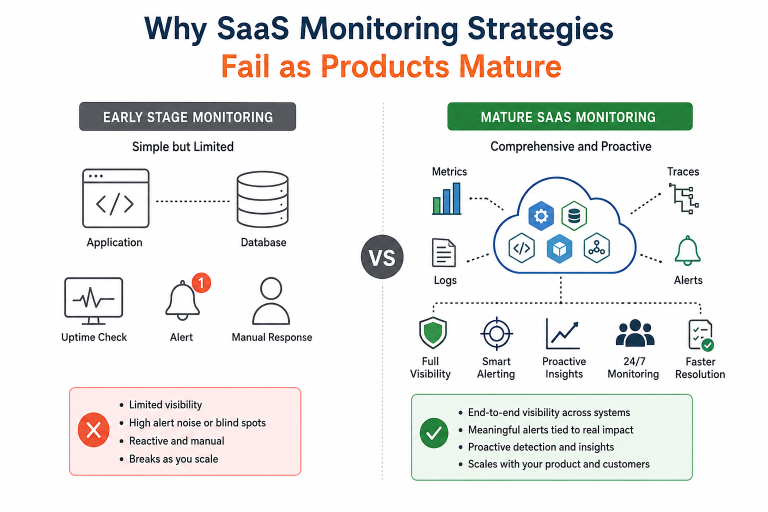
Read article →Every SaaS company starts monitoring the same way. A few uptime checks. A Slack alert when the server goes down. Maybe a dashboard nobody checks until something breaks. In the…
Read article →Tell us where you are and what's slowing you down. A senior engineer will get back to you within one business day.
Our team will get back to you within one business day.
Leave a Reply