
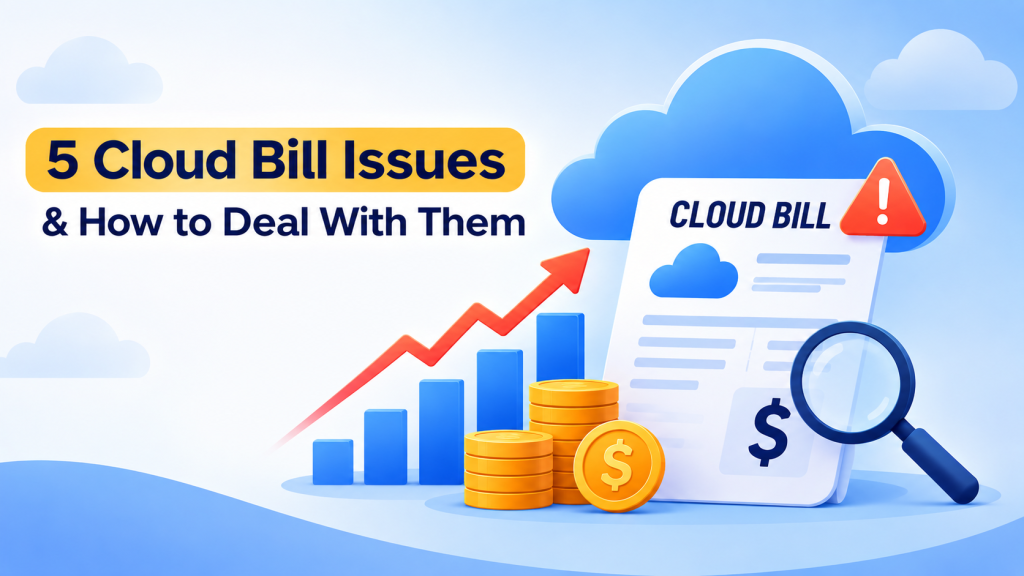
You open the monthly cloud invoice and your stomach drops. The number is higher again, and nobody on your team can tell you exactly why. Sound familiar? You’re not the only one. Finance teams everywhere are staring at cloud bills that grew faster than the business did, and engineering teams are scrambling to explain a jump nobody planned for.
Here’s the thing though. Cloud bills rarely spike for mysterious reasons. Almost every runaway bill traces back to one of a handful of root causes, and every one of them has a fix. That’s what real cloud cost optimization is about. Not just cutting costs once and hoping for the best, but building habits that keep your spend tied to what you’re actually using.
Below are the five cloud billing issues we see most often, and exactly what to do about each one.
1. Idle and Unused Resources Quietly Draining Your Budget
This one is the silent killer. A dev server someone spun up for a two week sprint that’s still running eight months later. A test database left on over a long weekend that never got shut off. A load balancer pointing at nothing because the service behind it was decommissioned months ago. None of these are doing a bit of work for you. All of them are billing you every single hour.
The fix:
- Run a resource audit at least once a month and flag anything with near zero utilization over the last two to four weeks.
- Set automated shutdown schedules for non production environments during nights, weekends, and holidays.
- Tag every resource with an owner and a purpose. Untagged resources are exactly the ones that get forgotten and left running.
This kind of housekeeping is exactly why a disciplined cost management process matters. Someone has to be watching for waste on a regular basis, or it just keeps quietly piling up.
2. Overprovisioned Infrastructure
It’s tempting to size things generously “just in case.” But most teams overestimate what they actually need, and cloud providers are more than happy to let you keep paying for capacity that sits idle. A classic example is a database sized for a traffic spike that never actually shows up, or a server running around the clock at 8 percent CPU.
What actually helps:
- Right size instances based on real historical usage, not a guess.
- Use auto scaling so infrastructure grows and shrinks with actual demand instead of staying locked at a fixed, oversized capacity.
- Revisit reserved instance and savings plan commitments regularly. Overprovisioning locked into a one or three year contract is expensive to walk back.
Right sizing is one of the simplest, highest impact parts of ongoing cloud cost optimization. It’s not a one time cleanup either. Workloads shift over time, so this needs to be revisited, not set and forgotten.
3. Zero Visibility Into Where the Money Is Going
You can’t fix what you can’t see. A lot of companies get a single lump sum cloud bill with no breakdown by team, project, or environment. When five teams share one account and nobody owns the cost, nobody feels responsible for bringing it down either. Honestly, this lack of visibility is usually the root cause sitting underneath most of the other problems on this list.
How to fix it:
- Put a consistent tagging and cost allocation strategy in place across every resource: team, environment, project, cost center.
- Use built in cost explorer tools or a third party dashboard to break spend down by service and owner.
- Set up budget alerts so people find out before costs spiral, not after the invoice lands in their inbox.
Closing this gap is exactly what good cloud strategy and planning services are meant to do: build visibility and accountability into your setup from the beginning instead of bolting it on after the damage is already done. If you’re running a SaaS product, it’s also worth reading this breakdown of common AWS cost optimization mistakes SaaS platforms make, since SaaS billing tends to hide waste in places a generic cloud audit often misses.
4. Unpredictable Spikes From Traffic, Data Transfer, and API Calls
Cloud pricing has zero patience for unpredictability. A sudden marketing push, a post that goes viral, or an API making far more calls than it should can send your data transfer and compute costs through the roof overnight. Egress fees are especially brutal. Moving data out of the cloud, or shuffling it between regions and availability zones, can add line items that dwarf your actual compute costs.
Steps that keep it under control:
- Design for cost aware data flow. Keep frequently accessed data and compute in the same region so you’re not paying to move it around.
- Use CDNs and caching to cut down on repeated pulls from origin servers.
- Set hard budget caps and rate limits on anything prone to runaway usage.
- Build in monitoring that catches unusual spend velocity as it happens, not weeks later when the bill arrives.
Getting the architecture right from day one comes down to solid strategic planning, so scaling events are budgeted for ahead of time instead of showing up as a shock on the invoice.
5. Sprawling, Multi Cloud Complexity Without Governance
As companies grow, it’s common to end up on AWS, Azure, and Google Cloud all at once, sometimes on purpose, sometimes because different teams made their own calls over the years. Each provider has its own pricing model and its own billing quirks. Without centralized governance, cost data gets scattered across three or more dashboards, teams accidentally spin up duplicate services, and negotiating volume discounts becomes nearly impossible because your spend is spread thin instead of consolidated.
How to get ahead of it:
- Build a single source of truth for multi cloud spend using a unified cost management platform.
- Apply the same governance policies across every provider: tagging, access control, budget approvals, all of it.
- Regularly check whether a workload is actually running on the most cost effective provider for its use case, instead of defaulting to whatever cloud it happened to start on.
- Consolidate reserved capacity and enterprise agreements where you can to unlock better discount tiers.
This is exactly where experienced cloud optimization services earn their keep. Instead of asking your internal team to become experts in three different billing systems at once, a specialized partner brings governance frameworks and cross cloud visibility that are genuinely hard to build from scratch in house.
Conclusion
Here’s the honest truth. None of these five issues get solved in a single cleanup sprint. Idle resources creep back in. New teams launch new projects without following tagging rules. Traffic patterns shift. Providers change their pricing. Real cloud cost optimization is a continuous habit, not a checkbox you tick once. It takes ongoing monitoring, regular right sizing, clear ownership, and governance that grows alongside your infrastructure.
The companies that actually get this right treat cost management the same way they treat security: something built into the process from day one, not something they react to after the invoice shows up. Whether that means investing in better internal tooling or bringing in outside help, the result is the same. A cloud bill that reflects what you’re actually using, not what someone forgot to turn off.
If your cloud invoice has been creeping up and nobody can explain why, that’s usually a sign it’s time for a real audit, not another round of guessing next month. The sooner the visibility gap closes, the sooner the bill starts making sense again.