

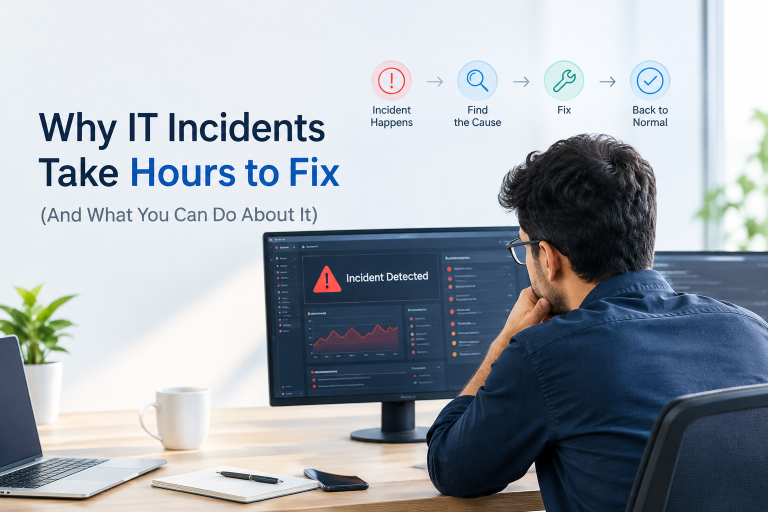
Why IT Incidents Take Hours to Fix
Your system is down right now, or it will be soon. Customers are refreshing a broken page. Someone in sales is asking your team for an update you don’t have.…
Read article →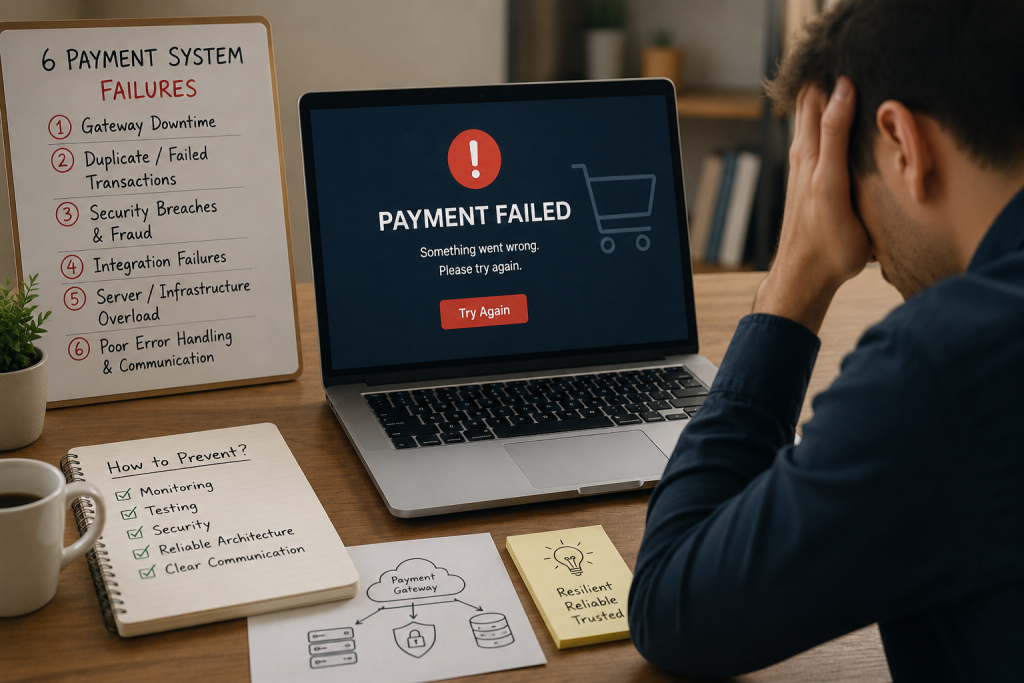
Picture this. A customer adds items to their cart, enters their card details, hits pay, and then… nothing. The page hangs. They refresh. Now they’re not sure if they were charged once, twice, or not at all. They close the tab and buy from a competitor instead.
That moment costs businesses far more than a single lost sale. It costs trust, and trust is the one thing customers don’t give back easily. This is the reality behind most payment system failures. They rarely announce themselves in advance. They show up during a big sale, a product launch, or a regular Tuesday afternoon, and by the time someone notices, the damage is already done.
The frustrating part is that almost none of this is random bad luck. Most payment system failures trace back to the same handful of root causes, and every one of them can be fixed before it turns into a crisis. Below are the six failures we see most often, along with what actually works to prevent them.
This is the one that hurts the most because it usually happens at the worst possible time. Flash sale goes live, traffic spikes, and the payment gateway simply can’t keep up. Checkout pages freeze, transactions time out, and customers who were ready to buy walk away instead.
It’s rarely the gateway provider’s fault entirely. More often it’s a mismatch between expected load and the infrastructure sitting behind it.
What actually helps:
Few things make a customer distrust a business faster than seeing two charges for one purchase. Or worse, seeing no confirmation at all and wondering whether the money left their account. This usually comes down to weak idempotency handling, network retries that fire twice, or a database that isn’t syncing properly with the payment gateway.
What actually helps:
Payment systems are an obvious target, and attackers know it. A single breach can expose card data, trigger fines, and take years to recover from in terms of reputation, even if the technical fix only takes a day. The usual weak points are outdated encryption, lapsed PCI DSS compliance, and access controls that are looser than anyone realized.
What actually helps:
Modern checkout flows aren’t just one system. There’s the payment gateway, the inventory tool, the CRM, the invoicing software, and the shipping API, all supposed to talk to each other smoothly. When one integration breaks, say an API update that quietly isn’t backward compatible, orders get stuck in limbo. Payment collected, order never confirmed, customer left wondering what happened.
What actually helps:
Sometimes the problem has nothing to do with the payment logic itself. It’s the servers underneath it. Undersized hardware, a poorly configured load balancer, or a single point of failure in the hosting setup can bring the entire payment flow down right when it matters most.
What actually helps:
This kind of resilience is really what people mean when they talk about payment platform stability. It’s not one feature or one server, it’s every layer working together so shocks get absorbed instead of passed downstream to the customer. We go deeper into this in our other article, which covers the architectural choices that keep transaction systems running smoothly under pressure.
Sometimes a payment fails for a completely legitimate reason. Expired card, insufficient funds, a bank decline. The problem isn’t the failure itself, it’s how badly some systems handle telling the customer about it. A vague “something went wrong” message leaves people confused and often assuming the business itself is unreliable, even when it was just a bank issue on their end.
What actually helps:
Preventing payment system failures isn’t a one time fix. It’s not a single patch or a server upgrade you do once and forget. It’s a habit of proactive monitoring, resilient architecture, and continuous testing built into how your payment systems run every single day. The businesses that treat payment reliability as an ongoing priority are the ones that keep growing without losing customer trust along the way.
If your team doesn’t have the bandwidth to manage all of this in house, working with an experienced technology partner can take a lot of that weight off your shoulders. From round the clock monitoring to better database design and stronger deployment practices, the right partner keeps your payment infrastructure fast, secure, and available no matter how much traffic comes through the door.
Payment failures are expensive, frustrating, and almost always avoidable. Get the monitoring, testing, and architecture right, and most of these six failure points never reach your customers at all.
If you want a closer look at what keeps transaction systems standing strong under real world pressure, read the full guide here.
Your system is down right now, or it will be soon. Customers are refreshing a broken page. Someone in sales is asking your team for an update you don’t have.…
Read article →A deployment goes out on a Thursday afternoon. Nobody expects trouble. Twenty minutes later, checkout fails for half your customers, and three engineers are staring at logs trying to figure…
Read article →Support just flagged another wave of complaints about a sluggish checkout. Your team pulls up the dashboard. CPU sits under 50%. Memory looks fine. Uptime reads 99.99%. Every light is…
Read article →Tell us where you are and what's slowing you down. A senior engineer will get back to you within one business day.
Our team will get back to you within one business day.


Leave a Reply