
The Gap Between “It Works in Staging” and Production Reality
There’s a phrase every developer has either said or heard at some point: “But it worked in my local environment.” It’s almost a rite of passage. However, when you’re managing CI/CD pipelines on a larger scale , that phrase stops being a punchline and starts being a very expensive problem.
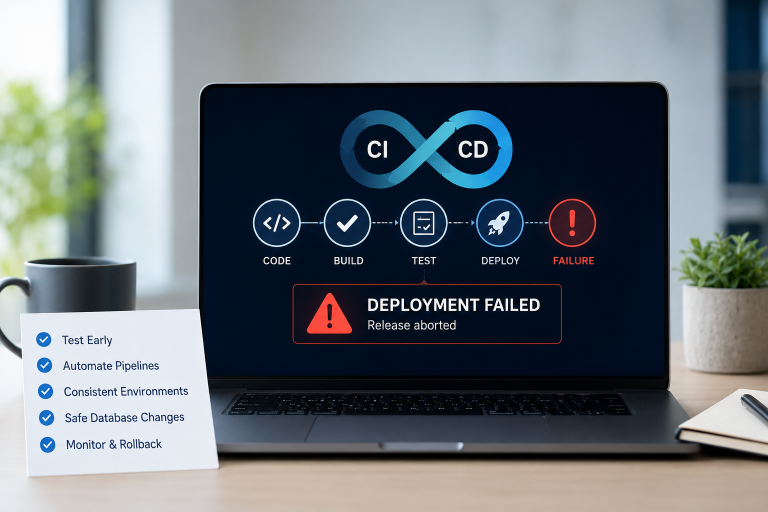
CI/CD pipeline failures are one of the most frustrating and surprisingly common challenges engineering teams face today. You’ve built the pipeline, set up the automation, connected everything together, and yet somehow, the very thing meant to make deployments safer ends up being the source of a 2 AM incident. Sound familiar?
In this post, we’re going to dig into the real reasons why CI/CD pipelines break down in production, not just the surface-level “configuration errors” you’ll find in most articles, but the deeper systemic and process-driven causes that teams often overlook until it’s too late.
1. Environment Mismatch: The Invisible Killer
One of the most overlooked reasons for CI/CD pipeline failures is the gap between testing environments and the actual production setup. Staging environments often rely on mocked services, simplified databases, or even outdated versions of infrastructure. Everything might look good during testing—the pipeline passes all checks, tests show green lights, and the deployment goes ahead—only to run into issues once it hits production.
This scenario happens more often than it should. Teams pour a lot of resources into building the pipeline but often neglect to keep the environments aligned. Infrastructure-as-Code (IaC) can help with this, but only if it’s regularly updated across all environments. A Terraform configuration that’s three months behind production is actually more detrimental than having no configuration at all, as it creates a false sense of security.
The solution isn’t just about technology; it’s about fostering a culture that prioritizes environment parity as a key engineering focus, rather than treating it as an afterthought.
2. Flaky Tests That Nobody Wants to Fix
Flaky tests are like the sneaky troublemakers in any CI/CD pipeline. These tests can pass one moment and fail the next, all without any changes to the code. Over time, they chip away at the trust you have in your pipeline. Engineers start to overlook those red builds, and suddenly, retries become the go-to solution. Before you know it, your pipeline turns into a mere rubber stamp instead of a genuine quality checkpoint. . Research published in Frontiers in Artificial Intelligence (2026) puts the test flakiness failure rate somewhere between 11% and 27% – a range wide enough to tell you this isn’t a fringe problem, it’s an industry-wide one.
The dangerous part? Teams often know which tests are flaky and still don’t fix them because “There are more pressing matters to tackle. ” But every flaky test you tolerate is a direct tax on your deployment reliability.
Tackling flaky tests takes commitment and a clear sense of priority. Identify them, isolate them, and make sure someone is responsible for them. Remember, a CI/CD pipeline is only as reliable as the tests it runs.
3. Hardcoded Secrets and Configuration Drift
This one is both a reliability and security issue. When secrets — API keys, database credentials, environment variables — are hardcoded or managed inconsistently across environments, pipelines break in ways that are hard to diagnose and even harder to recover from quickly.
Configuration drift is the related problem: over time, production environments get manually tweaked, patches applied directly, services restarted with different flags, and suddenly the environment is no longer what your pipeline expects. Your deployment assumes a certain state, encounters something different, and fails.
Centralizing configuration management through a secrets vault and enforcing immutable infrastructure practices goes a long way here. If a pipeline can’t be re-run reliably from scratch, that’s a sign of drift.
4. Insufficient Rollback and Recovery Planning
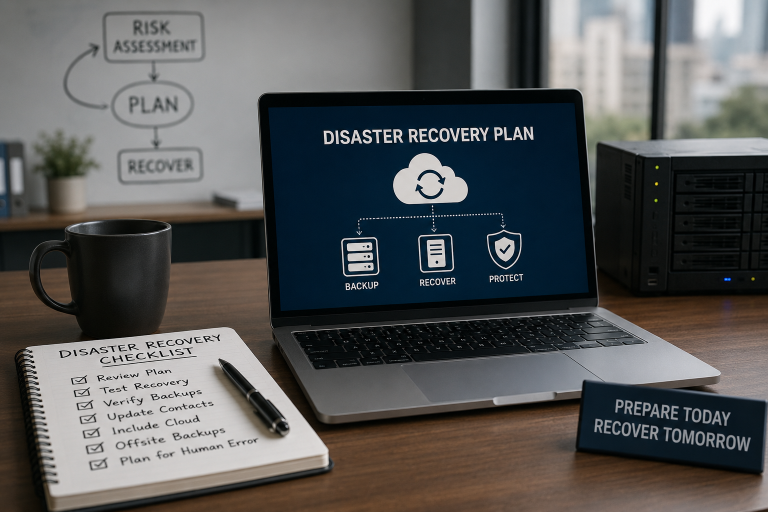
Here’s a question worth asking your team: if a deployment breaks production right now, how long would it take to roll back? If the answer is “we’d have to figure it out,” that’s the real failure — not the broken build.
A well-designed CI/CD pipeline doesn’t just deploy forward, it’s built with recovery in mind. Automated rollback triggers, versioned artifacts, blue-green deployments, and canary releases all serve the same purpose: making it safe to ship fast without betting the farm on every release.
Many teams skip this planning because it feels like extra work upfront. It is. But it’s nothing compared to the cost of a three-hour production outage while someone manually reverses a half-applied database migration. Teams that adopt a CI/CD pipeline as a service model often get these rollback capabilities baked in from day one, rather than bolting them on after a painful incident.
5. Inadequate Observability Post-Deployment
Deploying successfully and deploying well are not the same thing. Many pipelines see a successful deployment as the end of the road, but in truth, it’s just the start of the feedback loop. Without solid monitoring, logging, and alerting built into your deployment process, you’re essentially flying blind. You might not realize that a new release has triggered a memory leak until users start voicing their frustrations. And you won’t notice a slowdown in API response times until it escalates into a full-blown outage.
Post-deployment health checks should be woven into the pipeline itself, rather than being a manual task that someone might forget to do after the deployment is complete. It’s crucial to integrate smoke tests, synthetic monitoring, and performance baselines right into your release workflow.
6. Organizational and Process Gaps (Not Just Technical Ones)
It’s tempting to frame CI/CD pipeline failures as purely technical problems. In practice, a huge percentage of failures trace back to process and ownership gaps.
Who owns the pipeline when something breaks? Is there a clear runbook? Are developers empowered to pause a deployment if something feels off, or is there pressure to push through because a release was “scheduled”?
Working with a reliable DevOps as a service provider can help organizations that don’t have the internal bandwidth to maintain mature pipeline practices. It brings in experienced hands who’ve seen these failure patterns before and know how to build guardrails before things go wrong, not after.
7. Dependency Management Gone Wrong
Modern applications are deeply dependent on third-party libraries, services, and APIs. When those dependencies change unexpectedly — a package update breaks an API contract, an external service changes its rate limits, a cloud provider modifies behavior — your pipeline might not catch it.
While pinning dependency versions is a best practice, it’s not always adhered to. Even when it is, transitive dependencies (the dependencies of your dependencies) can still shift without war
Conducting regular dependency audits, implementing automated vulnerability scanning in your pipeline, and managing upgrade cycles may not be the most exciting tasks, but they play a crucial role in preventing a type of production failure that can be incredibly difficult to troubleshoot under pressure.
8. Pipeline Complexity That Outpaces Documentation
As teams expand and systems change, CI/CD pipelines can become quite complex. New jobs are added to meet fresh requirements, conditional logic builds up, and before you know it, the original design intent is lost beneath layers of patches and workarounds.
This complexity can turn into a real headache when something goes wrong. If only one or two people on the team truly grasp how the pipeline operates from start to finish, you end up with a knowledge bottleneck that can drag out every incident into a lengthy investigation.
Treat your pipeline configuration like you would production code. Regularly review it, document it, refactor it when necessary, and ensure that more than one person has a solid understanding of it.
Conclusion
The promise of CI/CD is faster, safer deployments. But that promise only holds when teams address the full stack of reasons pipelines fail — not just the obvious configuration errors, but the environment gaps, the trust erosion from flaky tests, the missing rollback plans, and the organizational patterns that let problems persist. The 2024 DORA State of DevOps Report found that roughly 25% of teams still fall into the low-performance category, with change failure rates as high as 40% and recovery times stretching between a week and a month. That’s not a tooling problem — that’s a process and culture problem.
CI/CD pipeline failures are rarely just technical problems. They’re usually a signal that something in the overall development and deployment process needs more intentional design. The teams that build the most reliable pipelines tend to be the ones treating the pipeline itself as a product — something that needs maintenance, ownership, and continuous improvement.
If you’re building or scaling a deployment workflow, take a hard look not just at whether your pipeline runs, but whether it runs in a way you’d trust at 3 AM with a critical release on the line. That’s the real test.z