

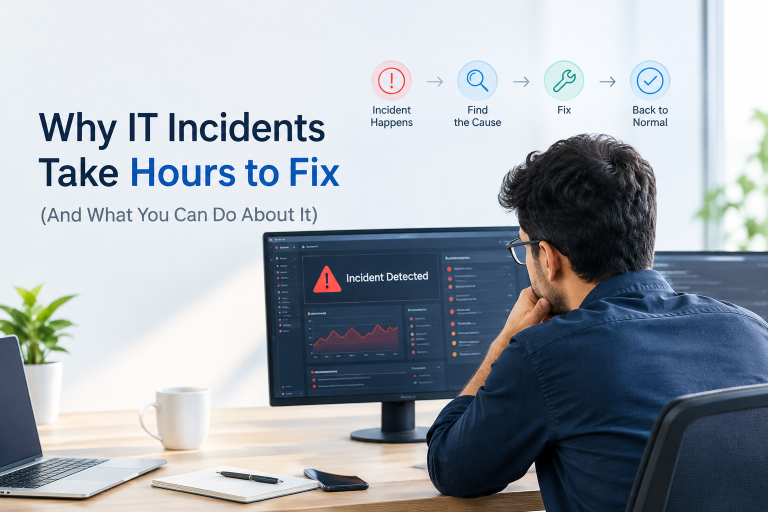
Why IT Incidents Take Hours to Fix
Your system is down right now, or it will be soon. Customers are refreshing a broken page. Someone in sales is asking your team for an update you don’t have.…
Read article →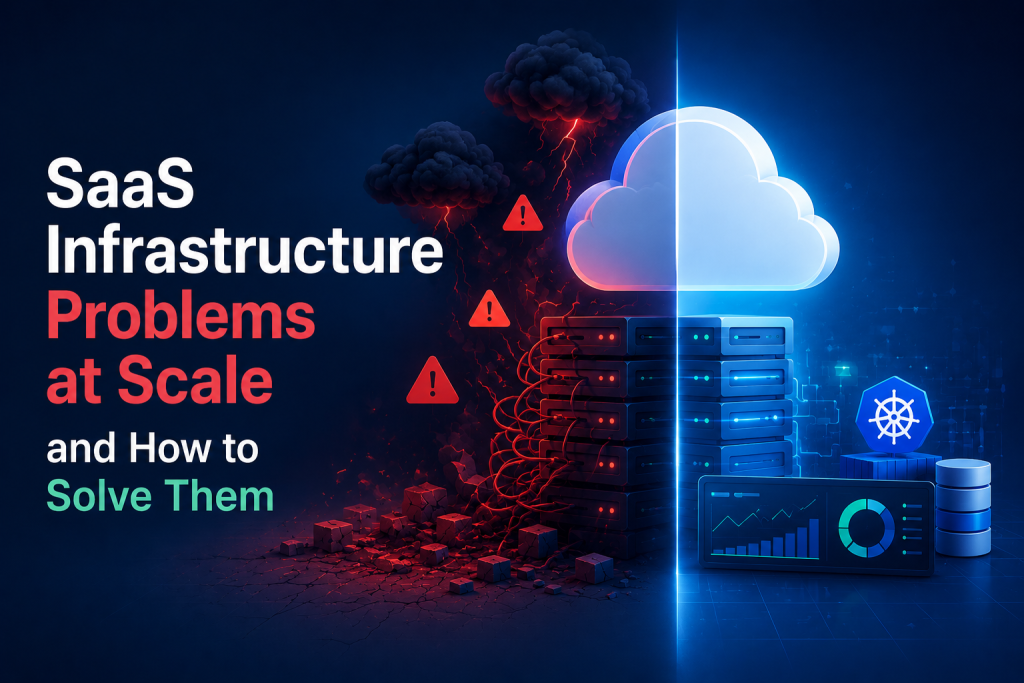
Nobody builds a SaaS product thinking about DNS timeouts, Kubernetes autoscaling, or inter-service latency. You’re thinking about the product. The users. The problem you’re solving. Infrastructure is just the thing running quietly in the background, doing its job.
And then growth happens. Real growth. The kind where your Slack is full of customer complaints, your engineers are getting paged at 2am, and your cloud bill just hit a number that made your CFO ask for a meeting. SaaS infrastructure problems at scale don’t arrive with a warning. They show up after the fact when customers are already affected and engineers are already exhausted.
This isn’t a rare story. A 2014 Gartner study put the average cost of unplanned downtime at $5,600 per minute. More recent research from the Ponemon Institute puts it closer to $9,000. Here’s what’s interesting about most SaaS infrastructure failures though: they’re not sudden. They don’t announce themselves. They creep in slowly, through a hundred small decisions made under pressure, until one day something breaks in front of a customer and you realize you’ve been sitting on a problem for months.
This post is about those problems, the ones that show up reliably as SaaS companies scale and what teams can actually do about them. Some of it you can handle internally. Some of it is where managed cloud services or IT infrastructure consulting services genuinely earn their keep. Either way, knowing what’s coming is half the battle.
There’s a version of your infrastructure that made perfect sense six months ago. A few services, a clean deployment pipeline, a database that handled everything. It was elegant, honestly. You could hold the whole system in your head.
Then you scaled. And what was once a tidy architecture is now a tangle of microservices, third-party integrations, and workarounds that were supposed to be temporary but somehow became permanent. This is where most SaaS infrastructure problems at scale quietly begin not in one big failure, but in dozens of small compromises that compound over time.
The volume isn’t even the hardest part. It’s that every new service you add creates new ways for things to fail. A change in your payment processing service starts affecting your notification system. A slow analytics query kills your API response times. A deployment in one team’s codebase takes down something three other teams depend on.
“Our application did not break suddenly. It slowly became harder to trust.” – SaaS founder, Series B
What actually happens when teams scale reactively rather than intentionally: deployment pipelines that once took 5 minutes balloon to 40. On-call engineers spend more time firefighting than shipping. Services that were loosely connected become dangerously interdependent. And a change that should have been simple takes three engineers and a full afternoon.
The fix isn’t glamorous. It starts with stopping and actually mapping what you have, which services exist, what depends on what, where the single points of failure are. Tools like Backstage or a basic service catalog help. So do quarterly architecture reviews, not the kind that happen after an outage, but the kind that happens before things get bad enough to force one.
Setting SLOs (Service Level Objectives) per service rather than just for the overall platform is also underrated. It forces honest conversations about what’s actually healthy versus what just looks healthy on a dashboard.
This one is particularly maddening. You’re looking at your monitoring setup – CPU at 45%, memory stable, no servers down and your support inbox is filling up with users who can’t log in.
This happens more than most teams expect, and the reason comes down to how traditional infrastructure monitoring was built for a simpler world. Checking whether servers are alive was enough back then. Whether the conversation between your authentication service and your user database is taking 8 seconds instead of 80 milliseconds? That was never part of the picture.
Modern SaaS systems fail between services, not inside them. A timeout in one internal API call can cascade silently across your entire platform – affecting auth, billing, notifications without triggering a single alert on your dashboard.
A SaaS platform was seeing repeated login failures during peak hours. Not constant – just intermittent enough to be confusing and frequent enough to make customers angry. The engineering team pulled up every dashboard they had. CPU fine. Memory fine. No servers down.
Two hours later, after digging into distributed traces, they found it: DNS timeout spikes inside their Kubernetes cluster were causing authentication service discovery to fail. The service was up. The database was up. But the handshake between them kept timing out under load, and nothing in their traditional monitoring was looking at that layer.
After fixing the service discovery configuration and adding proper observability across their microservices, the login failures stopped. But the real lesson wasn’t the fix, it was realizing they’d been flying blind on an entire category of failure.
The difference between monitoring and observability matters here. Monitoring tells you something broke. Observability tells you why, and where, and what it was doing right before it broke. For distributed systems, you need both – distributed tracing (OpenTelemetry with Jaeger or Honeycomb works well), structured logging with correlation IDs so you can follow a single request across ten services, and alerting on latency percentiles like p95 and p99 rather than just averages, which hide the outliers your worst-affected users are actually experiencing.
Cloud infrastructure has this interesting property where it’s incredibly easy to spend money without noticing. A cluster spins up for a load test and never gets torn down. Peak traffic gets provisioned for, but when things quiet down, nobody scales back. Then comes the logging tool storing 90 days of debug-level data in high-cost storage because setting a retention policy was never anybody’s priority.
Add it all up across a growing engineering team and it compounds fast. Cloud cost sprawl is one of the most financially painful SaaS infrastructure problems at scale and one of the least visible until it’s already out of hand. The Flexera 2026 State of the Cloud Report found that cloud waste actually increased this year – back up to 29% of total spend -largely driven by the cost complexity of AI workloads. That’s not a small rounding error. For a team spending $100,000 a month on cloud infrastructure, that’s $29,000 disappearing into idle compute, forgotten environments, and overprovisioned clusters.
The most common culprits tend to be: compute resources running 24/7 that only need to run during business hours, Kubernetes clusters sitting at 20% utilization because someone provisioned for the worst-case scenario and never revisited it, duplicate staging environments that mirror production at full cost, and database queries that were never optimized because they worked fine when the dataset was small.
None of this is complicated to fix once you can see it. The challenge is that most teams don’t have visibility into where the money is going at a granular level. Tagging every resource by team, environment, and product from day one sounds tedious but it’s what makes cost attribution possible later. Cost anomaly alerts in AWS Cost Explorer or GCP Billing catch the obvious stuff. Right-sizing compute quarterly based on actual utilization data not estimates – catches the rest.
A lot of scaling SaaS companies turn to managed cloud services at this point, not because they can’t manage costs themselves, but because cloud cost governance is a full-time job that nobody on the product engineering team was hired to do. Having someone whose entire focus is making sure your infrastructure spend matches your actual needs is genuinely valuable when you’re growing fast.
At the start, everyone does everything. The engineers who built the product also deploy it, monitor it, and fix it when it breaks. That’s fine. it’s actually healthy at an early stage. The team is small, the system is simple, and the context switching is manageable.
But there’s a point in every growing SaaS company where this stops working. It usually happens quietly. Incidents start taking longer to resolve because the engineer on call is also the engineer trying to ship a feature. Deployment failures start blocking releases. The runbook, if one exists – is out of date. And the people who actually understand the system are spending half their week on operational work they didn’t sign up for.
“We thought scaling meant adding more users. In reality, scaling meant adding more operational responsibility every single month.” – SaaS founder
Feature velocity slows. Technical debt accumulates because nobody has time to address it properly. Engineers who joined to build things start burning out from the operational overhead. And paradoxically, the more the company grows, the worse it gets.
The answer isn’t necessarily hiring a dedicated ops team right away, though that eventually makes sense. It starts with building operational discipline into how the engineering team already works. Runbooks for every critical failure scenario, written before the incident, not during it. On-call rotations with real escalation paths and postmortem processes that actually lead to improvements. Infrastructure as Code – Terraform or Pulumi -so that every infrastructure change is reviewable, reversible, and not locked inside someone’s head.
This is also the stage where IT infrastructure consulting services tend to deliver the most value. Not because the internal team isn’t capable, but because there’s a meaningful difference between knowing how to build infrastructure and knowing how to run it reliably at scale. Bringing in that expertise before the operational burden becomes a crisis when there’s still time to build proper systems rather than patch broken ones – almost always costs less than fixing things after they break.
Multi-region sounds straightforward when you’re planning it. Run your application in multiple data centers, route users to the closest one, handle failover automatically. Clean.
The reality tends to be messier. Authentication sessions that work perfectly in a single region start failing when a user’s request lands in a different one. Database replication lag – even a few hundred milliseconds, causes real problems when customers are making decisions based on data that hasn’t fully propagated yet. CDN cache invalidation behaves differently across edge nodes in ways that are hard to predict and harder to debug.
And then there’s compliance. GDPR data residency requirements, SOC 2 controls, industry-specific regulations -these constrain where your data can live in ways that interact badly with a multi-region architecture that wasn’t designed with them in mind.
The architectural decisions you make during rapid growth are the ones you’ll be living with for years. Active-active multi-region is powerful but genuinely complex – active-passive is often sufficient and much simpler to operate. Designing database access patterns for eventual consistency from the beginning saves enormous pain later. Testing failover scenarios quarterly with chaos engineering tools like Gremlin or AWS Fault Injection Simulator, before you need them to work, is the kind of discipline that separates teams that handle incidents gracefully from teams that scramble.
Security rarely breaks SaaS companies all at once. It erodes gradually, through the accumulation of small decisions made under time pressure.
An IAM role gets overly broad permissions during a late-night incident and nobody revokes them afterward. An S3 bucket gets misconfigured to allow public access during a rushed deployment. A third-party library with a known vulnerability sits in production for four months because the security scanner was turned off to speed up CI builds. Nobody ever set up audit logging for who accessed customer data because it wasn’t a priority when the company was small.
None of these feel dangerous individually. Together, they create an attack surface that grows with every new integration, every new API, every new engineer who needs cloud access.
The practical fixes are mostly unglamorous: automated security scanning in CI (Snyk and Semgrep both integrate in under an hour), the principle of least privilege enforced and audited quarterly rather than just stated in a policy document, secrets management through Vault or AWS Secrets Manager instead of environment variables, and audit logging enabled everywhere. Annual penetration testing matters too , partly because SOC 2 requires it, and partly because enterprise customers increasingly ask for it before signing.
The goal isn’t to slow down development. It’s to make security a normal part of how the engineering team works rather than a separate concern that gets addressed in a panic after something goes wrong.
There’s a pattern that shows up in almost every growing SaaS codebase: everything goes through the primary application database. Transactional queries, analytics reports, background job queues, logging pipelines – all of it hitting the same database, competing for the same resources.
Early on, this is fine. The database can handle it. But as traffic grows, things start interfering with each other in ways that are frustrating to debug. A complex analytics query written by someone in the data team starts affecting API response times for customers. A background job that kicks off at midnight starts causing timeout errors that wake someone up at 2am.
The fixes are relatively modest. Read replicas for analytics and reporting queries eliminate read/write contention without requiring application changes. Separating async job queues from synchronous API paths removes one of the most common sources of latency spikes. Redis caching for high-frequency, low-volatility data can cut database load by 40–70% in common access patterns. These aren’t dramatic architectural rewrites, they’re targeted interventions that often have an immediate, noticeable impact on stability.
Teams that implement these early usually experience a much smoother growth trajectory than teams that wait until a database starts failing and engineers start scrambling.
Most SaaS founders start out thinking about infrastructure as a backend concern – something the engineering team handles so the product team can focus on features. That framing works fine until it doesn’t.
After a certain point, infrastructure becomes customer experience. Your customers have no idea what Kubernetes is or how your CI/CD pipeline works. But they absolutely know when the dashboard is slow, when they can’t log in, when their integration stops syncing, when a notification they were waiting for never arrives.
Infrastructure reliability is one of the quietest, most consistent drivers of retention in SaaS and infrastructure instability is one of the quietest, most consistent drivers of churn. Customers rarely complain loudly about reliability. They just quietly start evaluating alternatives.
Every problem covered in this post – architecture complexity, monitoring blind spots, runaway cloud costs, operational burnout, multi-region failures, security drift, database bottlenecks -is a recognizable SaaS infrastructure problem at scale. They follow a pattern. They show up in roughly the same order, at roughly the same growth stages, at company after company.
That predictability is actually useful. It means you don’t have to wait until something breaks to know what’s coming. The SaaS teams that scale most smoothly aren’t the ones with the biggest infrastructure budgets or the most senior engineers. They’re the ones that take these problems seriously before they become urgent – running architecture reviews before the system becomes hard to trust, investing in observability before customers start complaining, building operational discipline before engineers burn out.
Whether you tackle this through internal engineering effort, managed cloud services, or IT infrastructure consulting services depends on your team, your stage, and your budget. The approach matters less than the timing. Infrastructure problems that are addressed early are engineering challenges. Infrastructure problems that are addressed late are customer experience crises.
Start before the cracks appear. Your future engineering team and your customers will thank you.
Is your SaaS infrastructure ready for your next growth phase? Go through the seven problem areas above and honestly assess how many apply to your current setup. If it’s three or more, the friction is probably already there – you just haven’t felt it yet. The best time to fix it is now, not after your next big launch.
Your system is down right now, or it will be soon. Customers are refreshing a broken page. Someone in sales is asking your team for an update you don’t have.…
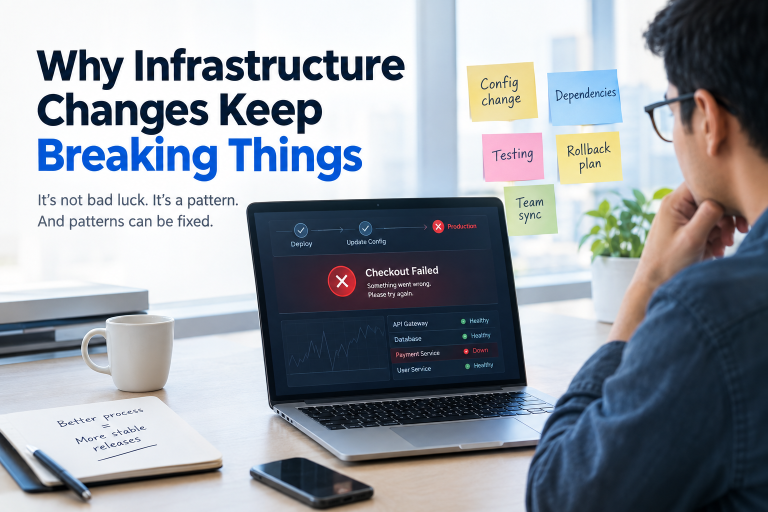
Read article →A deployment goes out on a Thursday afternoon. Nobody expects trouble. Twenty minutes later, checkout fails for half your customers, and three engineers are staring at logs trying to figure…
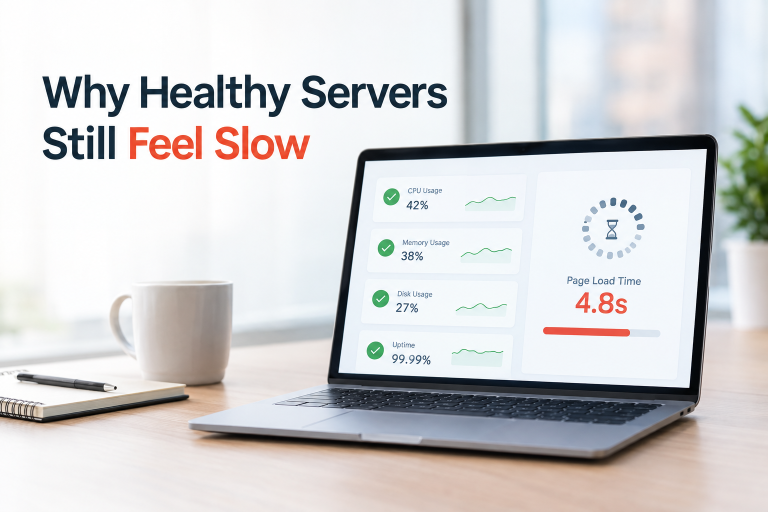
Read article →Support just flagged another wave of complaints about a sluggish checkout. Your team pulls up the dashboard. CPU sits under 50%. Memory looks fine. Uptime reads 99.99%. Every light is…
Read article →Tell us where you are and what's slowing you down. A senior engineer will get back to you within one business day.
Our team will get back to you within one business day.
Leave a Reply