

7 Signs of Cloud Complexity & How to Simplify Them
You dread deployment day. You flinch when the cloud invoice lands in your inbox. You’ve stopped trying to explain the architecture to new hires because you’re not fully sure how…
Read article →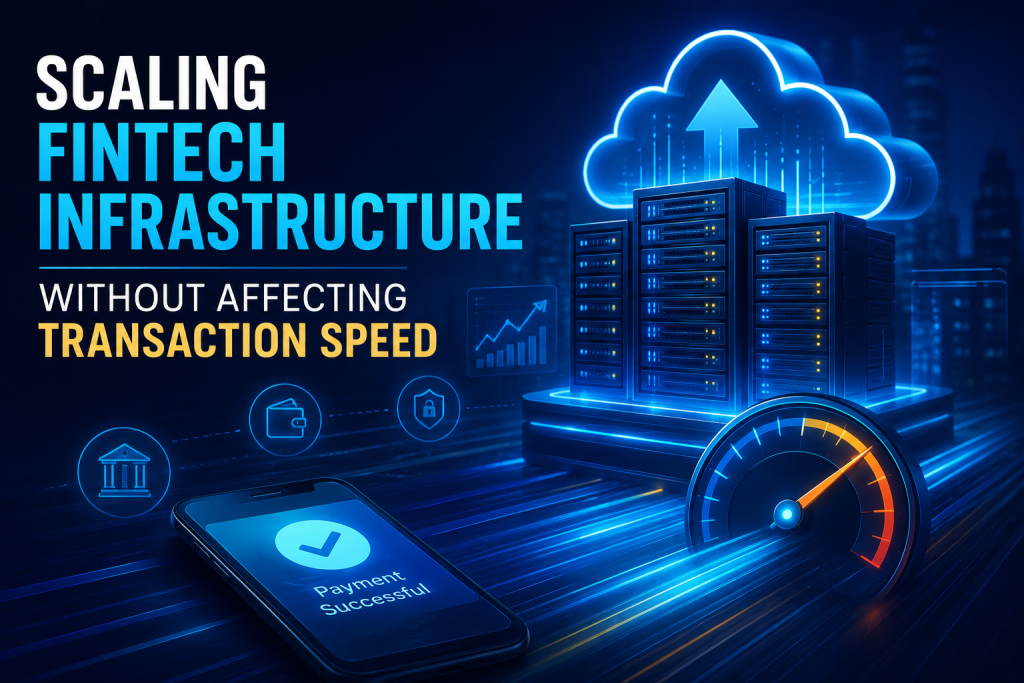
In fintech, speed is essential. It builds trust. A payment that takes five seconds instead of one can frustrate users. A delay during a stock trade can change financial decisions. If a banking app freezes during salary credit hours, it can lead to thousands of support tickets in minutes. As fintech platforms expand, keeping transaction speed while growing infrastructure is one of the toughest engineering challenges. Many startups start with infrastructure that works for a few thousand users. The real challenge arises when transaction volume suddenly increases due to rapid growth, festive traffic spikes, digital payment adoption, or global expansion.
What once seemed stable now shows signs of trouble: database bottlenecks, API delays, queue congestion, rising cloud costs, and unpredictable downtime, all of which contribute to serious fintech transaction speed issues. At this point, having a solid infrastructure strategy is more important than developing new features. At this point, having a solid infrastructure strategy is more important than developing new features.
The companies that do well are not always the ones with a huge team of developers. They are the companies that build systems that can handle a lot of stress and still perform well. These companies know how to make systems that work properly when things get tough. The key is that these companies build systems that are designed to perform under pressure and that is what helps the companies scale successfully.
In industries a slow application is just a hassle. In the fintech world it is a risk.
People who use these applications want to know when their payments are confirmed, they want to see their balance in real time and they want to be able to make transactions without any interruptions.
A few milliseconds can make a big difference in things like algorithmic trading, payment gateways, fraud detection and digital lending.
If an application is slow it can cause a lot of problems for a business, such as:
The big technical problem is that fintech systems do not just rely on one thing. When you make a payment it involves a lot of things like:
1. Checking who the user is
2. Looking for fraud
3. Talking to banks through computer programs
4. Checking how much money is in the users wallet
5. Updating the records
6. Sending out notifications
7. Keeping a record of everything that happens
8. Making sure everything is okay, with the rules
When more and more people use the system every part of it can become a problem. Slow everything down. The fintech system can get bogged down. This can cause issues. Fintech systems and fintech applications can be very slow.
One of the biggest mistakes fintech companies make is growing their infrastructure as a response to problems of planning it properly from the start.
When performance problems show up lots of teams just make their servers bigger. Add more computers. This might help for a while but it doesn’t fix the real issue.
Fintech companies end up with platforms that cost much, are hard to manage and don’t work well.
The infrastructure of fintech companies becomes unstable.
A growing fintech platform requires more than large servers. It needs an infrastructure design that is supported by good IT consulting services. These services can find problems that slow down transactions before they even happen.
This includes things like:
If a fintech platform does not have these things it can be bad for the platform when it grows. The fintech platform needs these elements to grow. Growth can actually be a problem for a fintech platform if it does not have the infrastructure design and IT consulting services to support it.
A fintech platform that is growing needs more than big servers. It needs a way to design its infrastructure and good IT consulting services to find problems before they slow down transactions.
This includes:
A lending platform that was growing fast had a big problem with performance during a loan campaign. The platform used to get around 8,000 loan requests every day.. During the campaign it got more than 120,000 requests in just a few hours.
The frontend of the platform appeared stable, but transaction completion time increased significantly. Processing time that previously averaged 1.8 seconds began reaching nearly 14 seconds.
Users got. Started sending their requests again and again because they were not getting confirmations on time. This made the backend services even busier with requests.
The problem was not just that the servers were not powerful enough.When the team looked into it they found weaknesses in the way the platform was designed:
Instead of just adding more servers the infrastructure team changed the way transactions were processed.
The infrastructure team separated critical payment workflows from lower-priority operations and introduced asynchronous processing. Fraud detection was optimized using risk-based scoring before deeper verification checks. Additional database instances were deployed to distribute load more efficiently. Auto-scaling policies were also improved by monitoring transaction queue depth instead of relying only on CPU utilization. These changes helped the platform manage rising transaction volumes more effectively.
This is where cloud optimization services really make a difference, for fintech companies. They need to balance how well their infrastructure works, how fast transactions happen and how much they spend on Cloud services. They have to do all this without making their systems less reliable when a lot of people are using them at the time.
Cloud optimization services help fintech companies do this. For example the time it takes to process a transaction got a lot faster. It took more than two seconds even when a lot of people were using the system. At the time the cost of running the infrastructure did not get out of control.
The main thing we learned from this is that fintech companies need to be careful and precise when they are making their infrastructure bigger. They should not just add resources without thinking about it. Cloud optimization services are very important for fintech companies to get this right.
Fintech platforms are using a way to build their systems. They are breaking down applications into smaller parts. These parts are like:
This makes it easier for teams to make some parts stronger when they need to. For example when a lot of people are making payments at the time the payment part can get more power to handle it. The other parts like reporting do not need to change.
This way of building systems is good because it makes the system:
Just using these small parts is not enough. If the parts do not talk to each other well it can slow down the system. When the parts talk to each other much or use the network too much it can make the system slow.
That is why modern fintech systems use technologies that enable services to communicate efficiently with each other. This includes optimized communication protocols, intelligent service discovery, and event-driven architectures that help manage transaction flows more effectively. These capabilities improve scalability, maintain reliability, and support consistent transaction performance even during periods of high user activity.
In fintech systems, databases often become the first major bottleneck during scale.
As transaction volume increases, write-heavy operations can overwhelm traditional relational databases.
Common symptoms include:
The solution is rarely about abandoning relational databases completely. Instead, high-performance fintech systems optimize database strategy intelligently.
This may include:
For example, a payment application may use relational databases for transactional consistency while using Redis-based caching for real-time balance visibility.
The goal is reducing unnecessary database pressure without compromising financial accuracy.
Many fintech companies realize the importance of observability only after major outages.
Infrastructure monitoring is no longer just about checking whether servers are online. Modern fintech systems require deep operational visibility across every transaction layer, which is why many fast-scaling platforms invest heavily in cloud monitoring and management services to maintain uptime, detect latency spikes early, and respond to incidents faster.
This includes:
Without observability, engineering teams spend hours identifying issues during incidents. With proper visibility, teams can isolate bottlenecks within minutes.
One payment platform reduced incident resolution time by nearly 70% after implementing centralized observability pipelines with intelligent alerting.
The platform previously relied on disconnected logs and manual debugging. After modernization, engineers could trace an individual transaction across every microservice instantly.
In fintech, faster debugging directly protects revenue.
Many organizations misunderstand auto-scaling.
True infrastructure scaling is not simply launching more instances during traffic spikes. Poorly configured auto-scaling can actually worsen performance by introducing resource instability.
Effective scaling strategies consider:
For fintech systems, predictive scaling is often more effective than reactive scaling.
For example, payment applications may anticipate traffic increases during:
Scaling resources proactively prevents performance degradation before it affects users.
The fintech infrastructure has a job to do.It needs to be secure. It cannot be too slow.
Fintech infrastructure has to find a balance between security controls and speed.If the security controls are too strong they can create a lot of delay.
This can happen when the authentication process is too complicated or when the encryption takes long or when the system is checking for fraud too much.If these things are not done properly they can make the transactions take a long time.
Modern fintech systems have found a way to solve this problem.They use a system with layers of security.This means that the system does not check every transaction in the way.
The fintech infrastructure uses risk engines to figure out which transactions are suspicious.
These risk engines look at the transactions. Decide which ones need to be checked more carefully.
For example:
This way the fintech infrastructure can keep people safe and also make sure that the transactions go through quickly.
The fintech infrastructure can do both things: protect people and perform well.
Technology by itself does not fix the problems that come with growing.
Fintech systems often break down because people work separately.
Development teams often prioritize faster feature delivery, while operations teams concentrate on maintaining platform stability. Security specialists typically focus on compliance requirements, whereas database engineers work toward improving data performance. When these functions operate in isolation, infrastructure efficiency and scalability can suffer due to limited cross-functional alignment.
The fintech companies that do a job of handling growth do it by working together as a team.
When it comes to making decisions about the system everyone works together including:
When everyone is, on the page it makes the system better, helps fix problems faster and makes the whole system more reliable.
At the heart of fintech infrastructure is customer trust.
Users usually do not notice when a system is working perfectly.. They do notice when there are delays, failures or inconsistencies.
The best fintech companies build infrastructure that users do not think about much because transactions feel smooth.
Getting to that level of reliability needs planning, building for performance and always improving.The helpful infrastructure partners see scaling fintech as a key business strategy, not just a technical task. They look for problems before they affect customers, make systems work well with transactions and build cloud systems that can handle pressure.
For fintech companies getting ready, for growth the aim is not just to scale up infrastructure. It is to scale up trust, speed and reliability at the time.
You dread deployment day. You flinch when the cloud invoice lands in your inbox. You’ve stopped trying to explain the architecture to new hires because you’re not fully sure how…
Read article →Your migration was supposed to be finished by now. Instead, you’re staring at a cloud bill that’s twice your budget. An application keeps timing out. Your team is exhausted from…
Read article →You open the monthly cloud invoice and your stomach drops. The number is higher again, and nobody on your team can tell you exactly why. Sound familiar? You’re not the…
Read article →Tell us where you are and what's slowing you down. A senior engineer will get back to you within one business day.
Our team will get back to you within one business day.


Leave a Reply