

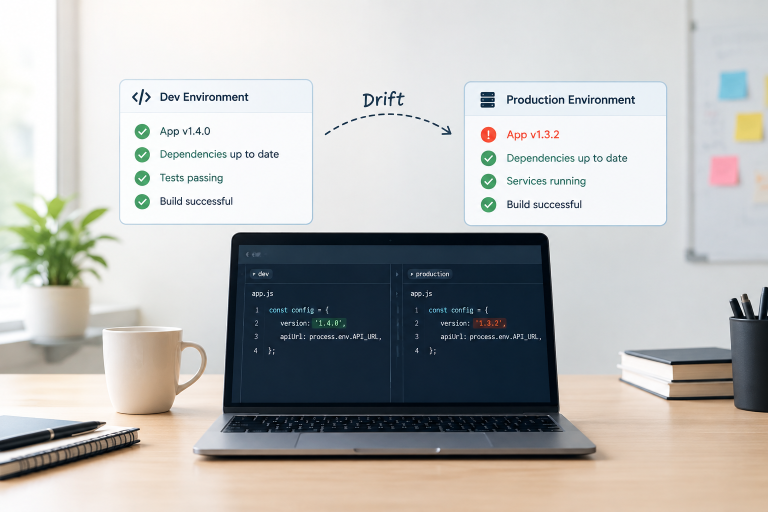
Why Dev and Production Environments Drift
It’s 11:47pm. The deploy that passed every test an hour ago just took production down. Nobody can figure out why, because nothing in staging looked like this. Someone finally says…
Read article →
The way we build and deliver software has transformed dramatically over the past decade. Applications are no longer released in quarterly cycles. They are continuously updated, deployed to cloud-native environments, and expected to be both feature-rich and secure.
Unfortunately, security practices have not always evolved at the same pace. Many organizations still operate under the outdated model of “develop first, test for security later.” This leads to situations where vulnerabilities are discovered far too late—sometimes after the software is already in production.
The costs of this reactive approach are substantial:
The industry’s answer is Shift-Left Security — a proactive, DevSecOps-driven strategy that integrates security into every stage of the software development lifecycle (SDLC).
When the SDLC is mapped out linearly — plan → design → develop → test → deploy — the “left” side represents early phases. Traditionally, security was performed toward the right (just before deployment). Shift-left moves these activities earlier.
In practice, shifting left means:
Why this works:
Finding a flaw early may take minutes to fix. Finding it after release can require weeks of urgent work, possible downtime, and reputational recovery efforts.
The pace and complexity of modern software delivery make late-stage security impractical.
Applications today are distributed across multiple services, often orchestrated by Kubernetes and spanning several cloud providers.
A single misconfigured role, open port, or network policy can become an entry point for attackers.
Example: An overly permissive Kubernetes ClusterRole could allow a compromised service to gain administrative control over the entire cluster. Early Infrastructure-as-Code (IaC) scanning detects these issues before deployment.
Most projects use open-source dependencies, container base images, and third-party integrations. These improve productivity but also create dependency risk.
High-profile supply chain attacks — such as malicious code injections into popular packages — have shown that a single compromised library can impact thousands of applications.
Implementing Software Composition Analysis (SCA) during build time ensures vulnerable or malicious components are flagged and replaced before integration.
According to IBM’s 2024 Cost of a Data Breach Report, fixing a flaw in production is up to 30 times more expensive than resolving it during coding.
And late discovery often triggers mandatory disclosure to regulators, causing public scrutiny and legal exposure.
Code reviews should include a structured security checklist that covers:
Practical tip: Integrate IDE plugins such as Snyk Code, SonarLint, or GitHub Advanced Security so developers receive immediate feedback as they write code.
Security checks can be embedded directly into CI/CD pipelines to block builds that contain critical vulnerabilities.
Common pipeline checks include:
Here, organizations that have adopted DevOps as a service often gain an edge, as their delivery pipelines come pre-integrated with automated security gates and policy enforcement mechanisms.
Cloud resources should be created only after their configuration files have passed security validation.
Example:
A Terraform script creates an AWS S3 bucket. An IaC scanner (e.g., Checkov, Terrascan, or tfsec) detects that the bucket is publicly accessible. The developer fixes it before deployment, avoiding a potential data leak.
To fully implement Shift-Left Security, teams should understand the main categories of security tools and how they fit into the pipeline.
A mature Shift-Left Security pipeline might look like this:
This continuous security enforcement ensures vulnerabilities are addressed as soon as they are introduced — not after release.
By 2025, AI-driven security is moving from experimental to essential.
Modern tools can:
For example, AI-assisted code review can suggest replacing vulnerable functions with safe library methods, improving both speed and accuracy.
Shifting left is not just about tools — it’s about people and process.
Best cultural practices:
For many organizations, building such a culture is easier when supported by Managed IT services teams that can handle routine operational tasks, freeing in-house engineers to focus on secure development and continuous improvement.
Developer resistance:
Embed security into existing tools and workflows to minimize disruption.
Excessive false positives:
Choose scanners with machine learning–based prioritization and allow rule customization.
Skill gaps:
Provide hands-on labs, gamified challenges, and regular workshops.
Modern software moves fast — cloud-native systems, microservices, and containerized workloads can go from idea to production in days. But speed without security is a gamble most businesses can’t afford. Waiting until the end of the development cycle to run security checks is like inspecting a ship for leaks after it has already set sail. By then, the smallest flaw can turn into a costly disaster.
Shift-Left Security flips that old mindset on its head. Instead of treating security as a final hurdle, it weaves protection into the fabric of development from day one. Developers get instant feedback when they write risky code, infrastructure is scanned before it ever goes live, and security becomes part of every decision — not a separate, last-minute task. The result is software that’s not just functional, but resilient, reliable, and ready for the real world.
More than tools and automation, this is a cultural change. It’s about creating teams where developers, security engineers, and operations staff work side-by-side, owning the safety of what they build. When security is everyone’s job, it stops being a blocker and starts being a competitive advantage. And in a world where trust is everything, building secure software from the very first commit isn’t just good practice — it’s good business.
It’s 11:47pm. The deploy that passed every test an hour ago just took production down. Nobody can figure out why, because nothing in staging looked like this. Someone finally says…
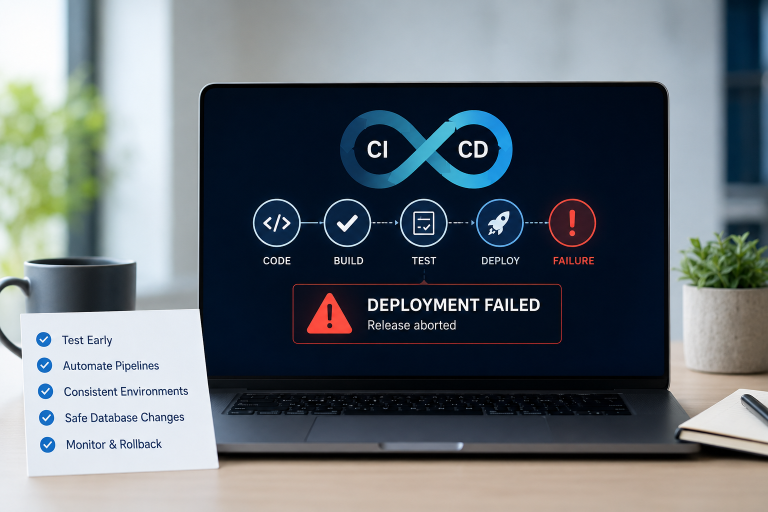
Read article →One bad release is all it takes to ruin a normal day at work. The build passes, the deploy goes out, and a few minutes later something breaks. Maybe checkout…
Read article →Nobody joins an engineering team because they love restarting servers at midnight. They join because they want to build things. Yet if you sit in on a few sprint planning…
Read article →Tell us where you are and what's slowing you down. A senior engineer will get back to you within one business day.
Our team will get back to you within one business day.

Leave a Reply