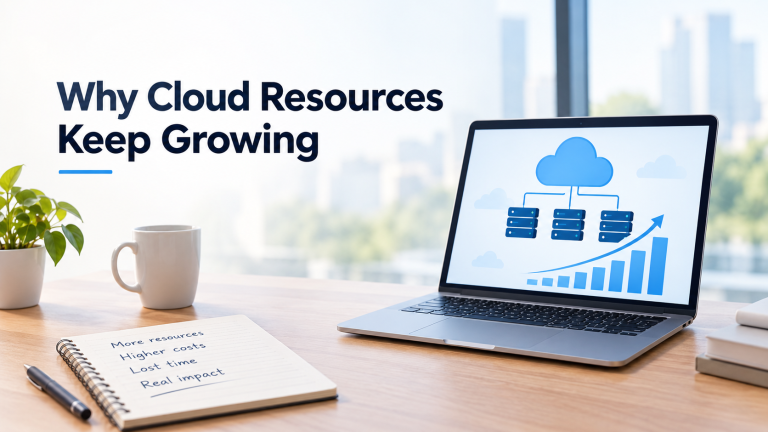
Why Cloud Resources Keep Growing
Monday morning, your finance lead sends a message. The cloud bill jumped again, and she wants to know why. You open the console and scroll through hundreds of resources. You…
Read article →
Successful cloud migration is a massive challenge for organizations. It needs a good understanding of cloud platforms and their functionality, proper strategy planning, and collaboration with a trusted cloud-managed service provider. Lift and shift cloud migration is a controversial mode of cloud migration. In the past, many avoided lift and shift cloud migration due to limited cloud benefits. But over time, people have understood that there are cases where lift and shift modes can be appropriate.
It is wise to conduct migrations in phases to minimize risk and speed up the time to production. Lift and shift, also known as ‘rehost’, is the most common cloud migration approach. In this mode, an application and its data can be directly moved to the cloud with minimal changes. This enables them to resume the operations in no time. On public cloud platforms like AWS, it’s easy to modernize and rearchitect application elements as needed. Then one can enjoy the cloud services and optimizations that provide maximum benefits. A lift and shift approach is ideal for moving applications to the cloud, especially when modernization can happen later.
Now, it’s your turn to determine whether the lift and shift approach is the right option for any application?
Here you can find three situations where this lift and shift approach is probably the best way for migration. And, scrolling down, you will find another three where you need to look for alternatives.
This is the most common lift and shift scenario. When you have to meet a stiff deadline, such as a hardware refreshment, datacentre closure, etc., a rehosting will be the most reasonable migration option without disturbing your ongoing projects.
When you need to move a large portion of the estate to the cloud in a short time, and you don’t have time to modernize or rebuild, you must go for lift and shift.
Another benefit of rehosting is that it allows you to minimize the ‘migration bubble’, whereas on-premise and cloud hosting costs overlap and increase the overall expenditure.
A lift and shift migration might not allow you to leverage cloud benefits right away, but it helps to get everything in the right place. As this migration phase is over, you can start working immediately without any change in your applications. You can modernize the applications afterwards as needed.
When your organization has an upcoming need for an increased storage facility or new digital platforms, but your current infrastructure (such as a data center) cannot support that, a lift and shift can be an effective solution. It is the fastest and easiest route to the cloud. Though your overall expense can be on the higher side, businesses might be willing to accept this short-term expenditure as it can serve those immediate business needs.
In these circumstances, as the migration overs, businesses must focus on the next phase that involves two tasks;
1. modernization of the applications in the cloud as needed
2. Upskilling of in-house staff to adopt new changes
Here one can take the help of the cloud IT consulting services for expert technical support, training and mentoring, and continuous improvement for long-term success.
Refactoring is a key to effective cloud migration. Here, the cloud engineers basically fragment your existing applications or processes into smaller components with fewer dependencies to foster agility and incorporate the needed updates. This process allows us to get rid of technical debt and enhance specific areas with cloud-native tools and approaches.
To rearchitect or rebuild an application, cloud engineers must thoroughly understand how it was built and works. So, they need complete documentation about the existing setup or access to the professionals who have been directly involved with the development. If the necessary information is not readily available, you can go for a lift and shift method for the timing. Once the application is in the cloud and you have all the essential information, you can go for refactoring. Even replacement, whatever is appropriate.
When you have the time and all required documentation ready to refactor, you must go for refactoring instead of lift or shift. A lift and shift could create unnecessary cost management issues along with performance and agility problems. Refactoring an application ensures it takes advantage of cloud benefits from day one.
Refactoring doesn’t involve rebuilding or recoding an entire application but improving certain parts to make the application advance and enable you to have cloud-native features.
If your employees don’t have cloud-native skills, it will be challenging for you to manage things in a cloud environment even after a lift and shift migration. Your team can be frustrated with haphazard work processes, plus they need to develop different approaches to troubleshoot and remediate for this new environment.
Instead of creating such disruption, you can reassess your on-premise workloads and consider modernizing with the help of a managed IT services partner while moving to the cloud.
When cost-saving and agility play a significant role behind your cloud migration, lift and shift is not a good option at all. To achieve these two benefits, you need to incorporate changes to the infrastructure of applications. The costs related to lift and shift are comparatively higher than they were in the previous environment. Here also, refactoring can be the solution as it results in better cloud cost management and agility.
The key to successful cloud migration is a strategic migration plan. You can plan the whole cloud journey in various phases and choose a migration approach as per every application’s need. Opting for lift and shift is sometimes beneficial, but sometimes it isn’t. You can consult with a trusted cloud partner and plan your journey accordingly.
Monday morning, your finance lead sends a message. The cloud bill jumped again, and she wants to know why. You open the console and scroll through hundreds of resources. You…
Read article →You dread deployment day. You flinch when the cloud invoice lands in your inbox. You’ve stopped trying to explain the architecture to new hires because you’re not fully sure how…
Read article →Your migration was supposed to be finished by now. Instead, you’re staring at a cloud bill that’s twice your budget. An application keeps timing out. Your team is exhausted from…
Read article →Tell us where you are and what's slowing you down. A senior engineer will get back to you within one business day.
Our team will get back to you within one business day.