Your system is down right now, or it will be soon. Customers are refreshing a broken page. Someone in sales is asking your team for an update you don’t have. And your engineers are still trying to figure out what actually broke, not fixing it yet, just figuring out where to even look.
That gap between the outage starting and someone finding the cause is where your money goes. Last quarter, a single dropped environment variable cost one company three and a half hours of downtime. The fix, once an engineer found it, took under two minutes. The other three hours and fifty eight minutes were spent guessing.
If you’ve ever sat in a war room watching the clock while your team scrambles to even locate the problem, you already know why IT incidents take hours to fix. It’s rarely the repair. It’s everything that happens before anyone knows what to repair, and every minute of that costs you.
This post shows exactly where that time disappears, what it’s costing you whether you’re tracking it or not, and what to fix before your next outage runs up the same bill.
What’s Actually Happening While You Wait
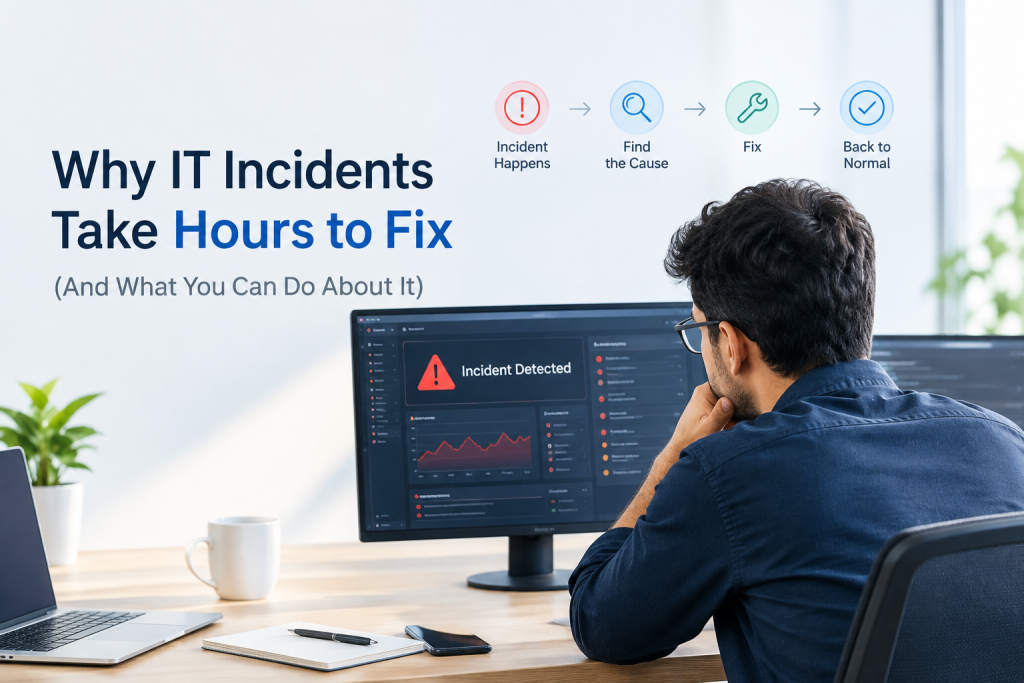
Map out a real incident minute by minute, and “problem happens, someone fixes it” isn’t what you get. Here’s what you’re actually paying for.
Someone notices something’s off, usually late, often from a customer complaint instead of a dashboard. Then comes the scramble to figure out how bad it is and who needs pulling in. Then the real cost starts: engineers pull logs, check deployments, and rule out causes one by one while your site stays down and your phone keeps buzzing. Only after all that does anyone touch an actual fix. And even then, someone has to confirm it worked before you can breathe.
Ask any engineer who’s lived through a bad outage. The fix is never the long part. Waiting to know what to fix is.
Where Your Hours Are Actually Going
You can’t see your whole system at once, and that costs you every incident. Most companies run monitoring in pieces: one tool for servers, another for logs, a Slack channel where someone asks “anyone seeing errors?” Your team wastes the first stretch just piecing things together. A checkout error and a database timeout ten minutes earlier might be the same problem, but nobody connects them since two dashboards show each one separately. That delay isn’t a technical detail, it’s minutes of revenue, every time.
This is exactly the gap 24/7 IT Monitoring services close. Centralized, continuous monitoring catches the anomaly the second it starts, not an hour later when a customer emails support.
Your alerts have also trained your team to ignore them. More tools usually mean more noise, not more speed. Dozens of low priority pings a day teach engineers to tune out notifications, including the one that matters.
Your systems also outgrew your response plan. A page load might touch a dozen microservices, several databases, and third party APIs. Finding the cause takes real expertise or costly trial and error, a big reason why IT incidents take hours to fix, even with talented engineers on staff.
Nobody decided who does what, so you’re deciding it live, mid emergency. Every undocumented incident turns into an argument about ownership, and answering those questions mid outage costs real dollars.
Your fixes still depend on someone typing fast enough under pressure. Manually restarting servers or editing configs at midnight is slow and turns a bad night worse. That step should already be automated.
Finally, your teams don’t talk daily, so they can’t coordinate in a crisis. Infrastructure, development, and database teams often act like separate companies, and the first ten minutes can vanish just getting the right people on one call.
What This Is Actually Costing You
This isn’t an abstract inconvenience. According to New Relic’s 2025 Observability Forecast, which surveyed more than 1,700 IT and engineering professionals across 23 countries, high impact outages now carry a median cost of $2 million per hour, and businesses report a median annual cost of $76 million from these events (source). Your numbers may look smaller, but the shape is the same: every extra hour bleeds transactions, pushes customers toward a competitor, and burns out the engineers who are still awake at midnight fixing it. If you’re in a regulated industry, add SLA penalties on top of all of that.
None of it shows up in the incident report. It shows up three months later, in churn numbers and resignation letters, quietly, after you’ve already moved on.
How to Actually Stop Paying This Tax
Teams that resolve incidents fast didn’t hire smarter engineers. They removed the guesswork before the next outage started.
Start by pulling your monitoring into one place instead of five, so nobody hunts across tabs while customers wait. Tune your alerts so the pager only fires for things that matter, so your team actually trusts it again. Automate the repetitive parts of remediation, restarts, rollbacks, scaling, so a human isn’t typing commands by hand at midnight. Write down, before the next incident, exactly who does what, so nobody improvises the org chart while your site is down.
Then be honest afterward. Document what went wrong without hunting for someone to blame, and you get faster with every incident. Skip that step, and you’ll have this exact same three hour outage again in six months, guaranteed.
Stop Handling This Alone
Getting to this level of readiness internally takes time, budget, and people who’ve handled enough real incidents to be fast at it. Most growing businesses don’t have that sitting around, which is exactly why managed IT services exist. It’s not that your internal team lacks skill. Building this from scratch takes years you probably don’t have to spare, and a good partner has already built it.
The part you won’t see is the incident that never happens: patched before it’s exploited, tuned before it degrades, scaled before a traffic spike becomes an outage. A solid cloud management services partner spends most of its time preventing the 2 AM call you never get, not just answering it faster.
Your Next Outage Is Already Loading
So why do IT incidents take hours to fix? Almost never because the fix is hard. It’s because finding the cause takes longer than fixing it, and that gap is costing you every single time it happens.
The difference between a five minute outage and a five hour one isn’t decided during the incident. It’s decided right now, in whether you fix these gaps before your system goes down again, or find out the hard way what another three hours actually costs you.
A deployment goes out on a Thursday afternoon. Nobody expects trouble. Twenty minutes later, checkout fails for half your customers, and three engineers are staring at logs trying to figure…
Support just flagged another wave of complaints about a sluggish checkout. Your team pulls up the dashboard. CPU sits under 50%. Memory looks fine. Uptime reads 99.99%. Every light is…
Most companies don’t wake up one morning to find their entire IT setup broken. It happens slowly. A server lags a little more each week. A backup job quietly fails…



Leave a Reply