Amazon Web Services (AWS) is the world's largest cloud platform — and for good reason. Over 1 million active businesses, from solo developers to Fortune 500 companies, run their operations on AWS infrastructure. If you have been wondering what amazon cloud services actually are, how they work, and whether they make sense for your business, this guide gives you a clear, honest answer.
What Are Amazon Cloud Services?
Amazon cloud services refer to the suite of on-demand computing resources offered by Amazon Web Services (AWS), Amazon's cloud computing division. Rather than owning physical servers, you rent computing power, storage, databases, and dozens of other capabilities over the internet — paying only for what you use.
AWS was launched in 2006 and now operates data centers across 33 geographic regions worldwide, with over 105 availability zones. When you use amazon cloud services, your applications and data live on Amazon's infrastructure — not on hardware you manage yourself.
Key Insight: AWS holds approximately 31% of the global cloud infrastructure market, making it the single largest provider ahead of Microsoft Azure and Google Cloud combined.
Here is the simplest way to think about it. Before cloud services, a startup that needed a web server had to buy physical hardware, install it, maintain it, and replace it when it failed. Amazon cloud services replace all of that with a subscription model — you spin up what you need in minutes, scale it when demand grows, and pay only for the hours you actually use it.
This model is particularly relevant for small businesses, SaaS product companies, and e-commerce operations in India, where the cost of building and maintaining physical server infrastructure is a significant barrier to growth.
Types of Amazon Cloud Services (AWS Products)
AWS offers over 200 individual services. Most businesses use a subset of them, grouped into a few core categories.
Core AWS service categories
Category
What It Covers
Common Examples
Compute
Processing power to run applications
EC2, Lambda, Elastic Beanstalk
Storage
File, object, and block storage
S3, EBS, Glacier
Databases
Managed relational and NoSQL databases
RDS, DynamoDB, Aurora
Networking
Traffic routing, CDN, DNS management
VPC, CloudFront, Route 53
Security
Identity management, encryption, compliance
IAM, Shield, WAF
AI and Machine Learning
Pre-built models and training infrastructure
SageMaker, Rekognition, Polly
Developer Tools
CI/CD pipelines, code repositories
CodePipeline, CodeCommit
Each of these categories within amazon cloud services solves a specific operational problem. Here is what matters most for the three audiences most likely reading this:
For small businesses: EC2 (Elastic Compute Cloud) and S3 (Simple Storage Service) are the two most commonly used services. EC2 gives you a virtual server. S3 gives you a place to store files, images, backups, and static website assets.
For SaaS product companies: RDS (Relational Database Service) and Elastic Beanstalk are workhorses. RDS manages your database without requiring a dedicated database administrator. Elastic Beanstalk handles application deployment automatically.
For e-commerce businesses: CloudFront (AWS's content delivery network) and Auto Scaling are critical. CloudFront serves your product images and pages from the nearest server to your customer. Auto Scaling ensures your site does not crash during a Diwali sale or product launch.
Cloud computing architecture on AWS is built around the concept of availability zones — physically separate data centers within a region that protect your application from single points of failure. Understanding this structure helps you design systems that stay online even when one data center has an issue.
Amazon Cloud Services vs Competitors
Amazon cloud services compete primarily with Microsoft Azure and Google Cloud Platform. Here is how they compare on the dimensions that matter most for businesses evaluating their options.
AWS vs Azure vs Google Cloud: a practical comparison
Factor
Amazon Cloud Services (AWS)
Microsoft Azure
Google Cloud Platform
Market share
~31%
~25%
~11%
Service breadth
200+ services
200+ services
150+ services
Best for
General workloads, startups, e-commerce
Microsoft-heavy enterprises
Data analytics, AI workloads
India data centers
Mumbai, Hyderabad
Pune, Chennai, Mumbai
Mumbai, Delhi
Free tier
12 months + always-free services
12 months + always-free services
90-day credit
Learning resources
Extensive (AWS Skill Builder)
Strong (Microsoft Learn)
Good (Google Cloud Training)
AWS has the deepest ecosystem of any cloud provider. If you search for a solution to a specific problem — say, processing video uploads or sending transactional emails — there is almost certainly an AWS service built for it.
Azure wins when your business already runs Microsoft products like Office 365, Active Directory, or SQL Server. The integration is seamless and the licensing costs often work out favorably.
Google Cloud is the strongest option if your primary use case is data analytics, machine learning, or BigQuery-based reporting. For general web application hosting, it trails AWS in both service maturity and community support.
For most small businesses and e-commerce operations in India, amazon cloud services represent the most practical starting point because of the community size, documentation quality, and the breadth of managed services available.
Benefits of Amazon Cloud Services
The business case for amazon cloud services comes down to five practical advantages.
Pay-as-you-go pricing. You do not pay for idle capacity. A server that sits unused on a Sunday night costs you nothing on AWS. Traditional infrastructure charges you whether or not you use it.
Scale in minutes, not months. Adding capacity to a physical server room takes procurement, shipping, installation, and configuration — often six to eight weeks. Scaling an EC2 instance on amazon cloud services takes under five minutes.
Global reach without global investment. AWS has regions in Mumbai and Hyderabad, which means an Indian startup can serve customers in Singapore or Frankfurt with low latency without building infrastructure there. You deploy to a new region through the AWS console in a few clicks.
Security built into the infrastructure. AWS maintains compliance certifications including ISO 27001, SOC 2, and PCI DSS. Security in cloud environments on AWS benefits from physical data center security, network-level protections, and identity management tools that most small businesses could not build independently.
Managed services reduce operational overhead. When you use RDS instead of managing your own MySQL server, Amazon handles patching, backups, and failover. Your team focuses on your product, not on database administration.
A practical example: an e-commerce business in Bengaluru selling through its own website used to run on a single shared hosting plan. During sale events, the site would slow down or crash. After migrating to amazon cloud services — specifically EC2 with Auto Scaling and CloudFront — the same business handled 10x normal traffic during a flash sale without any performance issues. The monthly cost was comparable to what they had paid for shared hosting.
How to Get Started with Amazon Cloud Services
Getting started with amazon cloud services is more straightforward than most people expect. Here is the process in order.
Pricing is the question most businesses ask first about amazon cloud services — and it is also the area with the most variability.
AWS uses three main pricing models:
On-demand pricing: You pay per hour or per second for what you use. No commitment. Highest per-unit cost. Best for unpredictable workloads.
Reserved instances: You commit to one or three years of usage in exchange for discounts of 30–72% compared to on-demand rates. Best for stable, predictable workloads.
Spot instances: You bid on unused AWS capacity at discounts of up to 90%. The catch is that AWS can reclaim the capacity with two minutes' notice. Best for batch processing and non-critical workloads.
A small business running a web application on amazon cloud services — one EC2 t3.small instance, an RDS MySQL database, and 50 GB of S3 storage — would typically pay between ₹3,000 and ₹8,000 per month depending on traffic and data transfer. Contact AWS directly or use the AWS Pricing Calculator for a personalized estimate based on your specific configuration.
The biggest cost surprises on amazon cloud services come from data transfer fees (moving data out of AWS to the internet) and from leaving resources running when they are not needed. Setting up automated shutdown schedules for development environments is a simple way to reduce costs by 40–60% for teams that only work during business hours.
Is Amazon Cloud Services Right for You?
Amazon cloud services are not the right answer for every situation. Here is an honest assessment.
AWS is a strong fit if:
* You are building or running a web application or SaaS product that needs to scale
* You are an e-commerce business that experiences variable traffic
* You want to avoid managing physical infrastructure
* You need compliance certifications (PCI DSS, HIPAA, ISO 27001) without building them yourself
* You are in India and want low-latency infrastructure for your users
AWS may not be the right fit if:
* You have a simple static website with no dynamic requirements — a basic hosting plan is cheaper and simpler
* Your entire stack runs on Microsoft tools and your team already knows Azure
* You have highly specialized data analytics needs where Google Cloud's BigQuery would be more efficient
* You do not have anyone on your team with cloud expertise and do not want to hire a managed services partner
The learning curve is real. AWS has 200+ services and a console that can feel overwhelming to new users. Businesses that get the most value from amazon cloud services either invest in training their team or work with a managed cloud services provider to handle the architecture and operations.
Common Questions About Amazon Cloud Services
What is the difference between AWS and amazon cloud services?
They are the same thing. Amazon Web Services (AWS) is the official name of Amazon's cloud computing division. "Amazon cloud services" is the common informal term people use to refer to AWS products and services. Both phrases refer to the same platform.
Is amazon cloud services safe for storing business data?
AWS maintains some of the most rigorous security certifications available, including ISO 27001, SOC 1 and SOC 2, and PCI DSS Level 1. Data stored on amazon cloud services is encrypted at rest and in transit by default on most services. The shared responsibility model means AWS secures the infrastructure, and you are responsible for securing your applications and access controls. For most small businesses, AWS provides a higher level of security than self-managed servers.
Can I use amazon cloud services for a small business with limited technical knowledge?
Yes, with the right support. AWS offers managed services like Lightsail (simplified virtual servers), Amplify (web application hosting), and Elastic Beanstalk (automated deployment) that reduce the technical complexity significantly. For businesses without in-house cloud expertise, partnering with a managed cloud services provider removes the technical barrier entirely.
How does amazon cloud services pricing compare to traditional hosting?
For small, stable workloads, traditional shared hosting is often cheaper. Amazon cloud services become cost-competitive or more economical as your requirements grow — particularly when you factor in the cost of managing physical infrastructure, handling traffic spikes, and maintaining uptime. The flexibility and scalability of amazon cloud services typically justify the cost for businesses growing beyond basic hosting needs.
What AWS services should an e-commerce business start with?
The core stack for an e-commerce business on amazon cloud services includes EC2 or Lightsail for compute, RDS for the database, S3 for product images and assets, CloudFront for content delivery, and SES (Simple Email Service) for transactional emails. This combination covers the fundamental infrastructure needs of most e-commerce operations.
Key Takeaways
Amazon cloud services give businesses of every size access to enterprise-grade infrastructure without the capital expense of owning hardware. The pay-as-you-go model, global reach, and managed services make AWS particularly practical for small businesses, SaaS companies, and e-commerce operations looking to scale without scaling their operations team.
Explore Sygitech's Managed Cloud Services to run your AWS infrastructure with expert management — so your team focuses on your product, not on server maintenance.
By Sygitech Solutions | Cloud Infrastructure Management & DevOps Most SaaS founders and CTOs eventually face the same decision: should we hire a dedicated DevOps or cloud engineer, or should…
Discover how cloud offerings transform business operations by providing on-demand access to computing power and storage without hefty infrastructure costs.


 Ready to get started?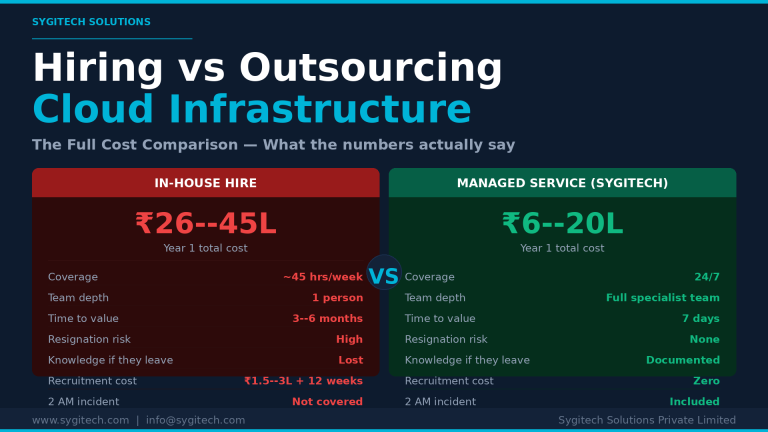

Leave a Reply