

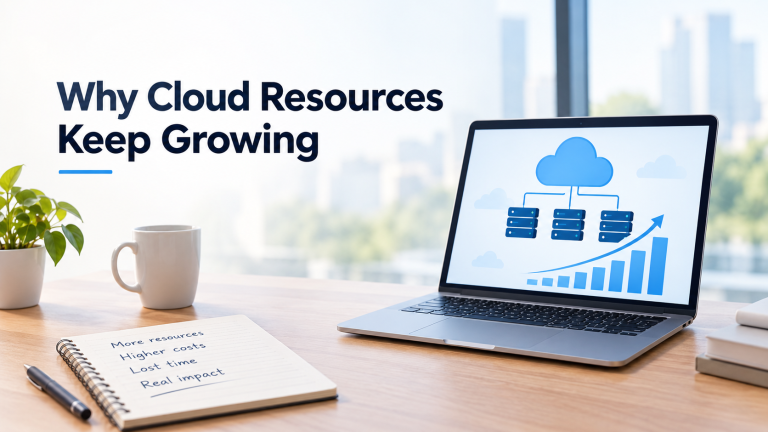
Why Cloud Resources Keep Growing
Monday morning, your finance lead sends a message. The cloud bill jumped again, and she wants to know why. You open the console and scroll through hundreds of resources. You…
Read article →
Cloud monitoring is the routine practice of monitoring cloud-hosted applications, services, and resources to maximize performance, security, and cost-effectiveness. It uses certain software that gathers, processes, and analyzes real-time information to enable companies to detect potential problems before they affect business.
Cloud environments are always changing, so keeping an eye on them requires more than just manual checks. Automation, AI-driven insights, and real-time alerts help catch issues before they turn into bigger problems. Whether you’re working with a public private or hybrid cloud, good monitoring gives you visibility and control over your systems. In this article, we’ll break down why cloud monitoring is important, the top tools available, and how it helps businesses stay secure and efficient.
As more businesses rely on cloud applications, their performance, security, and dependability become increasingly crucial. Consequently, a poor cloud experience can gradually damage brand reputation, reduce customer satisfaction, and hinder overall business effectiveness. This is precisely where cloud monitoring and management services come into play, ensuring optimal performance and reliability.
Think of cloud monitoring like a hospital’s IT support team, ensuring smooth digital operations. In the healthcare sector, patient records, appointment scheduling, and telemedicine services heavily rely on a stable and secure IT environment. Therefore, the IT department constantly monitors system performance, reduces cybersecurity risks, and ensures medical software and databases remain operational. Moreover, if an issue arises—such as slow access to patient records or a security threat—the team quickly detects and resolves it before it affects patient care.
Likewise, cloud monitoring in any industry monitors performance, detects problems, and optimizes resources to keep online operations running smoothly and securely.
With effective cloud monitoring, businesses can:
Ultimately, cloud monitoring allows organizations to provide high-performance, secure, and cost-effective cloud services with smooth business continuity.
These tools possess their own strengths and assist organizations in monitoring and maintaining their cloud environments effectively. This ensures that the performance, security, and reliability are good on various cloud platforms.
Having a cloud monitoring approach has a number of benefits that enhance efficiency and reliability. A few of the most significant benefits are:
Cyber attacks are also evolving constantly, and therefore real-time monitoring detects unauthorized access, DDoS attacks, and misconfigurations before they inflict harm.
AI notifications and automated responses prevent minor issues from escalating into big problems.
Cloud monitoring ensures your applications run smoothly by spotting slowdowns, network congestion, and wasted resources. By leveraging cloud optimization services, companies can improve resource allocation, leading to better speed, functionality, and overall performance.
Healthcare, finance, and government industries must adhere to stringent regulations such as HIPAA, GDPR, and ISO. Cloud monitoring software assists with ensuring and upholding these regulations.
Cloud monitoring solutions grow with your business, making it easy to scale up without compromising performance or stability.
Companies use cloud monitoring services to gain visibility into different aspects of their cloud environments. Some of the most crucial monitoring services are:
To achieve optimal cloud monitoring, companies should implement the following best practices:
Set clear goals for your cloud monitoring efforts, such as enhancing performance, security, or lowering costs. Well-defined goals assist in concentrating your monitoring plan.
Track important parameters such as CPU, memory, storage, and network usage. These parameters provide you with an open perspective on the performance and health of your cloud infrastructure.
Trigger live alerts to notify you of any significant problems, such as performance drops or security threats. Live alerts allow you to correct issues before they affect your users.
Use auto-scaling to scale cloud resources automatically based on real-time demand. This ensures peak performance without inefficient use of resources, thus making cost management easy.
Always remain alert for unauthorized access, vulnerabilities, and possible attacks. Keeping security in check ensures your cloud environment remains safe and compliant with regulations.
Use AI-based tools to monitor data, identify trends, and predict potential problems. These tools enable proactive monitoring and overall better efficiency of your cloud operations.
As your cloud infrastructure evolves, you must continuously adjust your monitoring parameters and thresholds in response. Consequently, this ensures that your monitoring system remains aligned with your environment’s current state.
Gather and consolidate logs and performance data from all cloud services in a single end-to-end dashboard. This helps in problem and trend detection, providing greater visibility.
Ensure that your monitoring tools are properly integrated on all your cloud services. Integration provides you with a holistic picture of your infrastructure, enabling you to identify issues sooner and manage overall better.
Use monitoring software to track your cloud usage and spending closely. This helps you identify inefficiencies, maximize resource usage, and prevent unnecessary cost overruns.
Cloud monitoring is essential for maintaining a secure, high-performing, and cost-efficient cloud environment. With the right tools and services, companies can proactively address issues, optimize resources, and ensure continuous accessibility of their cloud services. Moreover, as cloud environments become increasingly complex, leveraging managed cloud services allows organizations to access expert support and automated solutions, helping them stay ahead of potential challenges. By adopting these services, businesses not only enhance operational efficiency but also gain deeper insights into their cloud configurations, enabling seamless scalability while maintaining security and performance. Ultimately, having robust cloud monitoring in place is crucial for fostering long-term success in the digital landscape.
Monday morning, your finance lead sends a message. The cloud bill jumped again, and she wants to know why. You open the console and scroll through hundreds of resources. You…
Read article →You dread deployment day. You flinch when the cloud invoice lands in your inbox. You’ve stopped trying to explain the architecture to new hires because you’re not fully sure how…
Read article →Your migration was supposed to be finished by now. Instead, you’re staring at a cloud bill that’s twice your budget. An application keeps timing out. Your team is exhausted from…
Read article →Tell us where you are and what's slowing you down. A senior engineer will get back to you within one business day.
Our team will get back to you within one business day.
Leave a Reply