

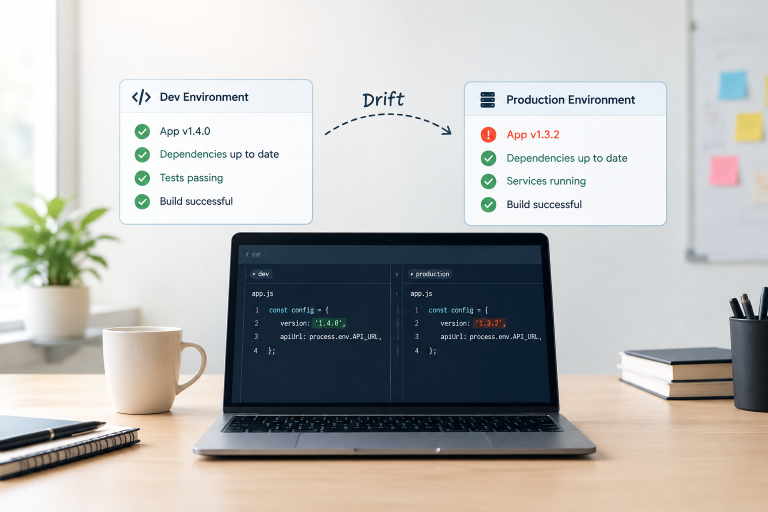
Why Dev and Production Environments Drift
It’s 11:47pm. The deploy that passed every test an hour ago just took production down. Nobody can figure out why, because nothing in staging looked like this. Someone finally says…
Read article →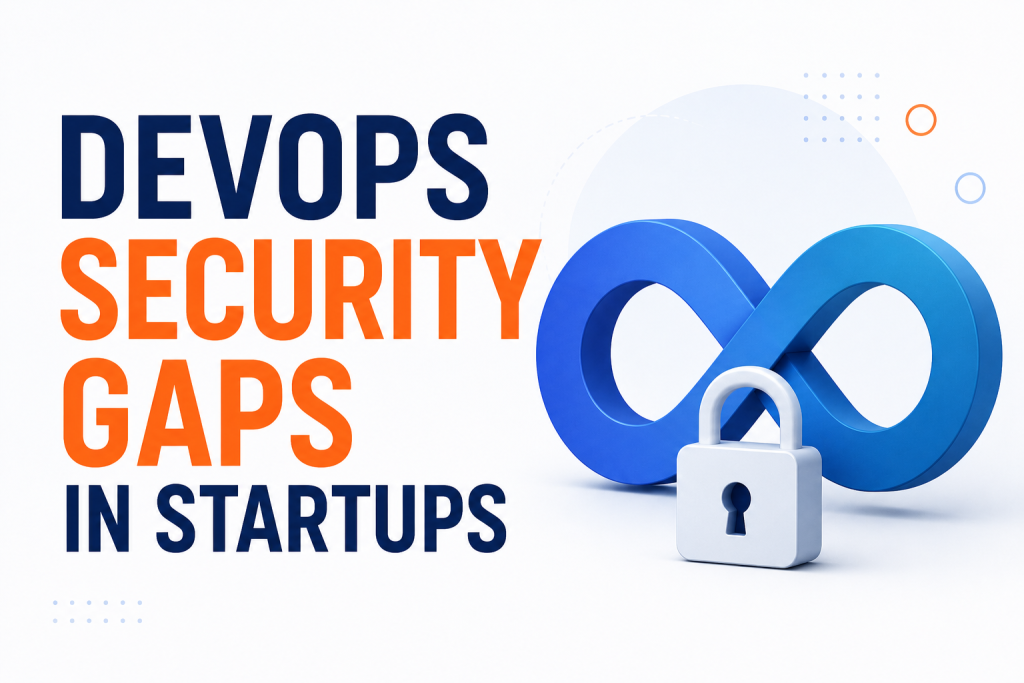
You raised your Series A. You hired fast. You shipped features at breakneck speed. Your growth charts look great. And somewhere in the middle of all that momentum, your AWS S3 bucket was left public-facing for six months. This isn’t hypothetical. It’s a pattern that plays out at startups across the world, companies with brilliant engineers, decent funding, and real customers that get blindsided by security breaches they never saw coming. Not because they didn’t care. Because they were moving too fast to notice the cracks forming in their DevOps pipeline The uncomfortable truth? Most DevOps security gaps in startups aren’t caused by sophisticated attackers. They’re caused by rushed deployments, misconfigured cloud settings, and the slow creep of “we’ll fix that later” culture.
There’s a reason why 43% of cyberattacks target small businesses and it has everything to do with the tradeoffs startups make during hypergrowth. When you’re racing to hit product-market fit, every engineering decision gets filtered through one question:
Does this ship faster? Security reviews slow you down. Vulnerability scans add friction. Secret rotation feels like busywork when your sprint backlog is overflowing.
So teams cut corners. Not recklessly but rationally. Shipping beats securing. Until it doesn’t.
The average cost of a data breach for small and mid-size businesses now sits above $3.3 million(IBM Cost of a Data Breach Report, 2023). For a startup burning runway, that’s not just painful, it’s often terminal. And breaches take an average of 204 days to identify and another 73 to contain. That’s nearly nine months of an attacker living inside your infrastructure.
The window between “fast-growing startup” and “startup that gets breached” is smaller than founders think.
Walk into any startup that’s been operating for 18+ months and ask an engineer:
“Do you have any API keys in your Git history?”
The honest ones will wince.
Hardcoded credentials like AWS keys, database passwords, third-party API tokens routinely end up committed to repositories. Even private repos become vulnerable when attackers compromise an engineer’s laptop or someone accidentally makes the repository public during a GitHub settings change.
Tools like TruffleHog, GitLeaks, and GitHub’s native secret scanning exist precisely because this problem is endemic. Yet most startups don’t have pre-commit hooks that catch secrets before they land in version control.
What’s really happening:Developers work locally, test with real credentials, and forget to replace them before committing. It’s a workflow problem masquerading as a security problem.
Actionable Fix: Implement pre-commit hooks using tools like detect-secrets or gitleaks. Integrate secret scanning into your CI/CD pipeline. Use a secrets manager (AWSSecrets Manager, HashiCorp Vault, or Doppler) from day one.
The principle of least privilege sounds obvious. In practice, teams abandon it the moment a developer cannot access the resource they need, and an admin grants full S3 access just to unblock the sprint.
This is how startups end up with developers running production workloads with administrator-level cloud permissions. Or with Lambda functions that have read/write access to every database. Or with EC2 instances that can assume any IAM role in the account.
The 2019 Capital One breach, while not a startup, is the textbook case. A misconfigured WAFallowed an attacker to exploit a server-side request forgery vulnerability, then pivot using an overly permissive IAM role to exfiltrate over 100 million customer records. The permissions were the real weapon.At startups, this gets worse because IAM hygiene doesn’t have a “ship it” moment. There’s no feature launch attached to cleaning up roles. So it stays on the backlog permanently.
The recommended approach is to audit your IAM roles quarterly. Use AWS IAM Access Analyzer or GCP’sPolicy Analyzer to surface overpermissioned roles automatically. Use infrastructure as code tools like Terraform or Pulumi to enforce least-privilege policies and review permissions in PRs like any other change.
This one sounds like basic hygiene. It’s also breathtakingly common. Startups often start with a single environment; everything runs in “production” because there’s nothing else yet. As the team grows, staging gets added, but the walls between environments stay paper-thin. Developers have production database credentials. Staging pulls from production data (with “anonymized” PII that often isn’t). CI/CD pipelines can deploy to production without approval gates.
When a developer accidentally runs a destructive migration script against production, or when a test script starts hitting live customer APIs, the damage is immediate and often irreversible.
To prevent this, we should treat environment separation as infrastructure-level, not policy-level.Separate AWS accounts for dev/staging/prod. Use VPCs with strict peering rules. Never allow production credentials to exist outside of production infrastructure and enforce this in your secrets management system.
Here’s a scenario that’s playing out at thousands of startups right now: Your Node.js application is running in a Docker container based on node:16. That base image was last updated eight months ago. It contains 47 known vulnerabilities, three of which are critical. Your package.json dependencies haven’t been audited since you shipped the MVP.And your container image tags are latest, meaning you have no reliable way to know what version is actually running in production.
The Log4Shell vulnerability in 2021 was devastating in part because companies didn’t know where Log4j was running in their stack. It was buried in dependencies of dependencies, a transitive vulnerability that attackers found before defenders did.
Dependency management is one of the least glamorous parts of DevSecOps. It’s also one of the highest-leverage security controls available.
Best Practice includes integrating Snyk, Dependabot, or OWASP Dependency-Check into your CIpipeline. Scan container images with Trivy or Grype before every deployment. Pin your baseimage versions and never use the latest in production. Set up automated PRs for dependency updates so security patches don’t require manual effort.
Most startups have CI/CD pipelines. Few have secure CI/CD pipelines.The typical early-stage pipeline: code merges to main → tests run → deploy to production. Fast.Clean. Completely devoid of security checks.
What’s missing: static application security testing (SAST), container image scanning,infrastructure-as-code scanning, and software composition analysis. The pipeline becomes a direct path from developer laptop to production with no security checkpoint in between.
This matters more than it used to because attackers have started targeting CI/CD systems directly. The SolarWinds attack in 2020 compromised the build pipeline itself – malicious code was injected upstream and then distributed to thousands of downstream customers who trusted the signed software. Supply chain attacks now account for a growing share of enterprise breaches, and startups are particularly vulnerable because their pipelines are rarely hardened.
The best practice includes implementing a security gate in your CI pipeline using tools like Semgrep (SAST), Checkov (IaC scanning), and Trivy (container scanning). Block deployments that fail critical checks. If building this in-house feels overwhelming, CI/CD pipeline as a service solutions let you plug in a fully secured, pre-configured pipeline without starting from scratch and they’re far cheaper than recovering from a supply chain breach.
You can’t respond to what you can’t see. Most startups have application-level logging, error logs, request logs, performance metrics.What they typically lack is security-oriented logging: who accessed what, from where, when, and whether that access pattern is anomalous.
Without centralized log management and alerting, a credential stuffing attack can run against your authentication endpoints for weeks before anyone notices the elevated error rates. An insider threat can exfiltrate customer data through a poorly secured API. An attacker with compromised cloud credentials can spin up crypto mining infrastructure on your account.
The 2020 Twitter hack, where attackers used social engineering to gain access to internal admin tools was possible in part because Twitter didn’t have sufficient controls on privileged access. The attackers were inside the system for hours before the first public signs appeared.
Actionable Fix: Centralized logging with CloudWatch, Datadog, or the ELK Stack.Set up alerts for anomalous behavior: unusual API call volumes, logins from new geographies, IAM role assumptions outside business hours. At minimum, enable CloudTrailin AWS and ensure logs are written to an immutable, cross-account S3 bucket.
When a breach happens, the most expensive minutes are the ones spent figuring out who does what. The majority of early-stage startups have no documented incident response process. Norunbooks. No designated incident commander. No communication templates for notifying customers or regulators. No practice drills.
The first time the team has to respond to a security incident is the worst possible time to also be inventing the process.Under GDPR, organizations have 72 hours to notify regulators of a data breach. Under state-level laws like the CCPA and various breach notification statutes, timelines can be even tighter.Scrambling to figure out your legal obligations during an active incident is a nightmare scenario that’s entirely avoidable.
The solution is to write a simple incident response playbook. Define severity levels, assign roles, document your notification obligations, and create a communication template. Then critically run a tabletop exercise. Pick a realistic breach scenario and walk through your response. You’ll find gaps before attackers do.
You don’t need enterprise-grade security tooling to close these gaps. You need the right defaults and consistent habits.
Secrets Management
Vulnerability Scanning
Cloud Security Posture
Monitoring and Alerting
The goal isn’t to implement everything at once. Pick the gaps most relevant to your current stage and close them systematically. If your team is stretched thin, DevOps as a service is worth exploring, many startups partner with specialized providers to get this stack implemented without hiring a full internal team.
A few trends worth watching:
AI-assisted attack automation is lowering the skill floor for attackers. Reconnaissance, exploitselection, and lateral movement are increasingly automated. Startups that were previously “too small to target” are now in scope.
Supply chain attacks are accelerating. Compromising a popular open-source library or CI/CDtool is more efficient than attacking individual companies. Your exposure to supply chain risk is a function of how well you understand your dependency tree.
Regulatory pressure is increasing globally. The EU’s NIS2 Directive, SEC cybersecurity disclosure rules in the US, and expanding state-level breach notification laws mean that security posture is increasingly a legal and financial matter, not just a technical one.
Startups that build security into their DevOps culture now will find it significantly easier to pass enterprise security reviews, close deals with risk-conscious buyers, and scale without accumulating critical security debt.
Security Is a Growth Lever, Not a Blocker. The framing of security-versus-speed is a false choice. The startups that get this right aren’t slowing down for security, they’re building security into the motion of development. Pre-commit hooks catch secrets automatically. Dependency bots update packages without human intervention. Automated pipeline gates fail fast and loud, long before issues reach production.
The cost of retrofitting security into a mature, complex codebase is always higher than the cost of building it in from the start. And the cost of a breach is higher still.
Your next sprint should include at least one security backlog item. Not because a compliance checklist demands it, but because the company you’re building deserves infrastructure that won’t collapse under you.Start with secret management. Then IAM hygiene. Then pipeline scanning. Build muscle,one sprint at a time.
It’s 11:47pm. The deploy that passed every test an hour ago just took production down. Nobody can figure out why, because nothing in staging looked like this. Someone finally says…
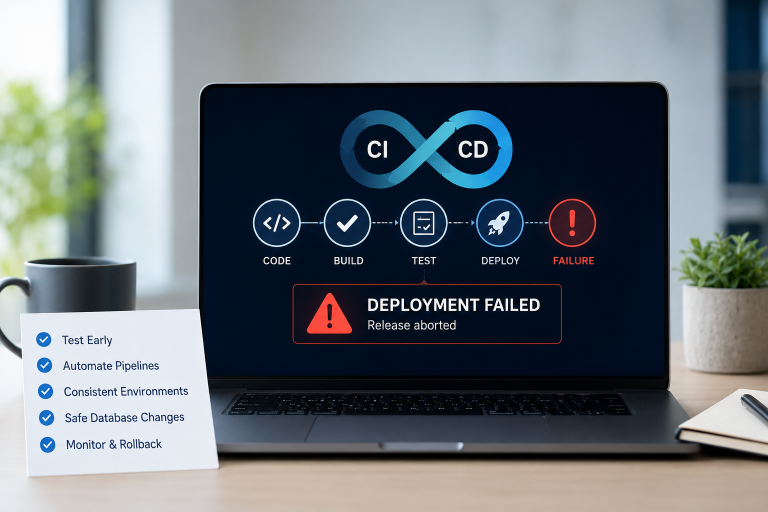
Read article →One bad release is all it takes to ruin a normal day at work. The build passes, the deploy goes out, and a few minutes later something breaks. Maybe checkout…
Read article →Nobody joins an engineering team because they love restarting servers at midnight. They join because they want to build things. Yet if you sit in on a few sprint planning…
Read article →Tell us where you are and what's slowing you down. A senior engineer will get back to you within one business day.
Our team will get back to you within one business day.

Leave a Reply