

Why Cloud Resources Keep Growing
Monday morning, your finance lead sends a message. The cloud bill jumped again, and she wants to know why. You open the console and scroll through hundreds of resources. You…
Read article →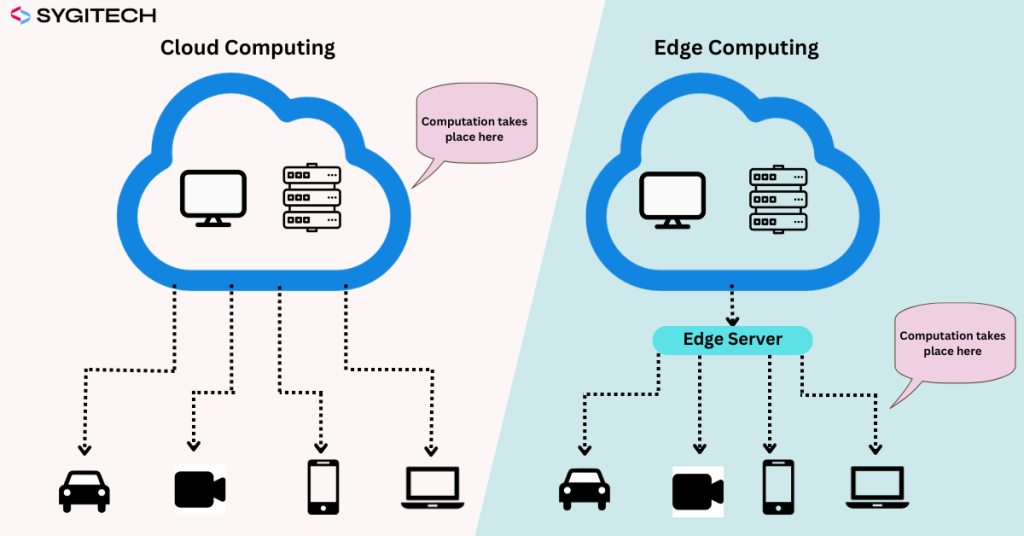
As businesses grow increasingly reliant on data-driven decision-making, the debate between edge computing and cloud computing continues to heat up. Both these technologies present unique advantages and benefits that may lead to the operational success of any business. The ultimate question still remains: which of the two computing solutions better suits the future? More importantly, how can businesses make the most of these advancements?
In this blog, we will explore the key differences between edge computing and cloud computing, their strengths, and how businesses can embrace these technologies to build smarter, faster, and more efficient IT infrastructures.
Cloud computing has changed the way modern information technology works. Organizations can keep, process, and manage data in central data centers, accessing it over the internet. By leveraging cloud management services from providers like Amazon Web Services (AWS), Microsoft Azure, or Google Cloud, businesses can efficiently expand their operations without significant upfront investment in hardware.
Edge computing is the new way of doing computing where data is processed near the source- like IoT devices, sensors, or local servers rather than big central data centers. This technique reduces delay and helps make decision-making faster, especially for things that need answers quickly, like autonomous vehicles or industrial automation. Many experts view edge computing as the future of cloud computing, offering innovative solutions for real-time data processing and localized operations.
| Features | Cloud Computing | Edge Computing |
| What it is | It’s when data is processed and stored in huge remote data centers that you access via the internet. | Data is processed right where it’s generated-on devices or nearby nodes-before it’s sent to the cloud. |
| Data Processing | Processes data in large data centers or centralized cloud servers. | Processes data locally on devices or at edge nodes before sending it to the cloud. |
| Latency | Higher latency due to the distance between the user/device and the cloud server. | Lower latency as data is processed closer to the source. |
| Bandwidth usage | Requires significant bandwidth for transmitting large volumes of data to the cloud. | Reduces bandwidth usage by processing data locally and sending only necessary information to the cloud. |
| Scalability | Super easy to scale-cloud providers have plenty of resources to grow with your needs. | It’s more limited-edge devices can handle only so much before you need more local nodes or devices. |
| Data Security | While cloud security is strong, data being stored far away might raise privacy concerns if not handled right. | Data stays close to home, offering more privacy, but securing lots of devices and nodes can get tricky. |
| Cost | Lower upfront costs but can add up with storage and processing fees over time. | Higher upfront costs for local devices, but ongoing costs are often lower because less data needs to travel. |
| Real time processing | Not the best for real-time tasks—delays can happen as data travels to and from the cloud. | Ideal for real-time action, as the data is processed immediately where it’s created. |
| Reliability | Depends on the internet connection—if it’s down, you can lose access to services. | More reliable for certain tasks because if the internet fails, local processing keeps things going. |
Both technologies have unique functions, and the decision between them often hinges on particular business needs:
Use Cloud Computing If:
Use Edge Computing If:
Consider a Hybrid Model:
For many businesses, the best approach is a combination of both. By leveraging managed cloud services alongside edge computing, you can benefit from the scalability of the cloud while enjoying the speed and efficiency of edge processing.
Decentralized data management, which combines edge and cloud computing, brings notable benefits but also several challenges. Data security is a primary concern; edge computing processes and stores sensitive information closer to its source, which can increase the risk of unauthorized access or breaches. In contrast, cloud computing focuses on securing data during transit, which comes with its own set of vulnerabilities.
Another challenge is managing costs; while edge computing can lower bandwidth expenses by processing data locally, the initial investment in local edge devices can be high. Conversely, cloud usage can escalate costs if businesses don’t closely monitor and optimize resource consumption.
Additionally, creating a seamless hybrid model that integrates edge and cloud computing requires careful planning and specialized knowledge to ensure smooth interoperability and prevent operational inefficiencies.
The future combines the strengths of both edge and cloud computing. As AI, 5G, and IoT evolve, businesses will adopt hybrid models for maximum benefit.
Edge computing and cloud computing are complementary technologies shaping the future of decentralized data. By understanding their strengths and limitations, businesses can implement solutions that drive innovation, efficiency, and scalability.
Monday morning, your finance lead sends a message. The cloud bill jumped again, and she wants to know why. You open the console and scroll through hundreds of resources. You…
Read article →You dread deployment day. You flinch when the cloud invoice lands in your inbox. You’ve stopped trying to explain the architecture to new hires because you’re not fully sure how…
Read article →Your migration was supposed to be finished by now. Instead, you’re staring at a cloud bill that’s twice your budget. An application keeps timing out. Your team is exhausted from…
Read article →Tell us where you are and what's slowing you down. A senior engineer will get back to you within one business day.
Our team will get back to you within one business day.
Leave a Reply