

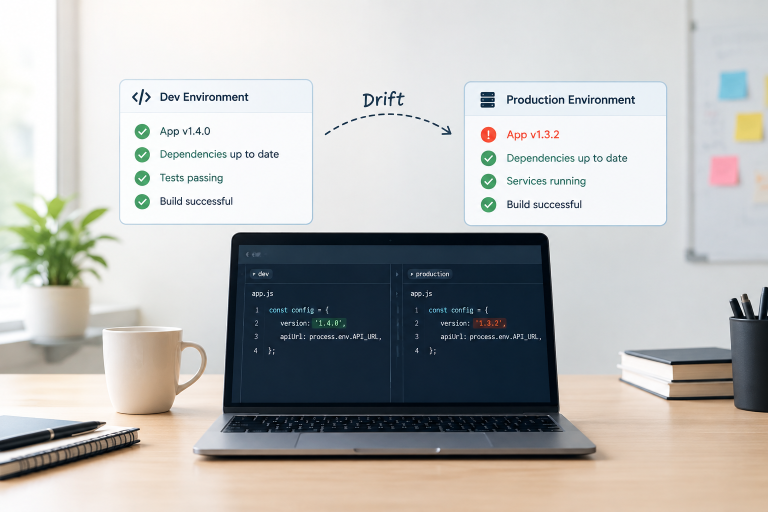
Why Dev and Production Environments Drift
It’s 11:47pm. The deploy that passed every test an hour ago just took production down. Nobody can figure out why, because nothing in staging looked like this. Someone finally says…
Read article →
In today’s competitive software industry, businesses can’t afford to overlook solid software development practices. Continuous Integration and Continuous Delivery (CI/CD) have become game-changers, making software development and deployment smoother and more efficient. By automating various stages of the software development lifecycle, CI/CD pipelines enhance efficiency, reduce errors, and accelerate time to market.
Automation shapes software development, and when combined with DevOps, it drives innovation and agility. By integrating CI/CD with DevOps practices, businesses can streamline workflows, improve collaboration, and deliver high-quality software faster than ever.
A CI/CD pipeline is like a smart assistant for software development, handling everything from integrating new code to testing and deploying it—without the usual manual hassle. It consists of two primary components:
Continuous Integration (CI): The developers continually integrate code updates into a shared repository. Tests are executed automatically to identify errors early and have quality code.
Continuous Deployment (CD): Once the code passes testing successfully, the system automatically deploys it to production, reducing manual intervention and deployment time.
By using a CI/CD pipeline, teams can work more efficiently, reduce errors, and release software smoothly and consistently.
Here, we explore how CI/CD pipelines improve software development efficiency.
In the past, developers worked on different parts of a project separately and had to merge their code manually, which often caused conflicts and slowed things down. CI/CD pipelines enable this by enabling developers to integrate their changes regularly. With Continuous Integration, the system automatically tests and merges every code change, reducing compatibility issues. Continuous Deployment takes it a step further by releasing new features and fixing bugs automatically. This automation speeds up development, allowing teams to provide updates quickly and effectively.
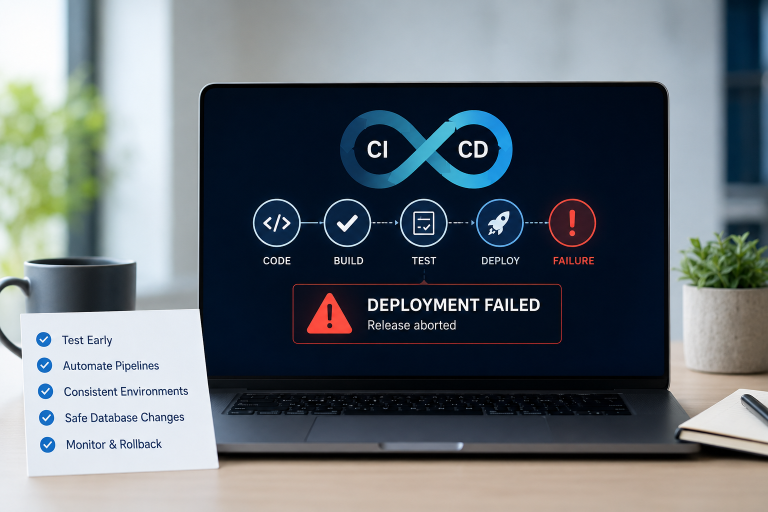
Manual deployment of software can have errors, such as misconfigured settings, missing dependencies, and human errors can cause major headaches. . CI/CD pipelines eliminate such issues by standardizing the deployment process each time. With built-in testing and scripted deployments, teams can ensure everything runs smoothly across different environments. Plus, version control makes it easy to track changes and roll back if something goes wrong. CI/CD minimizes manual efforts, and in doing so it boosts software reliability and helps prevent unexpected issues.
One of the biggest benefits of CI/CD pipelines is how they seamlessly integrate automated testing into the development process. Every time a developer pushes new code, tests run automatically to check for any issues. The automated tests involve unit tests, integration tests, and security scans to ensure that new updates do not have bugs or security vulnerabilities. CI/CD identifies problems early, enabling developers to fix them before the software release, resulting in more stable and higher-quality updates.
Instant feedback is important in software development, and CI/CD pipelines give immediate feedback on the performance of the code. Every time a change is made, automated tests and deployment reports highlight any issues right away. This enables teams to fix problems early instead of waiting until later in the development cycle. Quicker feedback loops result in better debugging and ongoing improvement, making the whole process of software development easier.
CI/CD facilitates easy interaction between operation teams, testers, and developers. Because each change is maintained in a central repository, the team members are able to clearly see the current updates and keep track of work in real-time. Automated pipelines ensure that code is always tested and deployable, reducing issues between development and operation teams. This collaborative approach makes workflows easy and increases productivity overall, making teams more efficient.
CI/CD pipelines grow alongside your project, making it easy to support larger teams, more complex code, and an expanding user base. You can tailor them to fit various workflows, whether deploying to the cloud, on-premises servers, or mobile platforms.
As a key part of DevOps, CI/CD pipelines seamlessly integrate with other practices like infrastructure as a code, monitoring, and continuous feedback. This integration boosts efficiency and helps teams deliver high-quality software faster.
Keeping software secure is a top priority, and CI/CD pipelines help by automating security checks every step of the way. From vulnerability scans to code analysis, these pipelines catch potential threats early, making it easier to fix issues before deployment.
Compliance is just as important—CI/CD can be set up to follow industry standards and regulations automatically. This ensures your software meets security requirements without slowing down development.
CI/CD pipelines have revolutionized software development by making the process faster, more efficient, and less reliant on manual efforts. As a result, companies that adopt CI/CD practices can develop software more quickly, deploy it seamlessly, and collaborate more effectively.
Integrating DevOps as a service takes this a step further, helping companies refine their software delivery, drive continuous innovation, and scale effortlessly. Investing in CI/CD pipelines is now necessary to remain competitive in the digital age.
Whether you’re a startup or an established enterprise, implementing CI/CD can help you build reliable, high-performing applications while keeping operations agile and efficient. The future of software development is all about automation, and CI/CD is at the heart of it.
It’s 11:47pm. The deploy that passed every test an hour ago just took production down. Nobody can figure out why, because nothing in staging looked like this. Someone finally says…
Read article →One bad release is all it takes to ruin a normal day at work. The build passes, the deploy goes out, and a few minutes later something breaks. Maybe checkout…
Read article →Nobody joins an engineering team because they love restarting servers at midnight. They join because they want to build things. Yet if you sit in on a few sprint planning…
Read article →Tell us where you are and what's slowing you down. A senior engineer will get back to you within one business day.
Our team will get back to you within one business day.

Leave a Reply