

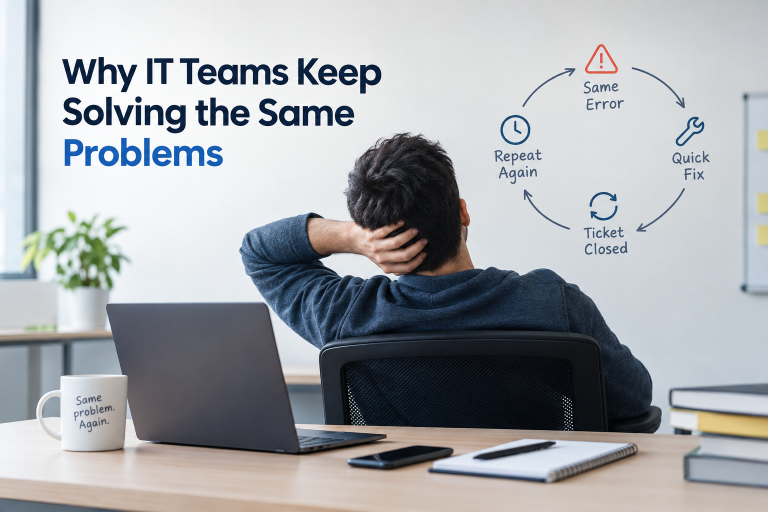
Why IT Teams Keep Solving the Same Problems
You close a ticket, feel a small sense of relief, and move on with your day. Then, three months later, the same issue shows up again, almost word for word.…
Read article →
Walk into a government office, and you will often find a paradox. On the one hand, there are passionate public servants with a vision for a better society—more accessible healthcare, faster legal systems, and transparent governance. On the other hand, these ambitions are tethered to legacy systems, manual workflows, and bureaucratic inertia. Somewhere between intent and implementation, innovation tends to lose its edge. Now, what if the bridge between vision and execution is not just technology—but the right-thinking partner? This is where technology consulting services quietly become the unsung architect of public sector transformation. In fact, IT consulting for government transformation is emerging as a critical function—one that connects policy, technology, and purpose to drive lasting public impact.
Let us discard the tired definition of digital transformation as simply “putting services online.” That is the low-hanging fruit. Real transformation means reimagining how government works—from its foundational logic to the citizen experience. And to do that, you need not just coders or cloud tools, but strategic provocateurs who ask the uncomfortable questions:
IT consultants—especially those experienced in public sector design—ask these questions and, more importantly, answer them.
In the public sector, digital success is not about moving fast and breaking things. It is about moving wisely and building things that last. IT consultants operate in this space as interpreters between policy, people, and platforms.
They translate legislative goals into actionable blueprints, decode user needs from data patterns, and balance innovation with compliance and risk. In essence, they act as both engineers of trust and orchestrators of change.
But the real magic lies in their ability to shift focus from technology as a tool to technology as an enabler of systemic change.
Here is something most digital strategies overlook: every technology decision made by a government eventually becomes a de facto policy decision.
IT consultants bring not just technical guidance but ethical foresight. The best among them guide governments through these silent crossroads—where code quietly rewrites how power distributes, how access grants, and how accountability enforces.
In day-to-day experiences, Indian citizens may occasionally face challenges when accessing public services. For example;
Solution: Microservice Layer & API Gateway Overlay
Instead of overhauling the entire legacy system, consultants introduce a modular microservices layer—just for key tasks like user login, application status, and payment tracking. These are exposed through a secure API gateway, enabling:
All of this happens without a full system rewrite—ensuring continuity and low risk.
Also, implement: New features and modules are deployed using a blue-green strategy—two identical production environments (one active, one idle). Traffic can be shifted instantly if an error occurs, resulting in zero-downtime updates.
Let us be honest: innovation in government is not a software update. It is a cultural negotiation. You are dealing with risk-averse structures, deeply ingrained processes, and systems that were built to resist rapid change. It is no wonder that most digital initiatives collapse under the weight of their own complexity.
This is precisely where the true value of IT consulting lies—not in writing code, but in rewriting the playbook of how innovation happens in complex, high-stakes environments.
Consultants often come in not just to build but to unblock—unblock silos, legacy debt, fear of failure, and above all, the inertia of “how things have always been done.”
They do this through mechanisms often invisible to public eyes:
Historically, governments treated consultants like vendors—brought in to deliver a fixed output on a defined timeline. But the new era of transformation demands something different: embedded allies who become part of the government’s digital DNA. And that shift starts with selecting the best IT consultants—not just for their technical skills, but for their ability to think systemically, build trust, and drive long-term public value.
This means long-term partnerships where consultants:
The consultant’s role expands from technical advisor to public sector futurist—helping governments not just fix today’s problems but design tomorrow’s potential.
Here is a radical idea: What if government RFPs started asking for problem solvers, not just solution providers?
Most public sector projects still operate on transactional procurement models that reward predictability over potential. But innovation is rarely predictable. It needs room for evolution, feedback loops, and human nuance.
Progressive governments are already shifting toward outcome-based engagements—where IT consultants are not penalized for learning along the way but incentivized for enabling measurable public impact. This changes everything.
Want to know where real government innovation happens? It is not in a glossy dashboard or a smart city prototype. It happens in quieter moments:
Behind each of these moments is a complex web of decisions, system integrations, stakeholder negotiations—and often, a team of consultants working silently in the background to make it all work.
The best consultants know when to leave. Because the true test of impact is not in how much they build, but how much they leave behind—in capability, in culture, in courage.
Government innovation cannot be outsourced. But it can be accelerated, guided, and scaffolded. IT consultants play that catalytic role—not by doing things for governments, but by teaching them to do things differently.
And when done right, they do not just deliver digital solutions—they reshape public institutions for a new era.
The next big leap for the government isn’t just about launching another shiny new product. It’s about shifting how we think – moving from simply reacting to problems toward actively reshaping public systems for the better. And making that shift won’t be just about writing lines of code.
It’s going to take consultants who really understand the complex web of governance, human behavior, ethics, infrastructure, and systems thinking. These are not just tech experts; they are architects of transformation, guiding governments through complexity with a clear and thoughtful vision.
This quiet revolution is gaining ground, driven by bold, purpose-led tech projects that reshape how governments serve:
Designing unified, cross-agency ID systems using biometrics, blockchain, and zero-knowledge proofs to streamline citizen access and protect privacy.
Using machine learning and digital twins to simulate the impact of policy decisions before implementation.
Building real-time health systems that combine hospital, genomic, and environmental data to anticipate outbreaks.
Piloting smart contracts and automated decision-making for low-risk tasks like tax refunds or benefit disbursement.
Deploying NLP-driven legal assistants to help citizens understand rights and draft basic legal documents.
Developing frameworks to audit government AI systems for bias, fairness, and transparency.
Advising governments on energy-efficient tech stacks, green data centers, and sustainable digital services. Each of these is more than just a digital project. They are structural interventions for a more intelligent, inclusive, and ethical public sector. This is not a digital government. This is adaptive government—a model that listens, learns, and evolves. At the heart of this movement lies IT consulting services—not as a vendor offering, but as a strategic function that reimagines how governments serve people in a digital age.
You close a ticket, feel a small sense of relief, and move on with your day. Then, three months later, the same issue shows up again, almost word for word.…
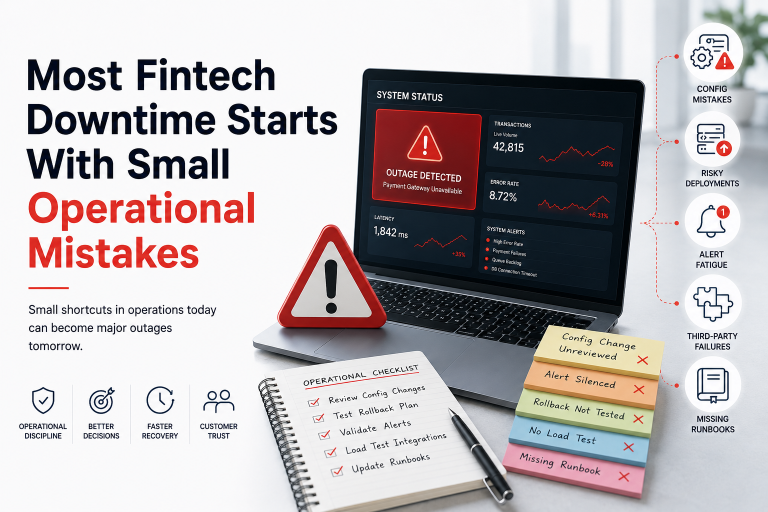
Read article →There’s a familiar pattern that often unfolds quietly within fintech engineering teams, usually just before things take a turn for the worse. A configuration file gets updated without anyone taking…
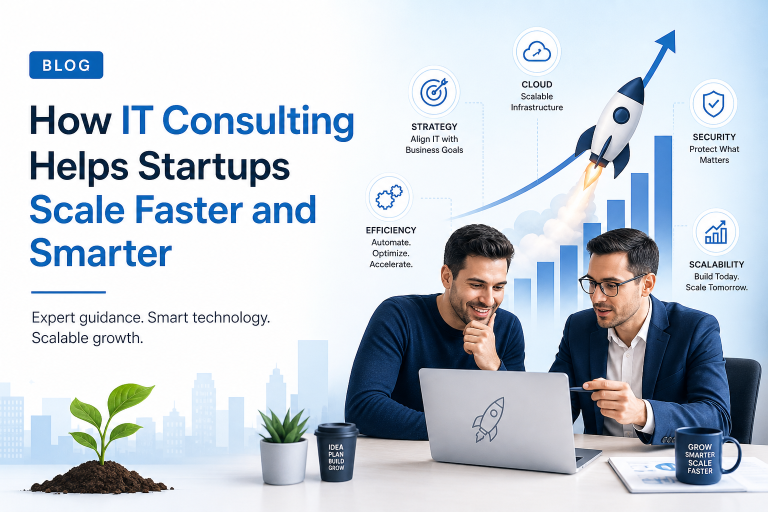
Read article →In a startup, rapidity is a tactical benefit and a potential threat. The capability to act swiftly allows for market entry, fast iteration, and the acquisition of initial customers. Nonetheless,…
Read article →Tell us where you are and what's slowing you down. A senior engineer will get back to you within one business day.
Our team will get back to you within one business day.
Leave a Reply