

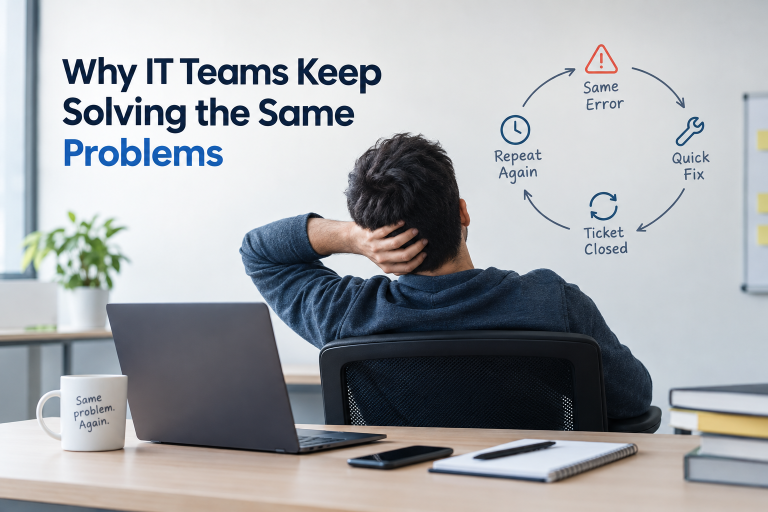
Why IT Teams Keep Solving the Same Problems
You close a ticket, feel a small sense of relief, and move on with your day. Then, three months later, the same issue shows up again, almost word for word.…
Read article →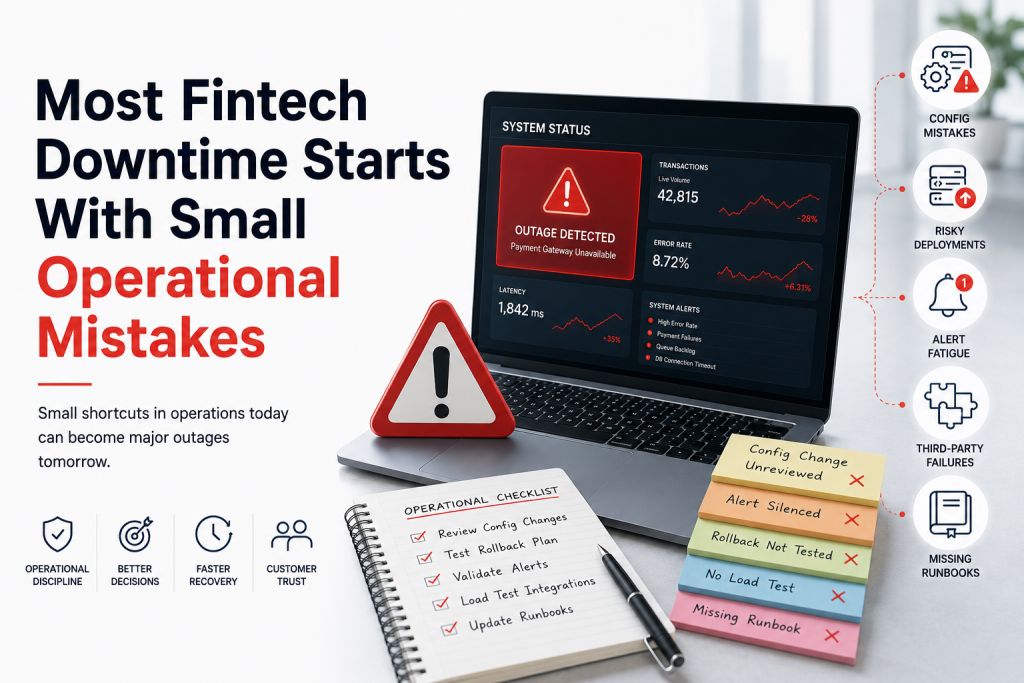
There’s a familiar pattern that often unfolds quietly within fintech engineering teams, usually just before things take a turn for the worse. A configuration file gets updated without anyone taking a second look. A deployment happens at 4:45 PM on a Friday because the sprint deadline is looming. An alert goes off, someone hits the snooze button on it, and it never gets turned back on. At the moment, none of these actions seem like a big deal. In fact, they hardly register as decisions. They’re just the little bumps that come with a fast-paced team trying to keep up under pressure.
Three weeks later, the payment gateway crashes during peak transactions, and the engineering channel floods with alerts.
What makes fintech downtime particularly painful isn’t just the financial impact, though that’s real and significant. It’s that most of it is traceable back to something that wasn’t a mystery at all. It was a known shortcut, a skipped step, or an operational habit that nobody thought to correct until it was too late. And yet, fintech downtime prevention rarely gets the dedicated attention it deserves until after the first serious incident.
Many engineering teams avoid admitting this: a working system is not always a reliable one. In fintech, that gap can become expensive quickly. A system might pass CI checks, move through staging, and deploy flawlessly, yet still rest on a shaky foundation that cracks under pressure or during sudden traffic spikes. A green deployment status does not guarantee your payment system can handle 40,000 users hitting it simultaneously at month-end.
Consider a situation that happens more frequently than most CTOs would care to admit. A fintech startup kicks off with a monolithic architecture that manages payments, user identities, and transaction records all in one service. In the beginning, the team is small, the pace is quick, and “reliability” simply means the app doesn’t crash. But as the user base expands and the challenge of scaling the fintech infrastructure arises, they start breaking out microservices one at a time. However, the operational practices like how they manage deployments, handle configurations, and track incidents to learn from them, don’t keep up with the architectural changes.
The codebase gets a modern makeover, but the culture lags behind. That disconnect is precisely where downtime sneaks in.
None of these are surprising. They just rarely get named.
Unreviewed configuration changes are probably the biggest hidden threat in fintech infrastructure. In many payment platforms, a simple misconfigured environment variable like an incorrect timeout value, a flipped feature flag, or an outdated API endpoint can trigger a chain reaction of failures that seem completely unrelated to the actual issue. Investigating it can take hours, while the fix itself might only take a few minutes. And that quick review that could have caught the problem? Just thirty seconds.
Take this real-life example: A payments team rolled out a routine configuration update that accidentally changed the retry timeout on their card authorization service from 3,000ms to 300ms- a typo, essentially. Everything looked fine in staging since the load was low. But in production, with normal transaction volume, the service began timing out and retrying in a tight loop. Within twenty minutes, they had a queue backup that took two hours to clear. The post-mortem identified the root cause in under five minutes: the config change had no reviewer assigned.
Incomplete rollback plans are another common issue. Teams invest heavily in deployment automation but treat rollback as an afterthought. When a release breaks production, the team’s rollback planning determines whether recovery takes five minutes or turns into a forty-five-minute scramble. In fintech, forty minutes of scramble during peak hours isn’t a technical failure. It’s a trust failure with your customers.
Alert fatigue is something almost every mid-sized fintech team will recognize. Monitoring dashboards grow over time, often without pruning. Teams start adding alerts liberally, thresholds get set too low, and before long, the on-call rotation is getting paged for things that don’t need human attention at 2 AM.
This is also where teams without 24/7 IT monitoring services feel the gap most acutely when nobody is watching the right signals around the clock, a slow-burn failure can go undetected until it’s already a production incident. The result is that genuinely critical alerts get treated with the same skepticism as the noise. When something real fires, the first instinct is to check if it’s another false positive and those lost minutes matter in financial systems.
Skipping load and chaos testing on new integrations can lead to some pretty serious issues. Fintech products aren’t standalone; they rely on payment processors, banking APIs, identity verification services, and fraud detection platforms. Each of these connections is a potential weak spot that many teams don’t stress-test nearly enough. A third-party API that times out when under pressure won’t show up in unit tests—it’ll rear its head in production, right when you’re at peak traffic, after you’ve already launched the feature.
Take this real-life example: a lending platform integrated a third-party KYC provider and ran extensive tests in staging—hundreds of verification requests, all coming back smoothly in under 800ms. But they overlooked testing for concurrent load. When their first big marketing push led to a flood of new signups, the KYC provider began throttling requests once they hit a concurrency limit that was buried deep in the API documentation. This caused a bottleneck in new user onboarding. The solution involved implementing a queue with backpressure, something that should have been part of the initial design. It ended up taking three days to get it right. A simple one-hour load test before the launch could have caught this issue entirely.
Missing runbooks become painfully obvious the moment a senior engineer goes on vacation. Most fintech teams spread undocumented operational knowledge across a handful of experienced people. When those individuals are unavailable, even skilled engineers can spend an hour navigating an incident that a clear runbook could resolve in fifteen minutes.
If these issues are so well-understood, why do they keep showing up?
Velocity pressure is the honest answer most of the time. Fintech is a competitive market and the pressure to ship fast is real. Operational hygiene -writing runbooks, reviewing alert thresholds, designing rollback procedures doesn’t show up on a product roadmap. It’s invisible work until the day it becomes very visible work at the worst possible time. Fintech downtime prevention gets treated as someone else’s problem right up until it becomes everyone’s emergency.
Then there’s organizational structure. Engineering teams often handle deployment and reliability while organizations under-resource SRE functions or delay establishing them altogether. When there’s no clear owner for operational standards, standards drift quietly until something breaks loudly. This is one of the more common patterns that surfaces when teams bring in IT consulting services to audit their reliability posture not missing technology, but missing ownership.
And then there’s the survivorship bias of having gotten away with it before. A team that deploys on Friday afternoons without incident for six months develops a false confidence. The mistake wasn’t caught, so the mistake doesn’t feel like a mistake. Until it is.
There’s a reason we keep seeing the same operational blunders pop up in fintech companies, no matter their size, tech stack, or location. Internal teams often become too immersed in the system to notice recurring patterns. After working inside the same architecture for two years, teams start treating obvious risks as normal operational behavior.
This is where experienced IT consulting services genuinely change the outcome, not by bringing in a new tool or rewriting the infrastructure, but by bringing in a perspective that isn’t anchored to how things have always been done on that particular team.
A good consulting engagement in this context isn’t an audit that produces a fifty-page report nobody reads. It’s a working process where an external team with cross-industry pattern recognition sits alongside engineering leadership and identifies the operational gaps that internal teams have normalized. The config change process works fine until it doesn’t. The alert setup that made sense eighteen months ago but hasn’t been touched since. The rollback procedure that exists in a doc somewhere that nobody has actually tested.
What makes the consulting lens particularly valuable in fintech is the pattern library it brings. A team that has worked across multiple payment platforms, lending products, and digital banking environments has seen where these operational cracks tend to appear and more importantly, they’ve seen what actually fixes them versus what looks good in a presentation but doesn’t hold up under real operational pressure.
Many teams struggle to fix operational debt because internal engineers often lack the time, authority, or distance needed to challenge long-standing habits. Teams usually recover faster when they bring in an outside perspective that helps leadership recognize operational risks before the next major incident exposes them.
None of this requires rebuilding from scratch. Effective fintech downtime prevention is less about new tooling and more about consistent habits enforced at the team level – ideally before the first major incident, not as a reaction to it.
Every infrastructure change, not just code, but config, IAM policies, DNS, feature flags should go through a lightweight review process. It doesn’t need to be heavy bureaucracy. A second pair of eyes and a changelog entry is often enough to catch the kind of mistake that causes hours of downtime.
Before any significant deployment, teams should document the rollback procedure, test it in staging, and review it alongside the deployment plan. This shifts the question from “how do we fix this if it breaks?” to “we already know exactly how to fix this.”
Set aside time -quarterly at minimum – to go through alert configurations as a team. Kill alerts that fire without actionable outcomes. Raise thresholds where the signal is too sensitive. A lean, high-signal alert setup will serve you far better than a comprehensive but noisy one that everyone has learned to ignore.
Deliberately introduce failure at your integration points in a controlled environment. What happens when your payment processor returns a 504? What happens when the fraud scoring service takes eight seconds instead of two? If you’ve already run the scenario in pre-production, you’ve already seen the blast radius and you’ve already built the handling for it.
Every operational procedure that exists only in someone’s head is a liability. This includes common incident types, manual override procedures, escalation paths, and known system quirks. The goal isn’t documentation for its own sake. It’s reducing the mean time to recovery when something happens at 2 AM and the person who built that system is unreachable.
There’s a meaningful difference between fintech companies that experience downtime as an occasional, well-managed event and those that experience it as a recurring crisis. That difference almost never comes down to technology. It depends on whether the team treats fintech downtime prevention as an ongoing discipline instead of a reaction after something breaks.
Every hour of downtime sends a clear message to your customers about how much you value their money and trust. More often than not, small issues trigger that message – an unchecked configuration change, a poorly configured alert, or an unplanned rollback.
The teams that manage to break this cycle of mistakes are the ones who integrate operational discipline into their daily routine, rather than just reacting to the latest outage.
You close a ticket, feel a small sense of relief, and move on with your day. Then, three months later, the same issue shows up again, almost word for word.…
Read article →In a startup, rapidity is a tactical benefit and a potential threat. The capability to act swiftly allows for market entry, fast iteration, and the acquisition of initial customers. Nonetheless,…
Read article →Walk into a government office, and you will often find a paradox. On the one hand, there are passionate public servants with a vision for a better society—more accessible healthcare,…
Read article →Tell us where you are and what's slowing you down. A senior engineer will get back to you within one business day.
Our team will get back to you within one business day.

Leave a Reply