

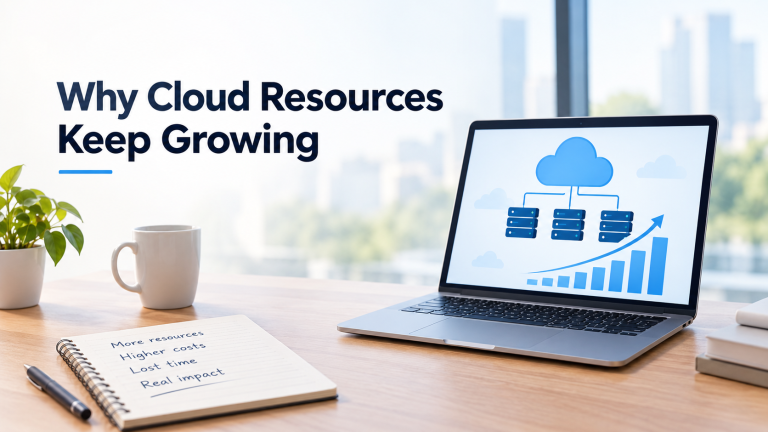
Why Cloud Resources Keep Growing
Monday morning, your finance lead sends a message. The cloud bill jumped again, and she wants to know why. You open the console and scroll through hundreds of resources. You…
Read article →
The swift move to cloud computing has transformed how businesses handle data storage, processing, and management. Moreover, cloud services provide unmatched scalability, flexibility, and cost efficiency, making them vital to contemporary IT infrastructures. However, this shift has also introduced various security risks that, if not managed effectively, could result in significant data breaches, financial setbacks, and issues with regulatory compliance. As a result, securing the cloud has become a top priority for both businesses and IT leaders, especially as cyber threats continue to advance.
While cloud computing provides scalability and cost-effectiveness, it also brings certain vulnerabilities. Many organizations overlook the fact that public-facing applications and storage buckets can be prime targets for cyberattacks.
Attackers frequently take advantage of human errors, employing phishing emails and malicious links to gain unauthorized access. Once they breach the defenses, they can deploy malware that either exfiltrates data or encrypts files for ransom. Furthermore, cybercriminals are constantly evolving their tactics, using AI-generated phishing emails that look increasingly convincing. Consequently, employees, vendors, and even customers can unintentionally become conduits for attacks, which highlights the importance of user education and the implementation of strong security measures.
One of the most commonly ignored security risks in cloud computing is misconfiguration. Publicly accessible cloud storage buckets, exposed APIs, and weak authentication methods create easy targets for hackers. Cybercriminals actively search the internet for vulnerable cloud assets, and a single misconfiguration can result in data leaks or complete system breaches.
To address these risks, adopting a Zero Trust security model is essential. Unlike traditional security methods that rely on a defined perimeter, Zero Trust operates on the principle of “never trust, always verify.” This approach requires that every request from users, devices, and applications undergoes rigorous authentication and authorization checks before access is granted.
Organizations should implement multi-factor authentication (MFA), enforce least-privilege access controls, and maintain continuous monitoring to uphold a robust security posture. By utilizing cloud monitoring and management services, businesses can identify anomalies early, enforce security policies effectively, and respond to potential threats before they develop into significant security breaches.
By adopting a Zero Trust framework, organizations can greatly diminish the risk of unauthorized access and minimize the impact of any attacks.
Even with top-notch security measures in place, breaches can still occur. The crucial factor is how organizations react to limit damage and recover swiftly.
To reduce data exposure, companies should adopt end-to-end encryption for data both at rest and in transit. Even if attackers manage to access encrypted data, it remains unreadable without the decryption keys. Implementing role-based access control (RBAC) guarantees that only authorized personnel can access critical systems, thereby minimizing insider threats.
Organizations ought to utilize AI-driven Security Information and Event Management (SIEM) and Extended Detection and Response (XDR) solutions to identify and address threats in real-time. Automating threat detection and response allows security teams to act quickly on anomalies before they develop into major breaches.
Employing Cloud Security Posture Management (CSPM) and Cloud Workload Protection Platforms (CWPP) can assist organizations in continuously monitoring and fixing security misconfigurations across cloud environments. Additionally, integrating cloud-native solutions through IT consulting enhances these efforts by providing expert guidance and ensuring robust security measures. These tools actively prevent unauthorized access and ensure adherence to security policies.
While security is often viewed as a cost, it is actually a vital investment. A robust security framework can help avoid expensive data breaches, regulatory fines, and damage to reputation.
Not adhering to security compliance standards can result in significant penalties. Regulations such as GDPR, HIPAA, ISO 27001, and SOC 2 require stringent cloud security measures. Organizations need to perform regular security audits, utilize automated compliance reporting, and ensure they align with industry standards to prevent legal issues.
Threat Intelligence & Security Information Sharing
Cyber threats are constantly evolving, making real-time threat intelligence essential. Organizations should incorporate threat intelligence feeds like MITRE ATT&CK, CISA advisories, and commercial threat intelligence platforms to continuously update security protocols and block known attack vectors before they can breach systems.
Automation in Security Operations
Securing the cloud through automation is crucial. Security teams can deploy automated playbooks to block threats, isolate assets, and send alerts.
Security is a collective responsibility that extends beyond just IT or cybersecurity teams.
By incorporating security into the software development lifecycle (SDLC), organizations can spot vulnerabilities at an early stage. DevSecOps weaves security practices into CI/CD pipelines, ensuring that security checks, vulnerability assessments, and compliance validations are conducted before applications go live. This proactive strategy minimizes security risks associated with misconfigurations and insecure coding practices.
Cyber threats aren’t solely the work of external actors. Insider threats, whether they are deliberate or accidental, can be just as harmful.
Organizations should adopt User and Entity Behavior Analytics (UEBA) to track and identify unusual activity patterns that could signal compromised accounts or malicious insiders. Additionally, mandatory security training programs are essential to inform employees about cybersecurity best practices.
Even the most robust security infrastructure requires regular testing. Incident response playbooks offer detailed instructions on effectively managing cyberattacks. Security teams should engage in tabletop exercises- simulated cyberattacks that evaluate their response capabilities in real-world scenarios.
As cyber threats keep changing, organizations need to adjust their cloud security strategies accordingly. New trends like AI-driven security analytics, defenses against zero-day exploits, and decentralized identity solutions are crucial for bolstering cloud environments. Moreover, with the advent of quantum computing, companies should start looking into quantum-safe encryption methods to secure their data for the future. Leveraging managed cloud services can further enhance security by offering expert guidance and advanced threat protection solutions.
Securing the cloud requires a proactive approach as cyber threats continue to evolve. Organizations can stay ahead by adopting a proactive approach. Implementing Zero Trust, encryption, DevSecOps, automation, and cloud-native security tools is vital for protecting cloud environments. Companies that invest in robust cloud security measures now will create a resilient infrastructure capable of withstanding future cyber threats.
By recognizing the risks, applying strong security controls, and promoting a security-first culture, organizations can safeguard their assets, maintain customer trust, and ensure long-term business continuity in the cloud.
Monday morning, your finance lead sends a message. The cloud bill jumped again, and she wants to know why. You open the console and scroll through hundreds of resources. You…
Read article →You dread deployment day. You flinch when the cloud invoice lands in your inbox. You’ve stopped trying to explain the architecture to new hires because you’re not fully sure how…
Read article →Your migration was supposed to be finished by now. Instead, you’re staring at a cloud bill that’s twice your budget. An application keeps timing out. Your team is exhausted from…
Read article →Tell us where you are and what's slowing you down. A senior engineer will get back to you within one business day.
Our team will get back to you within one business day.

Leave a Reply