

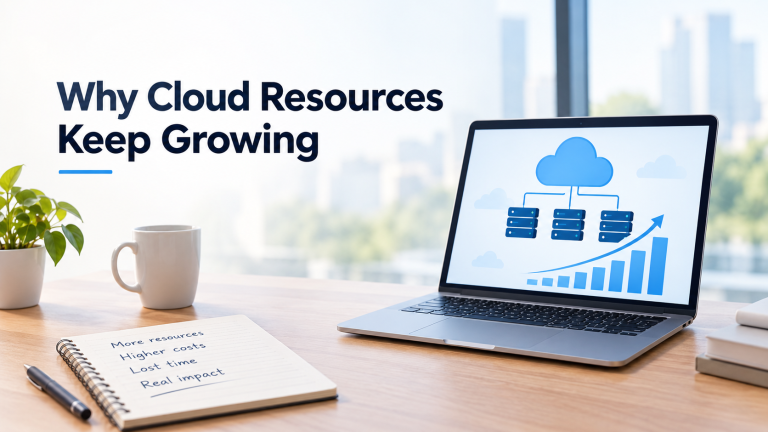
Why Cloud Resources Keep Growing
Monday morning, your finance lead sends a message. The cloud bill jumped again, and she wants to know why. You open the console and scroll through hundreds of resources. You…
Read article →
Working from home is no longer just a backup plan—it is a must-do. Most of the time, when people talk about remote work, they talk about video calls and virtual meetings. But the real engine behind this shift is cloud server infrastructure that supports automation, global collaboration, and business sustainability—making all of this possible through remote work with cloud servers.
In this blog, we will explore how cloud servers are reshaping not only where people work, but how work actually happens.
Cloud servers are virtual machines hosted in powerful data centers, accessible over the internet. Unlike traditional physical servers, cloud servers are:
Scalable: Adjust resources dynamically based on need.
Accessible: Reachable from anywhere with an internet connection.
Managed: Maintained by cloud service providers like AWS, Microsoft Azure, or Google Cloud.
They deliver computing power, storage, networking, and software environments remotely—enabling teams to stay productive from any location.
Initially, businesses adopted cloud servers simply to “enable” remote work—granting access to files, tools, and communication channels. But as needs evolved, so did cloud strategies. Now, cloud infrastructure is about empowering teams to work faster, smarter, and more securely. Empowerment includes:
AI-driven optimization: Cloud platforms use machine learning to distribute workloads efficiently, reducing delays.
Global performance balancing: Teams across continents get consistent, reliable service through smart load balancing.
Edge computing: Minimizes latency by processing data close to the user’s physical location.
These are not just tech upgrades, they are the foundation for modern business continuity and global collaboration.
The COVID-19 pandemic changed how the world thinks about work. Practically overnight, companies went digital and cloud server hosting solution have become the critical enabler.
Why was the cloud so vital?
Business Continuity: Cloud systems ensured employees could access tools and data from home without interrupting operations.
Operational Flexibility: New digital offerings and support channels were launched rapidly, without the need for physical infrastructure.
Real-Time Collaboration: Teams across locations stayed aligned using shared, cloud-based platforms.
Organizations already in the cloud transitioned seamlessly. Others had to catch up fast—revealing deep gaps in digital readiness and IT strategy.
Cloud servers are not just storage systems, they are the foundation for operating remotely at scale. Here’s how they fuel distributed workforces:
Employees can securely log into business systems from any internet-enabled device—whether it’s a desktop in Paris or a tablet in Pune. This ensures continuity, agility, and productivity, even during travel or emergencies.
Apps like Microsoft 365, Google Workspace, Notion, and Trello operate on cloud servers. These tools enable teams to collaborate live, manage projects, edit documents, and communicate efficiently. Version control, backups, and audit trails maintain clarity and accountability.
Cloud infrastructure supports rapid scaling. Need more storage or processing power? Increase capacity instantly. Want to cut costs during slow periods? Scale down with ease. This elasticity supports agile business decisions.
Leading cloud providers offer robust protections:
This makes the cloud a secure and compliant choice for remote teams working with sensitive information.
Businesses can reduce infrastructure investments and avoid costs for maintenance, cooling, and staffing. With the pay-as-you-go model, teams only pay for what they use—freeing up IT budgets for innovation. This is especially beneficial for startups and SMEs looking to scale efficiently.
The real magic of cloud infrastructure is in automation. Cloud servers help remove repetitive tasks so teams can focus on high-value work. With the support of cloud management services, businesses can streamline workflows, monitor usage, enforce policies, and automate deployment pipelines without the overhead of manual oversight.
Here is what automation in the cloud looks like:
Intelligent Reporting: Get auto-generated insights based on real-time metrics.
Automated Onboarding: New hires receive credentials, training materials, and tool access instantly.
AI Support Tools: Bots resolve basic queries, handle requests, and manage internal documentation around the clock.
These smart workflows speed up delivery, reduce errors, and enhance user experiences—internally and externally.
With cloud infrastructure, businesses are no longer tied to one location. They can hire top talent from across the globe and form highly capable, geographically diverse teams.
Strategic benefits include:
24/7 Workflows: Teams in different time zones keep productivity moving around the clock.
Diverse Talent: Global hiring opens access to varied skill sets and cultural perspectives.
Lower Costs: Avoid the expense of setting up international offices.
Need to scale fast? Spin up new cloud environments, grant secure access, and localize deployment—all within hours.
While cloud systems make remote work technically possible, managing remote teams requires intentional strategy.
Challenges include:
Time Zone Conflicts: Coordinating meetings and deliverables across regions.
Communication Delays: Misunderstandings due to asynchronous interactions.
Cultural Nuances: Building team unity across different backgrounds.
Successful leaders:
Cloud collaboration platforms help bring clarity, visibility, and rhythm to remote operations.
Not all employees are naturally tech-savvy. Organizations must proactively support the shift to remote work by closing the digital skill gap.
Steps include:
Training Programs: Offer structured learning paths for essential tools.
Tailored Onboarding: Customize programs for remote employees.
Encouraging Upskilling: Promote digital literacy as part of professional growth.
Cloud environments support these efforts by integrating learning management systems, feedback tools, and analytics into a single workspace.
A cloud-first strategy depends heavily on internet quality. Employees in regions with unreliable connectivity can face barriers.
Solutions include:
Planning for these variables ensures that the full team stays productive regardless of geography.
Cloud servers are not just keeping pace with the remote revolution—they are shaping its future. Expect these trends to gain traction:
Hybrid Workspaces: Cloud tools will bridge physical and virtual environments, allowing seamless work transitions.
AI for Management: Cloud-based analytics will support smarter decisions in HR, productivity, and operations.
Decentralized Hiring: Talent selection will focus on skills and performance, not location.
Resilient Operations: Cloud-based systems provide continuity through global disruptions—natural disasters, economic shifts, or cybersecurity incidents.
As these shifts play out, organizations that embrace cloud-first thinking will lead the charge in defining the next generation of work.
Cloud servers have fundamentally reshaped how and where we work. What started as a tool for accessibility has become a catalyst for business transformation—enabling agility, security, and borderless collaboration.
From empowering distributed teams to optimizing costs and enabling smarter workflows, cloud servers have become the digital foundation for the modern workplace.
This shift is not just a technical decision. It is a strategic transformation that aligns businesses with the future—resilient, efficient, and globally connected.
For forward-thinking companies looking to stay competitive in this new landscape, adopting managed cloud services is more than an upgrade—it is an essential move toward a truly empowered workforce.
Monday morning, your finance lead sends a message. The cloud bill jumped again, and she wants to know why. You open the console and scroll through hundreds of resources. You…
Read article →You dread deployment day. You flinch when the cloud invoice lands in your inbox. You’ve stopped trying to explain the architecture to new hires because you’re not fully sure how…
Read article →Your migration was supposed to be finished by now. Instead, you’re staring at a cloud bill that’s twice your budget. An application keeps timing out. Your team is exhausted from…
Read article →Tell us where you are and what's slowing you down. A senior engineer will get back to you within one business day.
Our team will get back to you within one business day.
Leave a Reply