
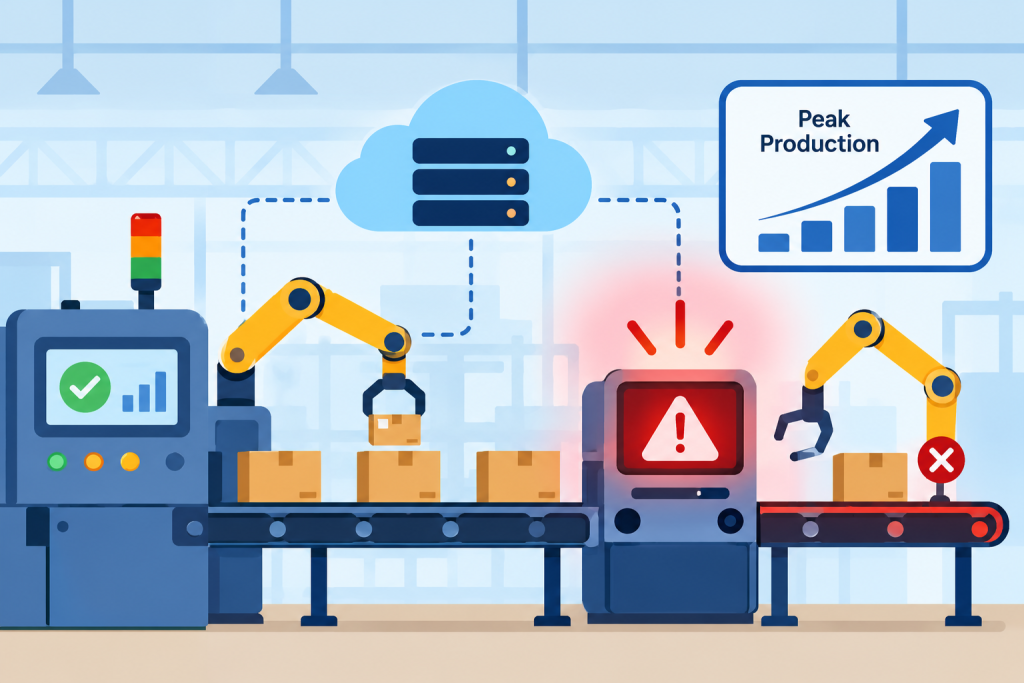
Every plant manager knows the feeling: the order book is finally full, the lines are running at full tilt, and then, without warning, a system stalls. Screens freeze, sensors stop reporting, and a scheduling app that worked fine all quarter suddenly can’t keep up. This is manufacturing system downtime at its most expensive, because it almost always shows up at the worst possible moment: peak production.
It isn’t bad luck. Manufacturing system downtime during production peaks is usually the predictable result of infrastructure, software, and processes built for an average day, not for the spikes that actually make a factory money. Let’s look at why it happens, and what actually fixes it.
The Real Cost of Manufacturing System Downtime
Before getting into causes, it’s worth putting a number on the pain. According to Siemens’ 2024 True Cost of Downtime report, the world’s 500 largest manufacturers collectively lose about $1.4 trillion a year to unplanned production stoppages, equal to roughly 11% of their total revenues, and up sharply from $864 billion just five years earlier (Siemens, True Cost of Downtime 2024). Separate research from Aberdeen puts the average cost of a single hour of downtime at around $260,000 for a typical manufacturing facility (Sumitomo Drive Technologies, Cost of Downtime in Industrial Manufacturing).
The financial hit during a production peak tends to run even higher than these averages, because peak periods are usually tied to seasonal demand, big contracts, or promotional windows, exactly the times a business can least afford a stoppage. A few hours of downtime during a peak season can wipe out weeks of margin and dent customer trust that took years to build.
Why Downtime Spikes When Production Ramps Up
1. Infrastructure Wasn’t Sized for Peak Load
Most manufacturing IT environments, including ERP systems, MES platforms, SCADA layers, and warehouse management tools, are provisioned for “normal” throughput, not the real thing. When order volume jumps 30 to 50% during a peak season, servers, databases, and network links that were perfectly fine on a quiet Tuesday suddenly can’t keep pace. Query times balloon, dashboards lag, PLCs stop getting instructions in real time. It’s one of the most common root causes of manufacturing system downtime, and honestly, one of the most avoidable, if capacity is planned properly ahead of time.
2. Legacy Systems and Siloed Data
A lot of factories are still running a patchwork of legacy, on premise systems that were never really designed to talk to one another. During peak production, when data needs to move instantly between the shop floor, inventory, and order management, those silos turn into bottlenecks. One unoptimized database query or one outdated integration point, and the whole line can grind to a halt.
3. No Real Time Visibility Into System Health
Here’s a pattern we see constantly: nobody notices a problem until a machine has already stopped. Without continuous monitoring, IT and OT teams end up reactive by default. They find out about a failing server or a saturated network link only after the line has gone quiet. By then, the damage is already done.
4. Manual Deployment and Patch Processes
Peak season is also when software updates, patches, and last minute configuration changes tend to get rushed through, often by hand, to support new SKUs or promotional workflows. Manual changes made under time pressure are a leading cause of misconfigurations. And misconfigurations are a leading cause of downtime. Without tested, automated deployment pipelines, every “quick fix” is a small gamble.
5. Insufficient Redundancy and Failover Planning
Plenty of manufacturing environments still lean on a single server, a single database instance, or a single internet connection for systems that are genuinely mission critical. There’s no automatic failover if that one point fails. On a normal day, this might go unnoticed for months. Under the load of a production peak, it becomes the most likely place for something to break.
6. Cybersecurity Pressure Peaks Too
Attackers pay attention to timing. Ransomware and DDoS attempts tend to spike right alongside legitimate order volume, because that’s when an attack does the most damage and gets the most leverage. A system that isn’t actively watched and hardened is far more exposed during the exact window when it can least afford to be.
Manufacturing System Downtime Is a Solvable Problem
None of this is inevitable. It’s the predictable outcome of infrastructure and processes that haven’t been built to flex with demand, which also means it can be engineered away. The manufacturers who avoid these costly stoppages are the ones who treat scalability, monitoring, and automation as part of their operating strategy, not something to worry about after the fact.
Build for Elastic Capacity
Instead of provisioning for the average day, forward looking manufacturers are shifting critical workloads onto elastic infrastructure that scales automatically as demand rises. cloud infrastructure management services make this practical: production and order management systems can scale up during a peak and scale back down once it passes, so you’re never paying for idle capacity or getting throttled by too little of it.
Get Eyes on Every System, All the Time
This is where 24/7 IT monitoring services earn their keep: a live, constant view of server load, application performance, and network health across every facility. Instead of finding out about a problem when the line stops, teams get an alert the moment a metric drifts out of normal range, often hours or days before it would have caused an outage.
Automate the Risky Manual Steps
Deployment pipelines, patching, and configuration changes should be automated and tested well before peak season starts, not improvised in the middle of it. Good automation takes human error out of the equation right when a business can least afford that risk.
Plan for Failure, Not Just Success
Redundant systems, automatic failover, and regular disaster recovery testing turn what could be a multi hour stoppage into a brief, barely noticed blip. That kind of resilience has to be designed ahead of time, not bolted on after the first bad peak season teaches everyone a hard lesson.
Modernize Before You’re Forced To
Migrating legacy, siloed systems onto integrated, cloud ready platforms removes the bottlenecks that cause downtime in the first place. It isn’t just an IT upgrade. It’s a direct investment in uptime, throughput, and customer satisfaction during the weeks that actually matter to revenue.
Conclusion
Manufacturing system downtime during production peaks isn’t bad luck. It’s the predictable result of infrastructure that hasn’t kept pace with demand, visibility gaps that leave teams reacting instead of preventing, and manual processes that break under pressure. The manufacturers who stop accepting peak season outages as “just part of the business” are the ones investing now in scalable infrastructure, continuous monitoring, and resilient, automated systems.
If downtime keeps showing up right when your production line matters most, that’s a sign your systems need to be built for peak performance, not just an average Tuesday. Get that right, and production peaks stop being your riskiest weeks and start being your most profitable ones.