Cloud offerings are services delivered over the internet — compute power, storage, software, and infrastructure — that businesses access on demand without owning physical hardware. Instead of buying servers and maintaining data centers, you pay for what you use, when you use it.
If you are running a small business, building a SaaS product, or managing an ecommerce store in India, the right cloud offering can cut your infrastructure costs significantly, scale with your traffic spikes, and free your team from IT maintenance. The challenge is that the market is crowded, and the terminology — IaaS, PaaS, SaaS, public, private, hybrid — can make even a straightforward decision feel complicated.
This guide explains every major type of cloud offering, how they compare to on-premise solutions, what the leading providers offer, and how to choose the right fit for your specific situation.
What Are Cloud Offerings?
Cloud offerings refer to the full spectrum of services that cloud providers deliver over the internet. The term covers everything from raw computing infrastructure to fully managed software applications. Rather than investing in physical hardware that sits in your office or a data center you manage, you rent capacity from a provider's global network of servers.
The core idea is simple. A cloud provider builds and maintains the physical infrastructure. You access it through a browser or API, pay based on consumption, and scale up or down as your needs change. According to cloud computing industry data, the global cloud services market exceeded USD 650 billion in 2023 and continues to grow at roughly 20% annually — driven largely by businesses moving away from on-premise infrastructure.
Cloud offerings sit at the intersection of three delivery models and three deployment types. The delivery models define what you get. The deployment types define how it is hosted and who controls it.
Key Insight: The right cloud offering is not the most feature-rich one — it is the one that matches your team's technical capacity, your budget, and your growth trajectory.
Types of Cloud Offerings: IaaS, PaaS, and SaaS
The three delivery models for cloud offerings each represent a different layer of abstraction. The higher you go up the stack, the less you manage — and the less flexibility you have.
Infrastructure as a Service (IaaS)
IaaS gives you virtualized computing resources — servers, storage, networking — over the internet. You manage the operating system, middleware, and applications. The provider manages the physical hardware.
IaaS is the right choice when your team has strong DevOps capability and needs full control over the environment. A SaaS product company building a multi-tenant application, for example, often starts on IaaS to control performance tuning and database configuration precisely.
Common IaaS examples: AWS EC2, Google Compute Engine, Microsoft Azure Virtual Machines.
Platform as a Service (PaaS)
PaaS adds a managed layer on top of infrastructure. The provider handles the operating system, runtime, and middleware. You focus on writing and deploying your application code.
For ecommerce businesses and SaaS startups that want to ship features faster without managing servers, PaaS reduces operational overhead significantly. You deploy code, the platform handles scaling and patching.
Common PaaS examples: Google App Engine, AWS Elastic Beanstalk, Heroku, Azure App Service.
Software as a Service (SaaS)
SaaS delivers fully built applications over the internet. You log in and use the software — no infrastructure, no deployment, no maintenance. This is the most widely used form of cloud offering for small businesses.
Common SaaS examples: Salesforce, Shopify, Slack, Google Workspace, Zoho.
Comparing the Three Cloud Offering Types
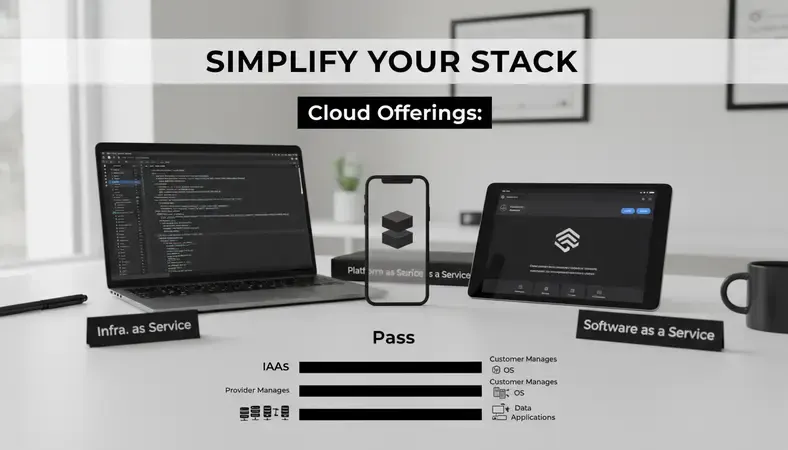
IaaS vs. PaaS vs. SaaS at a Glance
Cloud Offering Type
What You Manage
What the Provider Manages
Best For
IaaS
OS, apps, data, middleware
Hardware, networking, virtualization
DevOps teams, custom infrastructure
PaaS
Applications and data
OS, runtime, middleware, hardware
Developers building and deploying apps
SaaS
Nothing (just usage)
Everything
Business users needing ready-to-use tools
The table above illustrates the core trade-off: more control means more responsibility. Most businesses use all three types simultaneously — SaaS for productivity tools, PaaS for application development, and IaaS for specific workloads that need custom configuration.
Cloud Offerings vs. On-Premise Solutions
On-premise means your servers, your data center, your IT team. Cloud offerings flip that model entirely.
Here is what the comparison actually looks like in practice:
Factor
Cloud Offerings
On-Premise
Upfront cost
Low — pay as you go
High — hardware purchase required
Scalability
Instant, on demand
Limited by physical capacity
Maintenance
Provider handles it
Your IT team handles it
Security control
Shared responsibility
Full control
Downtime risk
Provider SLA (typically 99.9%+)
Dependent on your infrastructure
Customization
Moderate to high (IaaS)
Full
For most small businesses and ecommerce operations in India, on-premise infrastructure is simply not practical. The capital expenditure, the need for dedicated IT staff, and the inability to scale quickly during peak periods (like a sale or product launch) make cloud offerings the default choice.
The one scenario where on-premise still makes sense is when your business handles extremely sensitive data under strict regulatory requirements — certain banking, defense, or government workloads — and you need absolute physical control. For the vast majority of SaaS companies and ecommerce businesses, cloud offerings deliver better economics and better reliability.
Public, Private, and Hybrid Cloud Offerings
Beyond the IaaS/PaaS/SaaS split, cloud offerings also differ by deployment model. This is where terms like public cloud offerings, private cloud, and hybrid cloud offerings become relevant.
Public cloud offerings are the default for most businesses. AWS, Google Cloud, and Azure are public clouds — shared infrastructure, managed entirely by the provider, accessible to any paying customer. Public cloud offerings give you the lowest cost and the fastest path to deployment.
Private cloud means dedicated infrastructure, either hosted at your location or in a provider's data center, reserved exclusively for your organization. Higher cost, higher control.
Hybrid cloud offerings combine both. You run sensitive workloads on private infrastructure and burst to public cloud when you need additional capacity. A growing ecommerce business might keep its payment processing on a private environment while running its web servers and CDN on a public cloud.
Azure cloud offerings, for example, are built specifically to support hybrid architectures — Azure Arc lets businesses manage on-premise, multi-cloud, and edge environments from a single control plane. This makes Azure particularly popular with enterprises that cannot fully migrate to public cloud due to compliance requirements.
Benefits of Cloud Offerings for Businesses
The practical benefits of cloud offerings are not abstract. Here is what they mean for each audience:
For small businesses:
* No upfront hardware investment — you start with a monthly subscription
* IT maintenance shifts to the provider, freeing your team for core work
* Access to enterprise-grade tools (CRM, analytics, collaboration) that were previously unaffordable
* Scale up during busy seasons, scale down when demand drops
For SaaS product companies:
* Deploy globally in minutes using a provider's regional data centers
* Built-in redundancy and failover reduce downtime risk
* Managed databases, container orchestration, and CI/CD pipelines accelerate development
* Pay only for the compute you actually consume — no idle server costs
For ecommerce businesses:
* Handle traffic spikes during sales events without pre-provisioning servers
* Content delivery networks (CDNs) built into cloud platforms reduce page load times globally
* Cloud-native security tools protect customer data and payment information
* Integrate with logistics, payment, and analytics services through cloud-based APIs
Across all three audiences, cloud offerings also support Security in Cloud through shared responsibility models, where the provider secures the physical infrastructure and you manage access controls, encryption, and application-level security.
Popular Cloud Service Providers
The market for cloud-based service providers is dominated by a handful of major platforms, each with distinct strengths.
AWS Services
Amazon Web Services (AWS) is the largest provider of cloud services globally, with over 200 fully managed services spanning compute, storage, databases, machine learning, and networking. AWS Services are particularly strong for SaaS companies that need mature tooling — services like RDS, Lambda, S3, and CloudFront are deeply integrated and well-documented.
For Indian businesses, AWS has data centers in Mumbai and Hyderabad, which means low-latency access and data residency compliance for regulated industries.
Microsoft Azure
Azure cloud offerings are the strongest choice for businesses already running Microsoft infrastructure — Windows Server, Active Directory, Microsoft 365. Azure's hybrid capabilities are unmatched, and its enterprise agreements make it cost-effective at scale. Azure also has a strong presence in India with data centers in Pune and Chennai.
Google Cloud Platform (GCP)
GCP excels in data analytics, machine learning, and Kubernetes-native workloads. If your SaaS product is data-intensive or you are building AI-powered features, GCP's BigQuery, Vertex AI, and GKE are among the best in class. AI and Cloud convergence is most visible in GCP's product roadmap, where nearly every service has an AI layer built in.
Other Notable Providers
DigitalOcean — Developer-friendly, simple pricing, strong for small to mid-size workloads
Linode (Akamai Cloud) — Cost-effective compute, popular with Indian startups
Hetzner — European provider with very competitive pricing for VPS and dedicated servers
For businesses that need managed infrastructure without the complexity of configuring AWS or Azure directly, a managed cloud services partner handles the setup, monitoring, and optimization on your behalf.
How to Choose the Right Cloud Offering
Choosing between cloud offerings comes down to four questions:
What is your technical capacity? If you do not have a DevOps team, IaaS will create more problems than it solves. PaaS or a managed cloud service is a better starting point.
What are your compliance requirements? If you handle payment data (PCI-DSS), health records, or government data, you need to verify that your chosen provider meets those standards in your jurisdiction.
What is your growth trajectory? A SaaS startup expecting rapid user growth needs a provider with strong auto-scaling and global CDN capabilities. A small business with steady, predictable traffic has different priorities.
What is your budget model? Cloud offerings pricing is consumption-based, but costs can escalate quickly without proper monitoring. Set budget alerts and review your architecture regularly.
A practical starting point for most Indian businesses: start with a public cloud offering from AWS or Azure, use managed services where possible to reduce operational overhead, and bring in a managed cloud services partner if your team does not have dedicated cloud expertise.
Cloud Offerings Pricing and Cost Considerations
Cloud offerings pricing is not one-size-fits-all. Every major provider uses a consumption-based model, but the structure varies.
Common pricing models:
Pay-as-you-go — You pay for exactly what you use, billed by the hour or second. No commitment required. Highest per-unit cost.
Reserved instances — You commit to one or three years of usage in exchange for discounts of 30–60% versus on-demand pricing. Best for predictable, stable workloads.
Spot or preemptible instances — Spare capacity sold at deep discounts (up to 90% off). The provider can reclaim the capacity with short notice. Best for batch jobs and fault-tolerant workloads.
SaaS subscriptions — Flat monthly or annual fee per user or per feature tier. Predictable budgeting.
Hidden cost factors to watch:
Egress fees — Most providers charge for data leaving their network. If your application transfers large volumes of data to end users or between regions, egress costs can become significant.
Storage retrieval costs — Cold storage (like AWS Glacier) is cheap to store but expensive to retrieve. Model your access patterns before choosing a storage tier.
Support plan costs — Business and enterprise support tiers add meaningful cost. Factor this in if you need guaranteed response times.
According to cloud cost management best practices, organizations that implement tagging, right-sizing, and reserved instance planning consistently reduce their cloud spend by 20–35% compared to unoptimized environments.
The right approach is not to find the cheapest cloud offering — it is to match the pricing model to your usage pattern. A managed cloud services partner can audit your environment and identify where you are overspending.
Common Questions About Cloud Offerings
What is the difference between cloud offerings and cloud computing?
Cloud computing is the broader concept — delivering computing resources over the internet. Cloud offerings are the specific services, products, and packages that providers sell within that model. Think of cloud computing as the technology and cloud offerings as the catalog of services built on top of it.
Are cloud offerings secure for business data?
Cloud offerings from major providers meet rigorous security standards — ISO 27001, SOC 2, PCI-DSS, and more. The shared responsibility model means the provider secures the infrastructure, and you are responsible for access controls, encryption, and application security. Security gaps in cloud environments almost always originate from misconfiguration on the customer side, not from provider-side breaches.
Can a small business in India afford cloud offerings?
Cloud offerings are accessible at almost any budget. Many SaaS tools start at a few hundred rupees per month. IaaS compute from AWS or Azure can be as low as a few dollars per month for small workloads. The pay-as-you-go model means you do not need a large upfront investment — you start small and scale as revenue grows.
What is the difference between public and hybrid cloud offerings?
Public cloud offerings run on shared infrastructure managed entirely by the provider — accessible to any customer. Hybrid cloud offerings combine private infrastructure (which you control) with public cloud resources. Hybrid architectures are common in regulated industries where some data must stay on-premise while other workloads run on public cloud.
How do I migrate from on-premise to cloud offerings?
Migration typically follows a phased approach: assess your current workloads, choose a target cloud provider, lift-and-shift non-critical workloads first, then refactor applications to take advantage of cloud-native services. A managed cloud services partner can significantly reduce migration risk by handling the technical complexity and ensuring business continuity throughout the process.
Wrapping Up
Cloud offerings give businesses of every size access to infrastructure, platforms, and software that would have required significant capital investment a decade ago. The right combination of IaaS, PaaS, and SaaS — matched to your team's capability and your growth stage — can reduce costs, improve reliability, and accelerate what you build.
Explore Sygitech's managed cloud services to run your cloud infrastructure efficiently — with expert setup, ongoing optimization, and support built specifically for Indian businesses. Ready to get started? Visit Sygitech to learn more.
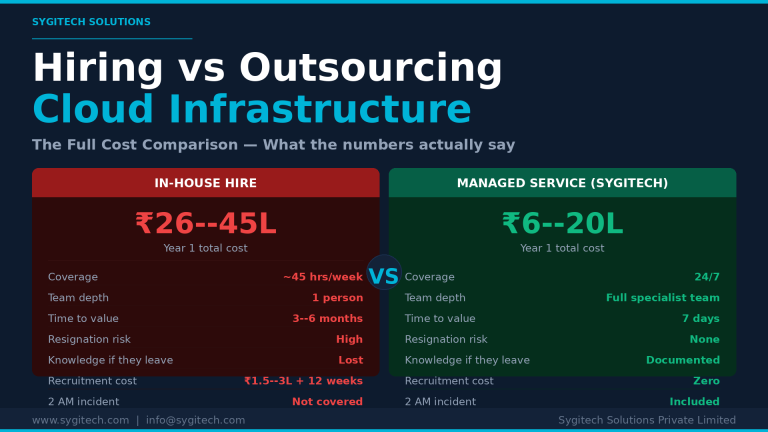
By Sygitech Solutions | Cloud Infrastructure Management & DevOps Most SaaS founders and CTOs eventually face the same decision: should we hire a dedicated DevOps or cloud engineer, or should…
Discover how cloud offerings transform business operations by providing on-demand access to computing power and storage without hefty infrastructure costs.




Leave a Reply