

Why Cloud Resources Keep Growing
Monday morning, your finance lead sends a message. The cloud bill jumped again, and she wants to know why. You open the console and scroll through hundreds of resources. You…
Read article →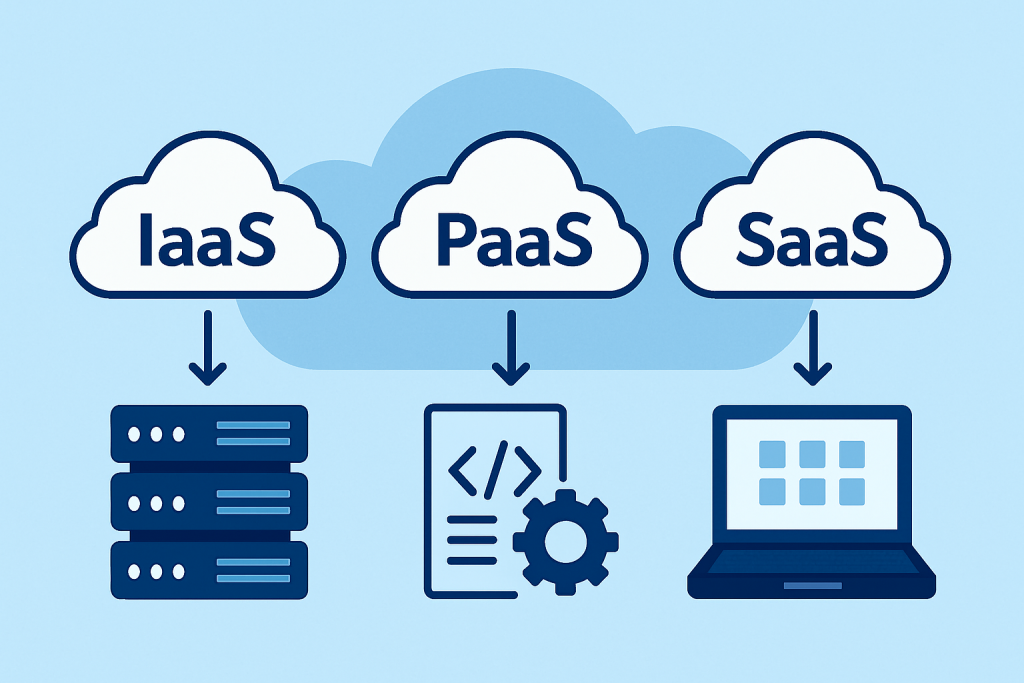
Compute services are no longer working quietly in the background—they are right at the heart of every major business decision. From developing modern applications to managing huge volumes of data or streamlining IT operations, the way you use cloud computing—whether it’s IaaS, PaaS, or SaaS—can shape the success of your entire digital strategy.
Let’s break down what each of these models offers, where they’re heading, and how they fit into a future where compute power drives transformation.
These three layers of cloud services represent a continuum of control, flexibility, and abstraction. Choosing between them or combining them, depends on your goals, team expertise, and operational priorities.
IaaS is the foundation of cloud computing. It offers virtualized compute resources—servers, storage, networking—delivered over the internet. You manage the OS, applications, and runtime, while the provider handles the infrastructure layer.
Benefits:
Use Cases:
Examples:
AWS EC2, Microsoft Azure Virtual Machines, Google Compute Engine
PaaS abstracts the infrastructure and gives developers a ready-to-use platform to build, deploy, and scale apps quickly. You focus on writing code, while the provider manages the runtime, OS, middleware, and more.
Benefits:
Use Cases:
Examples:
Google App Engine, Azure App Service, Heroku
SaaS delivers fully functional applications over the web. It requires no installation, no management, and no hardware. Users simply log in and use the software.
Benefits:
Use Cases:
Examples:
Google Workspace, Salesforce, Zoom, Microsoft 365
The choice between IaaS, PaaS, and SaaS is not just a matter of preference. It shapes how your business:
Let’s dig deeper into how compute services fuel different strategic priorities.
IaaS is ideal when you need to build customized, resource-intensive environments. For example, data science teams training ML models may require GPU-optimized virtual machines. With IaaS, businesses can design infrastructure that meets exact technical specifications while retaining full control over security and architecture. Organizations often rely on cloud migration services during this phase to transition legacy systems or on-prem workloads to scalable virtual machines without disruption
Future Outlook:
As demand grows for AI and real-time analytics, IaaS providers are offering auto-scaling, pay-per-second billing, and even sustainable compute tiers to reduce environmental impact.
With PaaS, development teams can go from idea to deployment faster than ever. Built-in frameworks, database integrations, and autoscaling tools eliminate bottlenecks. Developers focus on building features, not configuring environments.
To maintain efficiency across evolving applications and microservices, many businesses integrate cloud management services early in their development workflows. These services provide centralized dashboards, compliance controls, and resource usage analytics—all essential to sustaining growth without adding complexity.
Future Outlook:
PaaS is evolving into serverless computing—run code in response to events, without managing servers. This unlocks on-demand scalability, cost efficiency, and simplified DevOps pipelines.
SaaS solutions provide immediate business value with minimal overhead. Whether it is document collaboration, sales automation, or customer service chatbots, SaaS platforms are powering the modern workforce.
Future Outlook:
AI-powered SaaS tools will soon offer real-time personalization, decision intelligence, and dynamic workflows. SaaS is also converging with low-code platforms, enabling business users to build their own workflows with minimal IT support.
The most effective cloud strategies often use a combination of all three models.
| Scenario | Recommended Model |
| Custom, complex workloads | IaaS |
| App development and deployment | PaaS |
| Business software with fast implementation | SaaS |
| Data analytics and machine learning training | IaaS |
| Event-driven or microservices architecture | PaaS |
| Sales, marketing, and collaboration tools | SaaS |
Pro tip: You do not have to choose one over the other. Build a hybrid architecture that uses SaaS for core tools, PaaS for rapid app development, and IaaS for compute-intensive backends.
The future of cloud computing is not just about flexibility—it is about intelligence, automation, and integration.
Compute environments are increasingly being designed for machine learning workloads. GPU-accelerated instances, ML toolkits, and AI-as-a-Service models are enabling faster, smarter applications.
Compute is moving closer to where data is generated—at the edge. Whether it is smart factories or connected vehicles, compute services must be flexible enough to span cloud and edge environments.
Instead of static infrastructure, compute will be provisioned dynamically based on context—whether a user logs in, a sale is triggered, or an AI engine makes a prediction.
Cloud providers offer the tools—but not the tailored strategy. Choosing between IaaS, PaaS, and SaaS depends on factors like cost governance, workload types, compliance requirements, and long-term digital vision.
Forward-thinking companies often partner with IT consultants not only to streamline architecture, but also to managed cloud services across hybrid or multi-cloud setups. This ensures that governance, automation, and performance standards are maintained as infrastructure scales.
That is why forward-thinking businesses are increasingly turning to IT consulting services to:
Need a boost in modernization, but unsure where to begin?
Cloud assessments, architecture audits, and migration blueprints can help identify cost leaks and performance issues—and turn your cloud into a growth engine.
Before settling on a compute model, ask:
Answering these questions ensures you select the right mix of compute services aligned with your future goals.
The cloud is no longer about saving costs or eliminating servers. It is about delivering digital experiences, accelerating innovation, and unlocking data-driven insights. Your compute architecture whether based on IaaS, PaaS, SaaS, or a hybrid model will define how quickly and confidently your business moves forward.
As cloud services evolve toward AI, edge, and automation, your strategy needs to evolve too. Computing is not just an IT asset. It is the engine of business transformation.
Choosing the right cloud model is not just a technical decision. it is a strategic imperative. And with the right support, you can design a cloud strategy that’s agile, intelligent, and built for whatever the future brings.
Monday morning, your finance lead sends a message. The cloud bill jumped again, and she wants to know why. You open the console and scroll through hundreds of resources. You…
Read article →You dread deployment day. You flinch when the cloud invoice lands in your inbox. You’ve stopped trying to explain the architecture to new hires because you’re not fully sure how…
Read article →Your migration was supposed to be finished by now. Instead, you’re staring at a cloud bill that’s twice your budget. An application keeps timing out. Your team is exhausted from…
Read article →Tell us where you are and what's slowing you down. A senior engineer will get back to you within one business day.
Our team will get back to you within one business day.
Leave a Reply