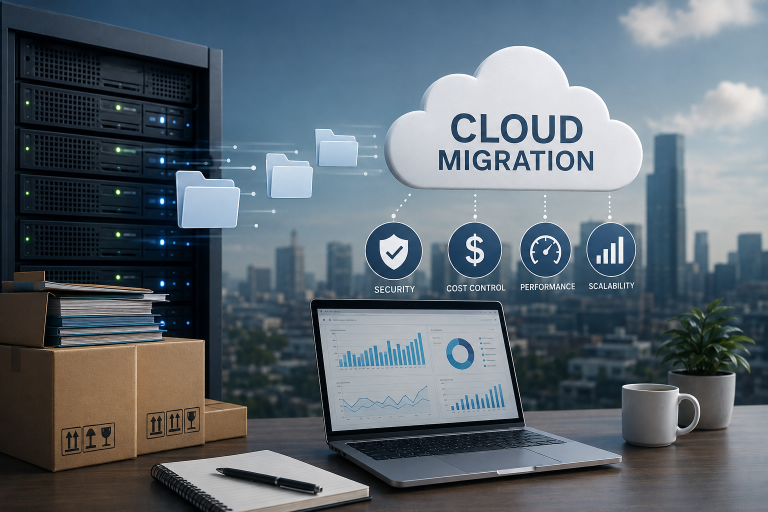

Cloud computing has quietly become the backbone of how modern businesses operate — and for good reason. If you are running a small business, building a SaaS product, or managing an ecommerce store, the advantages of cloud computing directly affect how fast you can grow, how much you spend on IT, and how well your team can work from anywhere.
This article breaks down every major advantage of cloud computing — what each one actually means for your business, and how to decide if a cloud-first approach makes sense for you right now.

What Are the Main Advantages of Cloud Computing?
The advantages of cloud computing come down to one core idea: you stop managing physical infrastructure and start paying for computing resources as a service. Instead of buying servers, maintaining hardware, and hiring a dedicated IT team to keep everything running, you access storage, processing power, and software over the internet — on demand.
According to cloud computing research from Gartner, global cloud services spending has grown consistently year over year as businesses of all sizes recognize that the cloud-based advantages outweigh the upfront costs of traditional IT infrastructure.
The five most significant advantages of cloud computing are:
- Cost savings: Pay for what you use instead of what you might need someday
- Scalability: Expand or reduce resources in minutes, not months
- Security: Enterprise-grade data protection without enterprise-level IT budgets
- Accessibility: Work from any device, any location, any time
- Reliability: Built-in redundancy that keeps your systems running even when hardware fails
Each of these deserves a closer look, because the real value is in the details.
A Quick Comparison of Cloud vs. Traditional IT
Cloud Computing vs. Traditional On-Premises IT
| Factor | Cloud Computing | Traditional On-Premises IT |
|---|---|---|
| Upfront cost | Low — pay-as-you-go model | High — hardware, licenses, setup |
| Scalability | Instant, on-demand | Slow — requires new hardware |
| Maintenance | Managed by cloud provider | Managed by your internal team |
| Security updates | Automatic | Manual, often delayed |
| Disaster recovery | Built-in redundancy | Requires separate planning |
| Remote access | Native — any device, anywhere | Requires VPN setup and management |
The table above shows why so many businesses are moving away from on-premises setups. The cloud-based advantages are not just technical — they are financial and operational.
Cost Savings and Reduced IT Expenses
The most immediate advantage cloud solutions offer is the shift from capital expenditure to operational expenditure. With traditional IT, you buy servers upfront, pay for a physical space to house them, and hire staff to manage them — all before you serve a single customer. With cloud computing, you pay a monthly bill based on what you actually used.
For a small business in India running on tight margins, this difference is significant. A retail business that used to spend ₹15–20 lakhs setting up an on-premises server environment can now access equivalent computing power through a managed cloud provider for a fraction of that cost, scaling up only during peak seasons like Diwali or end-of-year sales.
The cost advantages of cloud computing go beyond the obvious hardware savings:
- No hardware refresh cycles: On-premises servers need replacing every 3–5 years. Cloud infrastructure is the provider's responsibility.
- Reduced energy costs: Running physical servers 24/7 consumes significant electricity. Cloud eliminates that cost entirely.
- Smaller IT team requirements: You do not need an in-house team to manage physical infrastructure when a managed cloud service handles it.
- Pay-per-use pricing: Idle resources cost you nothing. You only pay when the compute power is actually being used.
For SaaS product companies, this model is especially valuable. You can run development, staging, and production environments separately without committing to hardware for each — and shut down non-production environments outside business hours to cut costs further.
Key Insight: A 2023 report from Flexera found that 47% of organizations cited cost savings as the primary driver for cloud adoption — but businesses that actively manage their cloud spend see 30% lower bills than those who simply migrate and forget.
Scalability and Flexibility
The scalability of cloud computing is arguably its most powerful advantage for growing businesses. Traditional IT scales in large, expensive steps — you need a new server, which means planning, procurement, installation, and configuration, often taking weeks or months. Cloud computing scales in minutes, sometimes seconds.
Here is what that means in practice. An ecommerce business running a flash sale expects 10x normal traffic for six hours. With traditional hosting, you either over-provision (paying for capacity you rarely need) or under-provision (crashing during the sale). With cloud computing, you configure auto-scaling rules that automatically spin up additional resources when traffic spikes and scale back down when it normalizes. You pay only for those extra six hours of capacity.
The flexibility dimension of cloud-based advantages extends beyond just compute resources:
- Geographic expansion: Deploy your application closer to new markets without building physical infrastructure in those regions
- Multi-environment development: Spin up isolated environments for testing new features without affecting production
- Rapid experimentation: Try new services or architectures without long-term commitment — if it does not work, shut it down
For SaaS companies, the scalability of cloud computing means you can onboard a large enterprise client without re-architecting your entire infrastructure first. You scale to meet the demand, then optimize costs once the workload stabilizes.
Cloud Computing Architecture plays a central role in enabling this scalability — the way cloud systems are designed with distributed, modular components means individual pieces can scale independently rather than requiring the entire system to grow together.

Improved Security and Data Protection
A common misconception is that moving data to the cloud means losing control over security. The opposite is generally true. Major cloud providers invest billions annually in security infrastructure that no individual business — regardless of size — could replicate on its own.
Security in Cloud environments typically includes multiple layers that work together:
- Encryption at rest and in transit: Your data is encrypted when stored and when moving between systems, so interception yields nothing usable
- Identity and access management (IAM): Granular controls over who can access what, with multi-factor authentication enforced at every level
- Automated threat detection: AI-driven monitoring that identifies unusual patterns — a login from an unfamiliar location, bulk data downloads at 3 AM — and flags or blocks them automatically
- Compliance certifications: Major cloud platforms maintain certifications like ISO 27001, SOC 2, and PCI DSS, which means your data is protected according to internationally recognized standards
For an ecommerce business handling customer payment data, these certifications matter enormously. Achieving PCI DSS compliance on your own requires significant investment in auditing, tooling, and process documentation. Using a cloud provider that is already certified transfers much of that compliance burden.
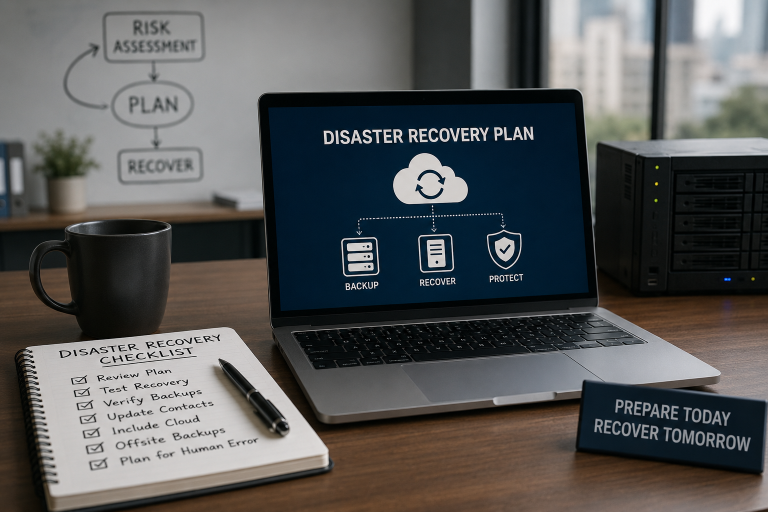
The advantage cloud solutions offer in security is not just about protection — it is about recovery. Cloud environments include automated backup and snapshot capabilities that can restore your data to a specific point in time within minutes. A ransomware attack that would permanently destroy an on-premises business can be recovered from in hours when your data lives in the cloud.
Accessibility and Remote Work Benefits
One of the most visible advantages of cloud computing is that your business stops being tied to a physical location. Any authorized user can access the tools, data, and applications they need from any device with an internet connection.
This matters in ways that go beyond the obvious. For a small business owner who travels frequently, cloud-based tools mean you can approve invoices, check inventory levels, or respond to customer issues from your phone at the airport. For a SaaS company with developers across multiple cities in India, cloud-based development environments mean everyone works in identical setups without the configuration chaos of local machines.
The remote work benefits of cloud computing became impossible to ignore after 2020, but the underlying advantage existed long before. Businesses that had already migrated to cloud infrastructure adapted to remote work in days. Those running on-premises systems spent weeks scrambling to set up VPNs, remote desktop connections, and file-sharing workarounds.
Practical accessibility advantages include:
- Device independence: Work from a laptop, tablet, or smartphone without functionality loss
- Real-time collaboration: Multiple team members can work on the same document or dataset simultaneously
- Centralized data: No more emailing files back and forth — a single source of truth that everyone accesses
- Faster onboarding: New employees get access to every tool they need through a browser, not through a two-day IT setup process

Reliability and Uptime
Downtime costs money. For an ecommerce business, every minute the site is unavailable is revenue lost. For a SaaS product, downtime means support tickets, churned customers, and damaged reputation. One of the clearest advantages of cloud computing is the reliability built into how cloud infrastructure is designed.
Cloud providers operate across multiple data centers — often in different geographic regions — so that if one location experiences a power outage, hardware failure, or network disruption, traffic automatically routes to another location. This is called redundancy, and it is extraordinarily expensive to replicate on-premises.
According to AWS infrastructure documentation, major cloud platforms offer service level agreements (SLAs) that guarantee 99.9% to 99.99% uptime. That translates to less than nine hours of downtime per year at 99.9%, and less than one hour per year at 99.99%. Most businesses running on-premises infrastructure cannot come close to those numbers.
AWS Services, for example, distribute workloads across availability zones so that a single hardware failure never takes down an entire application. This architecture is available to a two-person startup using AWS the same way it is available to a Fortune 500 company.
The reliability advantages of cloud computing also extend to disaster recovery. Traditional disaster recovery required maintaining a full secondary data center — essentially doubling your infrastructure costs just for a backup that you hoped you would never need. Cloud-based disaster recovery achieves the same protection at a fraction of the cost, because you only pay for the standby capacity when it is actually used.
Is Cloud Computing Right for Your Business?
The advantages of cloud computing are real and well-documented, but the right approach depends on your specific situation. Here is a straightforward framework for evaluating whether a cloud-first strategy makes sense for you.
Cloud computing is clearly the right move if:
- Your team works from multiple locations or needs remote access to business systems
- Your workload fluctuates significantly — seasonal ecommerce spikes, product launch traffic surges, or variable development cycles
- You are spending more than 20% of your IT budget on hardware maintenance, upgrades, or replacement
- You need to comply with data security standards but do not have the resources to maintain compliance infrastructure in-house
- You want to expand into new markets without building physical infrastructure in each location
Approach cloud migration carefully if:
- Your business operates in a highly regulated industry with specific data residency requirements (certain data must stay within India's borders, for example)
- You have legacy applications that were built specifically for on-premises environments and would require significant re-engineering to run in the cloud
- Your internet connectivity is unreliable — cloud computing depends on consistent network access
For most small businesses, SaaS companies, and ecommerce operations in India, the merits of cloud computing clearly outweigh the limitations. The question is not usually whether to move to the cloud, but how to do it in a way that maximizes the advantages of cloud computing while managing the transition carefully.
Common Questions About Cloud Computing
What are the 5 key benefits of cloud computing?
The five core benefits of cloud computing are cost savings (paying only for what you use), scalability (expanding resources on demand), improved security (enterprise-grade protection at accessible price points), accessibility (work from any device, anywhere), and reliability (built-in redundancy that keeps systems running). Each of these advantages of cloud computing compounds over time — the longer you operate in the cloud, the more you optimize costs, the more resilient your infrastructure becomes, and the more your team benefits from location independence.
Is cloud computing safe for sensitive business data?
Cloud computing is generally safer than on-premises alternatives for most businesses. Major cloud providers maintain security certifications like ISO 27001, SOC 2 Type II, and PCI DSS — standards that require continuous auditing and strict controls. They employ dedicated security teams, run automated threat detection, and encrypt data at rest and in transit. The risk is not the cloud itself but misconfiguration — leaving storage buckets publicly accessible, for example. Working with a managed cloud services provider reduces this risk significantly because configuration management is part of the service.
How do the advantages of cloud computing differ for small businesses vs. large enterprises?
Small businesses benefit most from the cost and accessibility advantages of cloud computing — they get enterprise-grade infrastructure without enterprise-level capital investment. Large enterprises benefit most from scalability and global reach — the ability to deploy applications across dozens of regions simultaneously. SaaS companies and ecommerce businesses sit in the middle: they need the scalability advantages for traffic spikes and the cost advantages for development environments, while also requiring the reliability guarantees that only cloud infrastructure can deliver at scale.
What is the difference between cloud computing and managed cloud services?
Cloud computing refers to the infrastructure itself — servers, storage, networking, and software delivered over the internet. Managed cloud services means a provider handles the setup, configuration, monitoring, optimization, and ongoing management of that cloud infrastructure on your behalf. If you use AWS or Google Cloud directly, you are using cloud computing. If a company like Sygitech manages your cloud environment — handling migrations, security configurations, cost optimization, and 24/7 monitoring — that is a managed cloud service. The advantage of managed services is that you get all the cloud-based advantages without needing in-house cloud expertise.
How quickly can a business migrate to the cloud?
Migration timelines vary based on complexity. A small business moving email and file storage to the cloud can complete the transition in days. A SaaS company migrating a complex application with a live database, multiple integrations, and thousands of active users may take three to six months to migrate properly — including testing, optimization, and cutover. The merits of cloud computing are clearest when migration is done methodically rather than rushed. A phased approach, starting with non-critical workloads and moving progressively to core systems, reduces risk and allows your team to build cloud familiarity before the most important systems move.
Does cloud computing work for businesses with limited IT expertise?
This is one of the clearest advantages of cloud computing for small businesses: you do not need deep IT expertise to benefit from it. Modern cloud platforms are designed with managed services, pre-configured environments, and intuitive dashboards that make common tasks accessible without specialized knowledge. For businesses that want the advantages of cloud computing without building internal cloud expertise, managed cloud services fill that gap entirely — your provider handles the technical complexity while you focus on running your business.
The Bottom Line
The advantages of cloud computing — lower costs, instant scalability, stronger security, and true location independence — are not future promises. They are operational realities that businesses across India are using right now to compete more effectively and grow more efficiently.
Migrate to managed cloud with Sygitech — get your infrastructure set up, secured, and optimized by experts, so you can focus on building your business instead of managing servers. Ready to get started? Visit Sygitech to learn more.